
Matrices and Matrix Dimensions
A matrix is a rectangular array of numbers arranged in rows and columns.
An \( n \times m \) matrix consists of:
\( n \) rows
\( m \) columns
The dimensions of a matrix are always written as
\( \text{rows} \times \text{columns} \)
Each entry in a matrix is identified by its row and column position.
Matrices are commonly used to organize data, represent systems of equations, and describe transformations.
Example:
Consider the matrix
\( \begin{pmatrix} 2 & 5 & -1 \\ 4 & 0 & 3 \end{pmatrix} \)
▶️ Answer/Explanation
This matrix has 2 rows and 3 columns.
Conclusion: It is a \( 2 \times 3 \) matrix.
Example:
How many entries are in a \( 4 \times 2 \) matrix?
▶️ Answer/Explanation
A \( 4 \times 2 \) matrix has:
4 rows
2 columns
Total number of entries:
\( 4 \cdot 2 = 8 \)
Conclusion: The matrix contains 8 entries.
Matrix Multiplication
Two matrices can be multiplied only if the number of columns in the first matrix equals the number of rows in the second matrix.
If matrix \( A \) is an \( n \times m \) matrix and matrix \( B \) is an \( m \times p \) matrix, then the product
\( AB \)
is defined and results in an \( n \times p \) matrix.
How Each Entry Is Computed
The entry in the \( i \)th row and \( j \)th column of the product matrix is found by taking the dot product of:
the \( i \)th row of the first matrix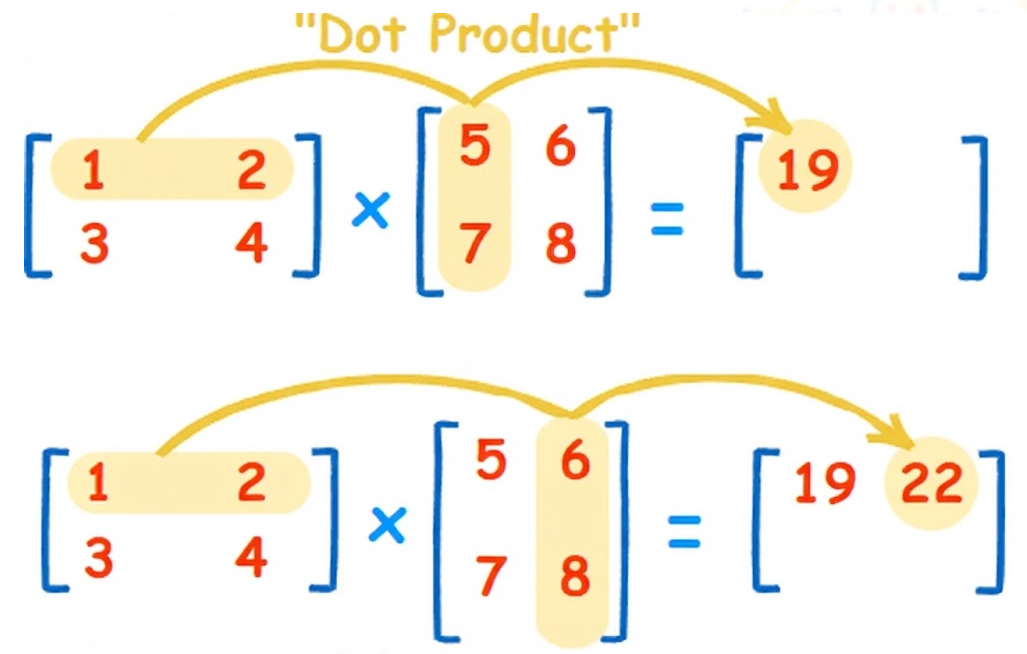
the \( j \)th column of the second matrix
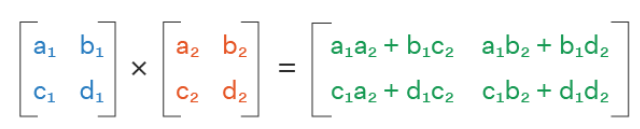
Matrix multiplication is not commutative, meaning in general
\( AB \ne BA \)
even when both products are defined.
Example:
Multiply the matrices
\( A = \begin{pmatrix} 1 & 2 \\ 3 & 4 \end{pmatrix}, \quad B = \begin{pmatrix} 5 & 6 \\ 7 & 8 \end{pmatrix} \)
▶️ Answer/Explanation
Both matrices are \( 2 \times 2 \), so the product is defined.
Compute each entry using row–column dot products.
\( AB = \begin{pmatrix} 1(5)+2(7) & 1(6)+2(8) \\ 3(5)+4(7) & 3(6)+4(8) \end{pmatrix} = \begin{pmatrix} 19 & 22 \\ 43 & 50 \end{pmatrix} \)
Final answer: \( AB = \begin{pmatrix} 19 & 22 \\ 43 & 50 \end{pmatrix} \)
Example:
Determine whether the product is defined and find the result if possible.
\( A = \begin{pmatrix} 2 & -1 & 3 \end{pmatrix}, \quad B = \begin{pmatrix} 1 \\ 4 \\ -2 \end{pmatrix} \)
▶️ Answer/Explanation
Matrix \( A \) is \( 1 \times 3 \) and matrix \( B \) is \( 3 \times 1 \).
Since the inner dimensions match, the product is defined.
\( AB = 2(1) + (-1)(4) + 3(-2) = 2 – 4 – 6 = -8 \)
Final answer: \( AB = \begin{pmatrix} -8 \end{pmatrix} \)