
Identity Matrix
The identity matrix, denoted by \( I \), is a square matrix with: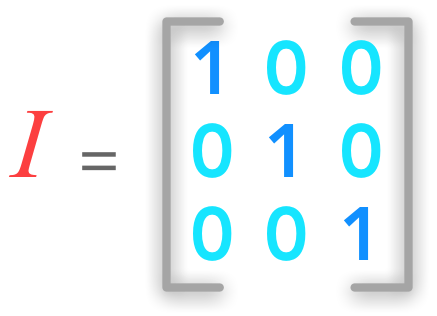
1s on the main diagonal from the top left to the bottom right
0s in all other positions
An identity matrix acts like the number 1 in matrix multiplication.
If \( A \) is an \( n \times n \) matrix, then
\( AI = IA = A \)
This means multiplying a matrix by the identity matrix does not change the matrix.
The identity matrix must have the same dimensions as the matrix it is multiplied with.
Example:
Write the \( 2 \times 2 \) identity matrix.
▶️ Answer/Explanation
\( I_2 = \begin{pmatrix} 1 & 0 \\ 0 & 1 \end{pmatrix} \)
Conclusion: The matrix has 1s on the diagonal and 0s elsewhere.
Example:
Verify that the identity matrix does not change a matrix under multiplication.
\( A = \begin{pmatrix} 2 & -1 \\ 3 & 4 \end{pmatrix}, \quad I_2 = \begin{pmatrix} 1 & 0 \\ 0 & 1 \end{pmatrix} \)
▶️ Answer/Explanation
Compute \( AI_2 \):
\( AI_2 = \begin{pmatrix} 2(1)+(-1)(0) & 2(0)+(-1)(1) \\ 3(1)+4(0) & 3(0)+4(1) \end{pmatrix} = \begin{pmatrix} 2 & -1 \\ 3 & 4 \end{pmatrix} \)
The product equals the original matrix.
Conclusion: Multiplying by the identity matrix leaves the matrix unchanged.
Effect of the Identity Matrix on Matrix Multiplication
For any square matrix \( A \), multiplying by its corresponding identity matrix results in the original matrix.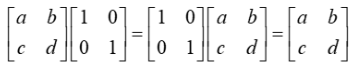
If \( A \) is an \( n \times n \) matrix and \( I_n \) is the \( n \times n \) identity matrix, then
\( AI_n = I_nA = A \)
This property is analogous to multiplying a real number by 1.
The identity matrix must have the same dimensions as the matrix being multiplied for the product to be defined.
Example:
Verify that multiplying a matrix by the identity matrix leaves it unchanged.
\( A = \begin{pmatrix} 1 & 3 \\ -2 & 4 \end{pmatrix}, \quad I_2 = \begin{pmatrix} 1 & 0 \\ 0 & 1 \end{pmatrix} \)
▶️ Answer/Explanation
Compute \( AI_2 \):
\( AI_2 = \begin{pmatrix} 1(1)+3(0) & 1(0)+3(1) \\ -2(1)+4(0) & -2(0)+4(1) \end{pmatrix} = \begin{pmatrix} 1 & 3 \\ -2 & 4 \end{pmatrix} \)
Conclusion: \( AI_2 = A \).
Example:
Let
\( B = \begin{pmatrix} 5 & 0 & -1 \\ 2 & 3 & 4 \\ 0 & -2 & 1 \end{pmatrix} \)
Explain why \( BI_3 = B \).
▶️ Answer/Explanation
The matrix \( I_3 \) has 1s on the diagonal and 0s elsewhere.
Each row of \( B \) is multiplied by the corresponding column of \( I_3 \), leaving every entry unchanged.
Conclusion: Multiplying a square matrix by its identity matrix returns the original matrix.
Inverse of a Square Matrix
For a square matrix \( A \), an inverse matrix \( A^{-1} \) is a matrix that reverses the effect of multiplication by \( A \).
When the inverse exists, multiplying a matrix by its inverse results in the identity matrix of the same size.
\( AA^{-1} = A^{-1}A = I \)
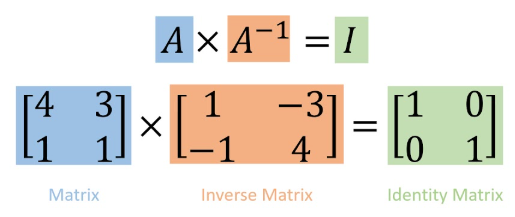
Not every square matrix has an inverse. A matrix that does have an inverse is called invertible or nonsingular.
The identity matrix \( I \) must have the same dimensions as matrix \( A \).
Example:
Let
\( A = \begin{pmatrix} 1 & 2 \\ 3 & 4 \end{pmatrix} \)
The inverse of \( A \) is
\( A^{-1} = \begin{pmatrix} -2 & 1 \\ \dfrac{3}{2} & -\dfrac{1}{2} \end{pmatrix} \)
▶️ Answer/Explanation
Multiply \( A \) by \( A^{-1} \):
\( AA^{-1} = \begin{pmatrix} 1 & 2 \\ 3 & 4 \end{pmatrix} \begin{pmatrix} -2 & 1 \\ \dfrac{3}{2} & -\dfrac{1}{2} \end{pmatrix} = \begin{pmatrix} 1 & 0 \\ 0 & 1 \end{pmatrix} \)
Conclusion: The product is the identity matrix.
Example:
Explain why a matrix without an inverse cannot produce the identity matrix when multiplied by another matrix.
▶️ Answer/Explanation
If a matrix does not have an inverse, no matrix exists that can undo its effect.
Therefore, it cannot be multiplied with another matrix to produce the identity matrix.
Conclusion: Only invertible matrices have inverses that yield the identity matrix.
Inverse of a \( 2 \times 2 \) Matrix
The inverse of a \( 2 \times 2 \) matrix, when it exists, can be found algebraically by hand or using technology.
Consider a \( 2 \times 2 \) matrix
\( A = \begin{pmatrix} a & b \\ c & d \end{pmatrix} \)
The matrix \( A \) has an inverse if and only if its determinant is nonzero.
\( \det(A) = ad – bc \ne 0 \)
When the determinant is nonzero, the inverse is given by
\( A^{-1} = \dfrac{1}{ad – bc} \begin{pmatrix} d & -b \\ -c & a \end{pmatrix} \)
Technology can also be used to compute matrix inverses, especially when working with larger numbers or in applied problems.
Example:
Find the inverse of
\( A = \begin{pmatrix} 2 & 1 \\ 5 & 3 \end{pmatrix} \)
▶️ Answer/Explanation
Compute the determinant:
\( \det(A) = (2)(3) – (1)(5) = 6 – 5 = 1 \)
Since the determinant is nonzero, the inverse exists.
Apply the inverse formula:
\( A^{-1} = \begin{pmatrix} 3 & -1 \\ -5 & 2 \end{pmatrix} \)
Final answer: \( A^{-1} = \begin{pmatrix} 3 & -1 \\ -5 & 2 \end{pmatrix} \)
Example:
Explain why the matrix
\( B = \begin{pmatrix} 4 & 2 \\ 6 & 3 \end{pmatrix} \)
does not have an inverse.
▶️ Answer/Explanation
Compute the determinant:
\( \det(B) = (4)(3) – (2)(6) = 12 – 12 = 0 \)
Since the determinant is zero, the matrix is not invertible.
Conclusion: The inverse does not exist.
Determinant of a \( 2 \times 2 \) Matrix
Consider a \( 2 \times 2 \) matrix
\( A = \begin{pmatrix} a & b \\ c & d \end{pmatrix} \)
The determinant of matrix \( A \) is a real number that provides important information about the matrix.
The determinant is defined as
\( \det(A) = ad – bc \)
The determinant can be calculated by hand using this formula or with technology.
The value of the determinant helps determine whether a matrix is invertible and provides information about geometric transformations.
Example:
Find the determinant of the matrix
\( A = \begin{pmatrix} 3 & 5 \\ 2 & 4 \end{pmatrix} \)
▶️ Answer/Explanation
Apply the determinant formula:
\( \det(A) = (3)(4) – (5)(2) = 12 – 10 = 2 \)
Final answer: \( \det(A) = 2 \)
Example:
Determine whether the matrix is invertible.
\( B = \begin{pmatrix} 6 & 9 \\ 2 & 3 \end{pmatrix} \)
▶️ Answer/Explanation
Compute the determinant:
\( \det(B) = (6)(3) – (9)(2) = 18 – 18 = 0 \)
Since the determinant is zero, the matrix does not have an inverse.
Conclusion: Matrix \( B \) is not invertible.
Geometric Meaning of the Determinant of a \( 2 \times 2 \) Matrix
Consider a \( 2 \times 2 \) matrix whose columns or rows are vectors in \( \mathbb{R}^2 \). 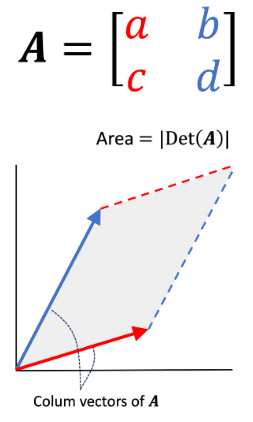
Let
\( A = \begin{pmatrix} a & b \\ c & d \end{pmatrix} \)
The absolute value of the determinant of \( A \) has a clear geometric interpretation.
Area Interpretation
If the columns or rows of the matrix represent two vectors in \( \mathbb{R}^2 \), then
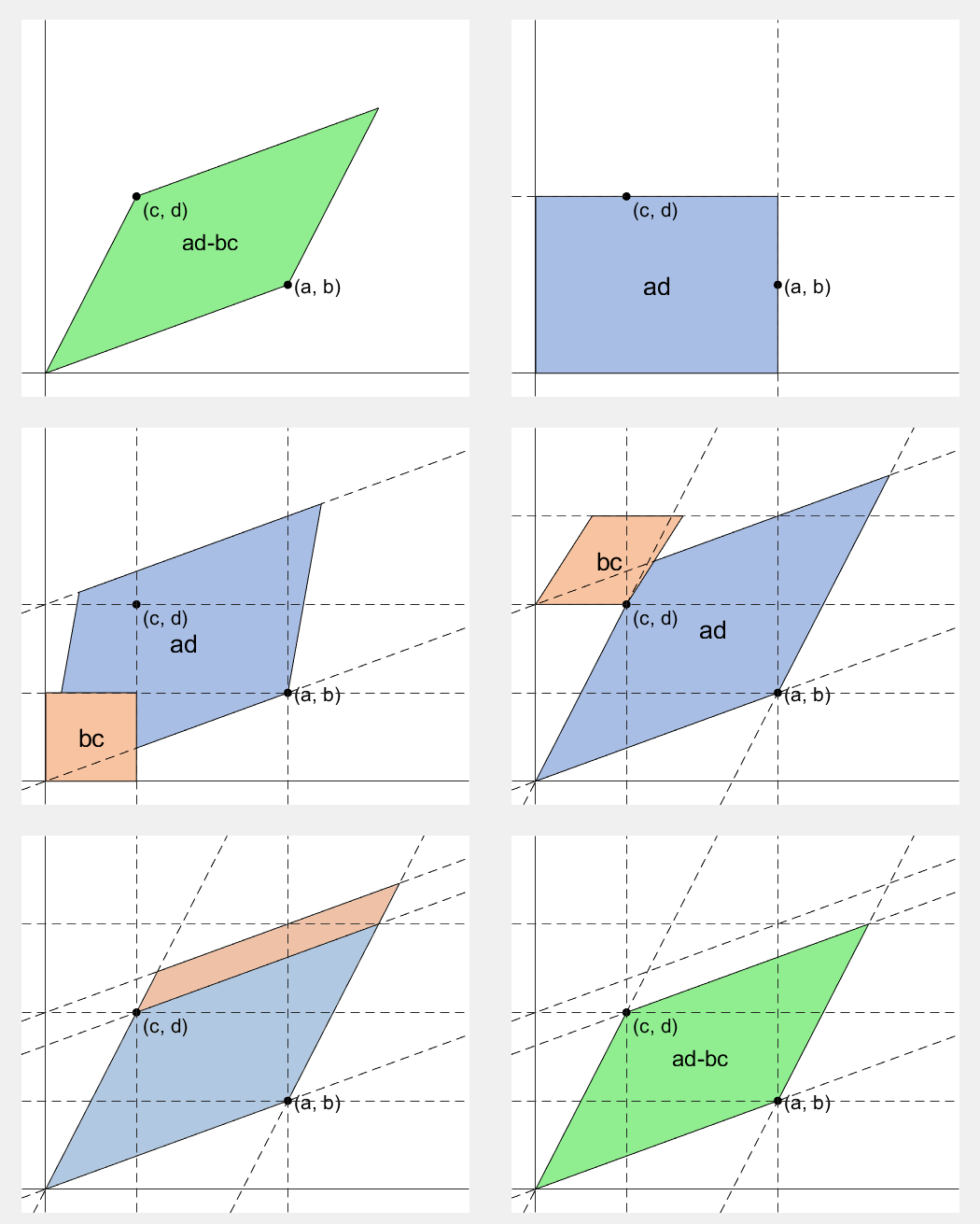
\( |\det(A)| \) is the area of the parallelogram spanned by those two vectors.
The sign of the determinant indicates orientation, while the absolute value gives the area.
Zero Determinant
If
\( \det(A) = 0 \)
then the area of the parallelogram is zero.
This means the vectors are parallel or linearly dependent.
Example:
The columns of the matrix
\( A = \begin{pmatrix} 2 & 1 \\ 3 & 4 \end{pmatrix} \)
represent two vectors in \( \mathbb{R}^2 \).
Find the area of the parallelogram spanned by these vectors.
▶️ Answer/Explanation
Compute the determinant:
\( \det(A) = (2)(4) – (1)(3) = 8 – 3 = 5 \)
Take the absolute value:
\( |\det(A)| = 5 \)
Conclusion: The area of the parallelogram is 5 square units.
Example:
Determine whether the vectors represented by the rows of the matrix
\( B = \begin{pmatrix} 1 & 2 \\ 2 & 4 \end{pmatrix} \)
are parallel.
▶️ Answer/Explanation
Compute the determinant:
\( \det(B) = (1)(4) – (2)(2) = 4 – 4 = 0 \)
Since the determinant is zero, the area is zero.
Conclusion: The vectors are parallel.
Invertibility and the Determinant
A square matrix \( A \) has an inverse if and only if its determinant is nonzero.
\( A \text{ is invertible } \Longleftrightarrow \det(A) \ne 0 \)
If \( \det(A) = 0 \), then the matrix does not have an inverse and is called singular.
A nonzero determinant indicates that the rows and columns of the matrix are linearly independent, which allows the inverse to exist.
This condition applies to square matrices of any size.
Example:
Determine whether the matrix is invertible.
\( A = \begin{pmatrix} 4 & 1 \\ 2 & 3 \end{pmatrix} \)
▶️ Answer/Explanation
Compute the determinant:
\( \det(A) = (4)(3) – (1)(2) = 12 – 2 = 10 \)
Since the determinant is nonzero, the matrix has an inverse.
Conclusion: Matrix \( A \) is invertible.
Example:
Explain why the matrix
\( B = \begin{pmatrix} 3 & 6 \\ 1 & 2 \end{pmatrix} \)
does not have an inverse.
▶️ Answer/Explanation
Compute the determinant:
\( \det(B) = (3)(2) – (6)(1) = 6 – 6 = 0 \)
Since the determinant equals zero, the matrix is singular.
Conclusion: Matrix \( B \) does not have an inverse.