
Parametric Model of a Complete Revolution on the Unit Circle
A complete counterclockwise revolution around the unit circle, centered at the origin and starting at the point \( (1, 0) \), can be modeled using parametric equations.
The parametric function is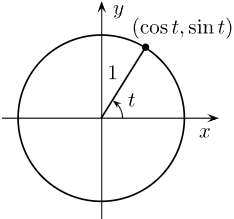
\( (x(t), y(t)) = (\cos t, \sin t) \)
with domain
\( 0 \le t \le 2\pi \)
At any value of \( t \), the point \( (\cos t, \sin t) \) lies on the unit circle because
\( \cos^2 t + \sin^2 t = 1 \)
As \( t \) increases from \( 0 \) to \( 2\pi \), the point moves counterclockwise exactly once around the circle, returning to the starting point \( (1,0) \).
Example:
Find the position of the particle at key values of \( t \) for the parametric function
\( (x(t), y(t)) = (\cos t, \sin t) \)
▶️ Answer/Explanation
| \( t \) | \( x(t) \) | \( y(t) \) |
|---|---|---|
| 0 | 1 | 0 |
| \( \dfrac{\pi}{2} \) | 0 | 1 |
| \( \pi \) | -1 | 0 |
| \( \dfrac{3\pi}{2} \) | 0 | -1 |
| \( 2\pi \) | 1 | 0 |
Conclusion: These points confirm one full counterclockwise revolution around the unit circle.
Example:
Describe the direction of motion for the parametric function
\( (x(t), y(t)) = (\cos t, \sin t) \), \( 0 \le t \le 2\pi \)
▶️ Answer/Explanation
As \( t \) increases:
• \( x(t) = \cos t \) initially decreases, so the motion starts to the left.
• \( y(t) = \sin t \) initially increases, so the motion starts upward.
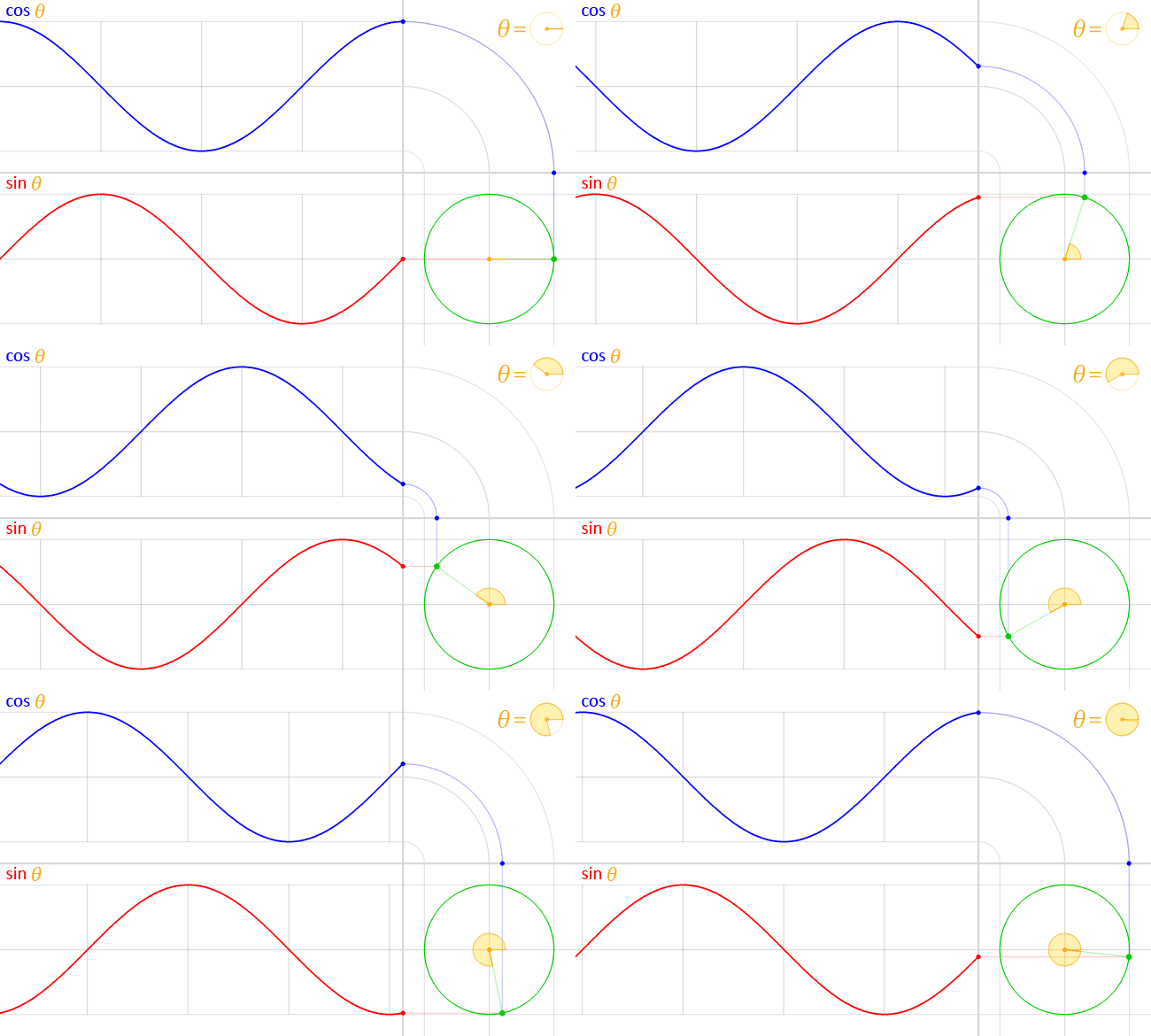
Conclusion: The particle moves counterclockwise around the unit circle, completing exactly one full revolution.
Parametrizing a Linear Path Between Two Points
A linear path along the line segment from the point \( (x_1, y_1) \) to the point \( (x_2, y_2) \) can be described using a parametric function.
One common approach is to start at the initial position \( (x_1, y_1) \) and use constant rates of change for \( x \) and \( y \) with respect to the parameter \( t \).
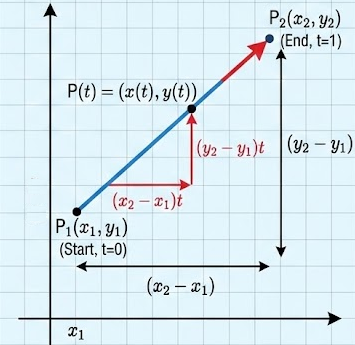
A standard parametrization of the line segment is
\( x(t) = x_1 + (x_2 – x_1)t,\quad y(t) = y_1 + (y_2 – y_1)t \)
with domain
\( 0 \le t \le 1 \)
Here, \( x_2 – x_1 \) and \( y_2 – y_1 \) represent the constant rates of change of \( x \) and \( y \), respectively.
Different parametrizations can be created by changing the interval for \( t \), reversing direction, or scaling the rates of change.
Example:
Parametrize the line segment from \( (1, 2) \) to \( (5, 6) \).
▶️ Answer/Explanation
Compute the rates of change:
\( x_2 – x_1 = 5 – 1 = 4,\quad y_2 – y_1 = 6 – 2 = 4 \)
Write the parametric equations:
\( x(t) = 1 + 4t,\quad y(t) = 2 + 4t,\quad 0 \le t \le 1 \)
Conclusion: As \( t \) increases from 0 to 1, the point moves linearly from \( (1,2) \) to \( (5,6) \).
Example:
A particle moves along the line segment from \( (-2, 3) \) to \( (4, -1) \) in 6 seconds. Find a parametrization using time \( t \), where \( 0 \le t \le 6 \).
▶️ Answer/Explanation
Compute the rates of change per second:
\( \dfrac{4 – (-2)}{6} = 1,\quad \dfrac{-1 – 3}{6} = -\dfrac{2}{3} \)
Write the parametric equations:
\( x(t) = -2 + t,\quad y(t) = 3 – \dfrac{2}{3}t,\quad 0 \le t \le 6 \)
Conclusion: This parametrization models uniform motion along the line segment over the given time interval.