
Vertex Form of a Parabola
A parabola is a curve defined as the set of all points that are the same distance from a fixed point, called the focus, and a fixed line, called the directrix.
If a parabola has vertex \( (h, k) \) and \( a \neq 0 \), it can be represented analytically in vertex form, where the orientation of the parabola depends on which variable is squared.
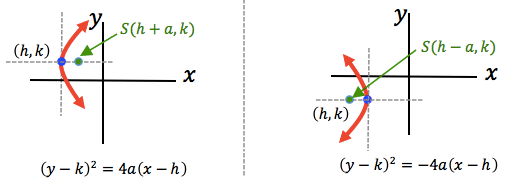
Horizontal parabolas open left or right and are written as
\( x – h = a(y – k)^2 \)
• If \( a > 0 \), the parabola opens to the right.
• If \( a < 0 \), the parabola opens to the left.
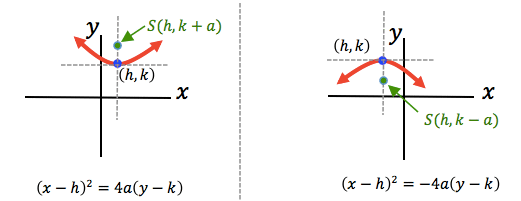
Vertical parabolas open up or down and are written as
\( y – k = a(x – h)^2 \)
• If \( a > 0 \), the parabola opens upward.
• If \( a < 0 \), the parabola opens downward.
The value of \( |a| \) controls how wide or narrow the parabola is. Larger values of \( |a| \) produce a narrower parabola.
Example:
Write an equation for a parabola with vertex \( (2, -1) \) that opens upward and has \( a = 3 \).
▶️ Answer/Explanation
Since the parabola opens upward, use the vertical form
\( y – k = a(x – h)^2 \)
Substitute \( h = 2 \), \( k = -1 \), and \( a = 3 \):
\( y + 1 = 3(x – 2)^2 \)
Conclusion: The equation of the parabola is \( y + 1 = 3(x – 2)^2 \).
Example:
Identify the vertex and direction of opening for the parabola
\( x – 1 = -2(y + 3)^2 \)
▶️ Answer/Explanation
Compare the equation to the form \( x – h = a(y – k)^2 \).
Here, \( h = 1 \) and \( k = -3 \), so the vertex is \( (1, -3) \).
Since \( a = -2 < 0 \), the parabola opens to the left.
Conclusion: The parabola has vertex \( (1, -3) \) and opens left.
Standard Form of an Ellipse
An ellipse is a closed curve consisting of all points for which the sum of the distances to two fixed points, called the foci, is constant.
An ellipse centered at \( (h, k) \) with horizontal radius \( a \) and vertical radius \( b \) can be represented analytically by the equation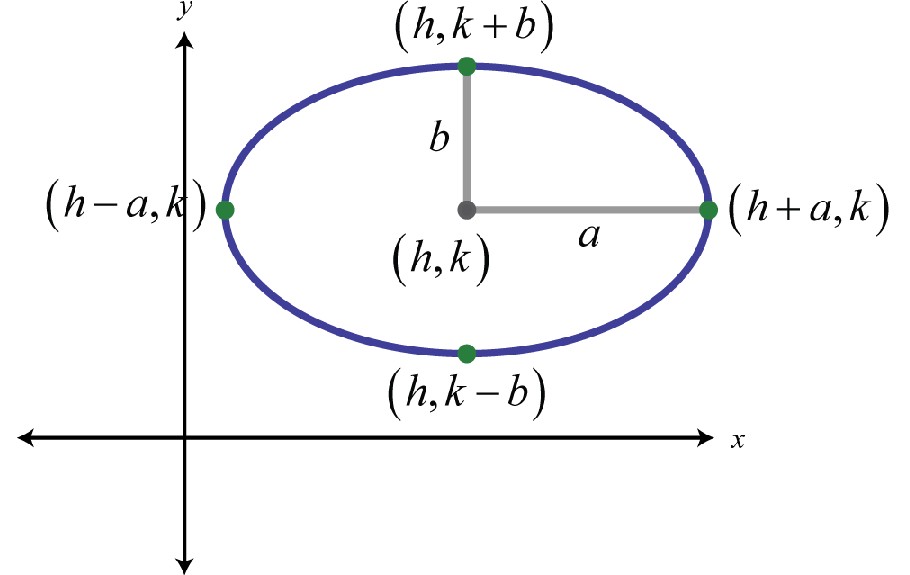
\( \dfrac{(x – h)^2}{a^2} + \dfrac{(y – k)^2}{b^2} = 1 \)
In this form:
• \( (h, k) \) is the center of the ellipse
• \( a \) is the distance from the center to the left or right endpoint
• \( b \) is the distance from the center to the top or bottom endpoint
A circle is a special case of an ellipse in which the horizontal and vertical radii are equal, meaning \( a = b \).
When \( a = b = r \), the equation simplifies to
\( (x – h)^2 + (y – k)^2 = r^2 \)
Example:
Write the equation of an ellipse centered at \( (1, -2) \) with horizontal radius 4 and vertical radius 2.
▶️ Answer/Explanation
Identify the values:
\( h = 1,\quad k = -2,\quad a = 4,\quad b = 2 \)
Substitute into the standard form:
\( \dfrac{(x – 1)^2}{16} + \dfrac{(y + 2)^2}{4} = 1 \)
Conclusion: This equation represents the given ellipse.
Example:
Identify the center and radius of the circle
\( (x + 3)^2 + (y – 1)^2 = 9 \)
▶️ Answer/Explanation
Compare with \( (x – h)^2 + (y – k)^2 = r^2 \).
The center is \( (-3, 1) \) and the radius is \( r = 3 \).
Conclusion: This circle is a special case of an ellipse with equal radii.
Standard Form of a Hyperbola
A hyperbola is a curve consisting of two separate branches that open away from each other and are symmetric about both a horizontal and a vertical line through its center.
A hyperbola centered at \( (h, k) \) with vertical and horizontal lines of symmetry can be represented algebraically in two standard forms, depending on its orientation.
Hyperbola opening left and right:
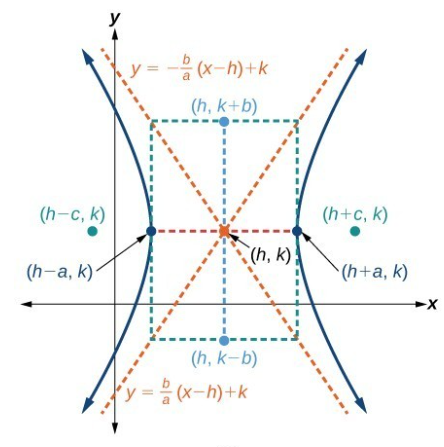
\( \dfrac{(x – h)^2}{a^2} – \dfrac{(y – k)^2}{b^2} = 1 \)
In this form, the transverse axis is horizontal and the branches open to the left and right.
Hyperbola opening up and down:
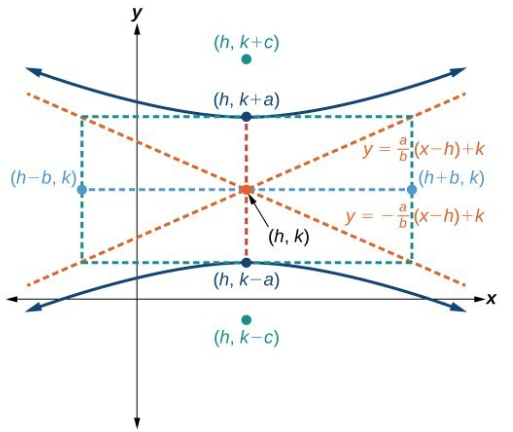
\( \dfrac{(y – k)^2}{b^2} – \dfrac{(x – h)^2}{a^2} = 1 \)
In this form, the transverse axis is vertical and the branches open upward and downward.
For both orientations, the hyperbola has two asymptotes that describe the direction the branches approach but never touch.
Asymptotes: \( y – k = \pm \dfrac{b}{a}(x – h) \)
The values of \( a \) and \( b \) determine how wide or narrow the hyperbola opens.
Example:
Write the equation of a hyperbola centered at \( (2, -1) \) that opens left and right with \( a = 3 \) and \( b = 4 \). Then write its asymptotes.
▶️ Answer/Explanation
Since the hyperbola opens left and right, use
\( \dfrac{(x – h)^2}{a^2} – \dfrac{(y – k)^2}{b^2} = 1 \)
Substitute \( h = 2 \), \( k = -1 \), \( a = 3 \), and \( b = 4 \):
\( \dfrac{(x – 2)^2}{9} – \dfrac{(y + 1)^2}{16} = 1 \)
The asymptotes are
\( y + 1 = \pm \dfrac{4}{3}(x – 2) \)
Conclusion: This equation and its asymptotes describe the given hyperbola.
Example:
Identify the center, orientation, and asymptotes of the hyperbola
\( \dfrac{(y – 3)^2}{4} – \dfrac{(x + 1)^2}{9} = 1 \)
▶️ Answer/Explanation
The center is \( (-1, 3) \).
Since the \( y \)-term is positive, the hyperbola opens up and down.
Here, \( a = 3 \) and \( b = 2 \).
The asymptotes are
\( y – 3 = \pm \dfrac{2}{3}(x + 1) \)
Conclusion: The equation represents a vertical hyperbola centered at \( (-1, 3) \).