AP Statistics 1.1 Introducing Statistics: What Can We Learn from Data?- Exam Style Questions - MCQs - New Syllabus
Question

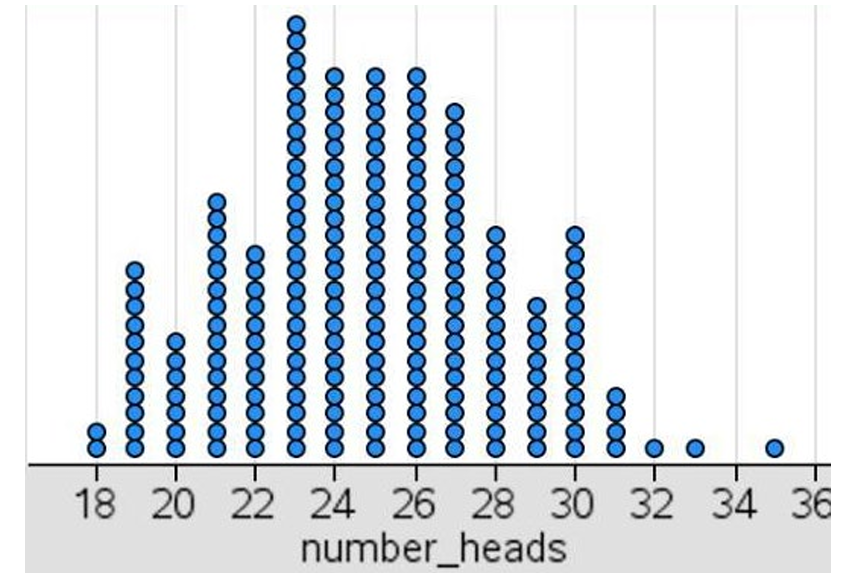
Hannah is studying probability in her statistics course and wants to determine if a coin being spun instead of tossed would change the probability of the coin landing on heads. She spins a coin 50 times, and the coin shows heads 31 times. She simulates 50 spins of a coin 200 times under the assumption that the probability of the coin landing on heads is 0.5. The simulated values are shown in the graph below.
Using the simulation, which of the following would be a correct statement?
(A) If the probability of a spun coin landing on heads is 0.5; a sample of 50 spins is estimated to produce at least 31 heads 3.5% of the time.
(B) If the probability of a spun coin landing on heads is 0.5; a sample of 50 spins will produce at least 31 heads exactly 3.5% of the time.
(C) If the probability of a spun coin landing on heads is 0.5; a sample of 50 spins is estimated to produce at least 31 heads 7% of the time.
(D) If the probability of a spun coin landing on heads is 0.62; a sample of 50 spins will produce at least 31 heads exactly 7% of the time.
(E) If the probability of a spun coin landing on heads is 0.62; a sample of 50 spins is estimated to produce at least 31 heads 3.5% of the time.
▶️ Answer/Explanation
The simulation was conducted under the assumption that
\( p = 0.5 \),
and there were 200 simulated samples of 50 spins each.
From the dotplot, there are approximately 7 simulated samples with 31 or more heads:
\(31, 32, 33,\) and \(35\) heads.
Therefore, the estimated probability is:
\( \frac{7}{200} = 0.035 \)
\( = 3.5\% \)
Simulations provide an estimate, not an exact probability. Thus the correct interpretation is that if the true probability of heads is 0.5, a sample of 50 spins is estimated to produce at least 31 heads about 3.5% of the time.
✅ Answer: (A)
Question
(B) The median of the five measurements is more likely to be close to the actual distance than is a single measurement.
(C) The actual distance should be considered a variable, and taking five measurements allows the manager to estimate the variability in the actual distance.
(D) If one or two odometers give inaccurate readings, the estimate still should be fairly close to the actual distance.
(E) The manager can get some indication of how far off the estimate might be.
▶️ Answer/Explanation
1. Analyze the Manager’s Plan:
The manager is taking multiple measurements of a fixed quantity and using a measure of center (the median) to estimate it.
2. Evaluate the Statements:
– (A), (B), (D), and (E) are all valid statistical justifications. Measurements vary (A), the center of a sample is a better estimate than one point (B), the median is resistant to outliers (D), and the spread of the sample gives an idea of precision (E).
– (C) is statistically incorrect. The actual distance to the park is a fixed, constant value (a parameter), not a variable. The measurements of that distance are a random variable. One cannot estimate the variability of a constant.
Therefore, statement (C) is not a valid statistical justification.
✅ Answer: (C)
In which of the following situations would it be most difficult to use a census?
(A) To determine what proportion of licensed bicycles on a university campus have lights
(B) To determine what proportion of students in a high school support wearing uniforms
(C) To determine what proportion of registered students enrolled in a college are employed more than 20 hours each week
(D) To determine what proportion of single-family dwellings in a small town have two-car garages
(E) To determine what proportion of fish in Lake Michigan are bass
▶️ Answer/Explanation
A census requires collecting information from every member of the population. Options (A) through (D) involve populations that can reasonably be identified and counted, even if doing so may take time and effort.
However, determining the proportion of fish in Lake Michigan that are bass would require locating and identifying every fish in the lake, which is practically impossible. The population is extremely large, mobile, and difficult to observe completely.
Therefore, a census would be most difficult in this situation, and sampling methods would be far more practical.
✅ Answer: (E)
