
AP Statistics 1.12 Potential Problems with Sampling- Exam Style Questions - MCQs - New Syllabus
Question
A company that manufactures cleaning products wants to test to see if using a powder or a liquid detergent is better for cleaning clothes. They will test their products using two machines in their research lab, one top-load machine and the other a front-load machine. Each machine has three temperature options and a single or extra rinse setting. Which of the following describes the best experimental design for the company?
(A) A completely randomized design with four factors (cleaner type, machine type, temperature, rinse).
(B) A randomized block design with the cleaner type as the blocks and three factors (machine type, temperature, rinse).
(C) A randomized block design with the machine type as the blocks and three factors (cleaner type, temperature, rinse).
(D) A randomized block design with the temperature as the blocks and three factors (cleaner type, machine type, rinse).
(E) A randomized block design with the temperature and rinse options as the blocks and two factors (cleaner type, machine type).
▶️ Answer/Explanation
The goal is to compare two detergent types while controlling for variation caused by the washing machines. Since there are only two machine types (top-load and front-load), machine type is a natural blocking variable because it may affect cleaning performance independently of the detergent used.
Within each machine-type block, the company can investigate the experimental factors:
• Cleaner type (powder or liquid)
• Temperature setting
• Rinse setting
Blocking on machine type reduces unexplained variability and allows a more accurate comparison of the detergents. Therefore, the best design is a randomized block design with machine type as the blocks.
✅ Answer: (C)
Question
A television news editor would like to know how local registered voters would respond to the question, “Are you in favor of the school bond measure that will be voted on in an upcoming special election?” A television survey is conducted during a break in the evening news by listing two telephone numbers side by side on the screen, one for viewers to call if they approve of the bond measure, and the other to call if they disapprove. This survey method could produce biased results for a number of reasons. Which one of the following is the most obvious reason?
(A) It uses a stratified sample rather than a simple random sample.
(B) People who feel strongly about the issue are more likely to respond.
(C) Viewers should be told about the issues before the survey is conducted.
(D) Some registered voters who call might not vote in the election.
(E) The wording of the question is biased.
▶️ Answer/Explanation
This survey is a classic example of a voluntary response sample. Participation is completely optional, so people with strong opinions are much more likely to take the time to call and respond.
As a result, the sample may not accurately represent all registered voters. Individuals who feel neutral or only mildly interested in the issue are less likely to participate.
This self-selection creates bias and can lead to results that overrepresent strong opinions.
✅ Answer: (B)
Question
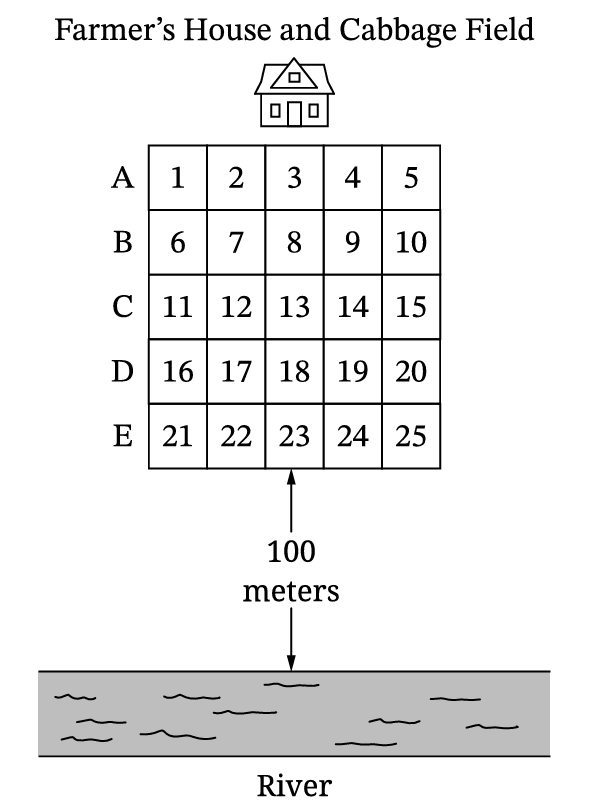
(B) It is likely to be an overestimate because row \(E\) is closest to the river.
(C) It is likely to be exactly equal to the true population proportion because row \(E\) was randomly selected.
(D) It cannot be biased because every cabbage plant in row \(E\) is examined.
▶️ Answer/Explanation
Row \(E\) is the row closest to the river.
Since the farmer believes aphid damage is greater closer to the river, the cabbage plants in row \(E\) are likely to have a higher proportion of aphid damage than the field as a whole.
Therefore, using only row \(E\) is likely to produce an overestimate of the true proportion of damaged cabbage plants in the entire field.
✅ Answer: (B)