AP Statistics 1.2 Variables- Exam Style Questions - MCQs - New Syllabus
Question
A local university is considering creating two new Co-Op programs, one in the College of Engineering and one in the College of Nursing. The university plans to survey students about their interest in participating in a Co-Op program. Which of the following sampling methods is the most appropriate?
(A) A simple random sample of students
(B) A stratified random sample with the strata being where students live (on or off campus).
(C) A stratified random sample with the strata being the two colleges (Engineering and Nursing).
(D) A cluster random sample with the clusters being where students live (on or off campus).
(E) A cluster random sample with the clusters being the two colleges (Engineering and Nursing).
▶️ Answer/Explanation
The university is specifically interested in two groups of students: those in the College of Engineering and those in the College of Nursing. These groups may have very different levels of interest in a Co-Op program.
A stratified random sample ensures that both colleges are represented in the sample. By creating strata based on college and then randomly sampling within each stratum, the university can obtain more precise estimates for each group.
Cluster sampling would not be appropriate because selecting only one college could exclude the other entirely. Housing location is not directly related to the purpose of the study.
✅ Answer: (C)
Question
A city council is interested in assessing the opinions of city residents regarding a proposed shopping center in their city. Which of the following scenarios would introduce the LEAST amount of bias in the survey?
(A) Putting the survey up on the city council’s webpage and asking people to vote there.
(B) Conducting a phone survey during working hours to reach a diverse range of residents.
(C) Sending the survey out to everyone who voted in the last local election.
(D) Taking a random sample of shoppers at one of the other shopping centers in the city.
(E) Taking a random sample of citizens from a list of all of the city’s residents.
▶️ Answer/Explanation
The goal is to obtain opinions that accurately represent all city residents. A random sample selected from a complete list of residents gives every resident an equal chance of being chosen and minimizes selection bias.
Choice (A) suffers from voluntary response bias. Choice (B) may miss many residents who are unavailable during working hours. Choice (C) excludes nonvoters, and choice (D) only surveys people already shopping at another shopping center, which may not represent all residents.
Therefore, the least biased approach is to take a random sample from a list containing all city residents.
✅ Answer: (E)
Question
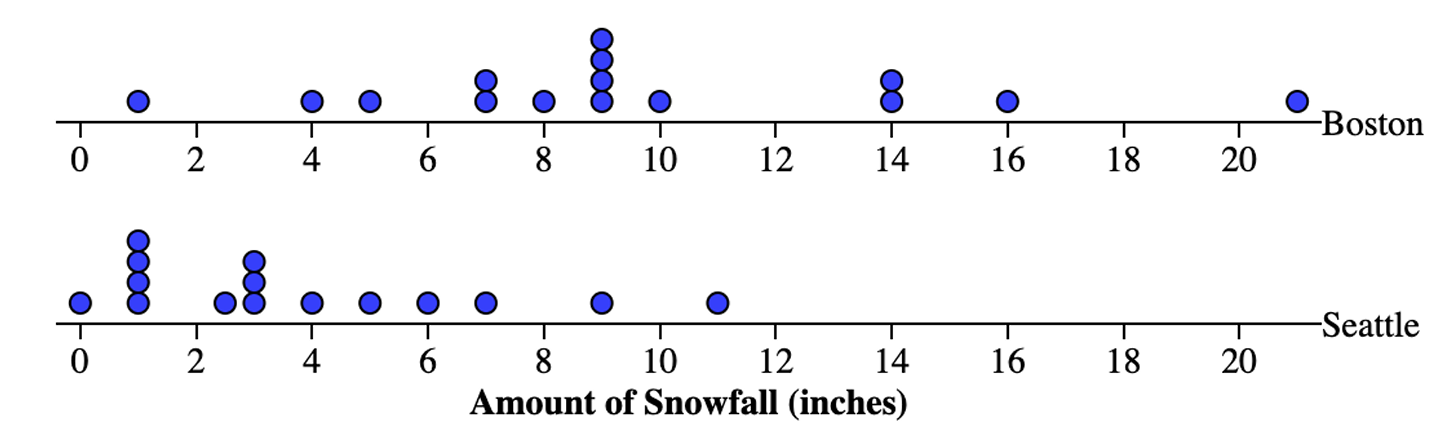
For winters in Boston and Seattle, the monthly snowfall totals, in inches, for the past five years are displayed below. When comparing the amounts of snowfall between the two cities, which of the following statements is true?

(A) The distribution of monthly snowfall in Boston is roughly symmetric while the distribution of monthly snowfall in Seattle is skewed to the right.
(B) Boston always gets more snow than Seattle.
(C) The amount of snowfall varies more in Seattle compared to Boston.
(D) The distribution of monthly snowfall in Seattle is left skewed, so the median should be used to measure typical monthly snowfall.
(E) The median amount of monthly snowfall is 4 inches for Boston and Seattle.
▶️ Answer/Explanation
Looking at the dotplots, Boston’s snowfall amounts are centered around 8–10 inches and have values extending fairly evenly on both sides of the center, making the distribution roughly symmetric.
Seattle’s snowfall amounts are concentrated at smaller values (around 1–3 inches) with a long tail extending to larger values such as 9 and 11 inches. This indicates a right-skewed distribution.
Choice (B) is false because there are months where Seattle’s snowfall exceeds some of Boston’s snowfall values. Choice (C) is false because Boston has the larger spread. Choice (D) incorrectly identifies the skew direction, and Choice (E) is not supported by the data.
Therefore, the true statement is that Boston is roughly symmetric while Seattle is skewed to the right.
✅ Answer: (A)
