AP Statistics 2.2 Summary Statistics for Two Categorical Variables- Exam Style Questions - MCQs - New Syllabus
Question
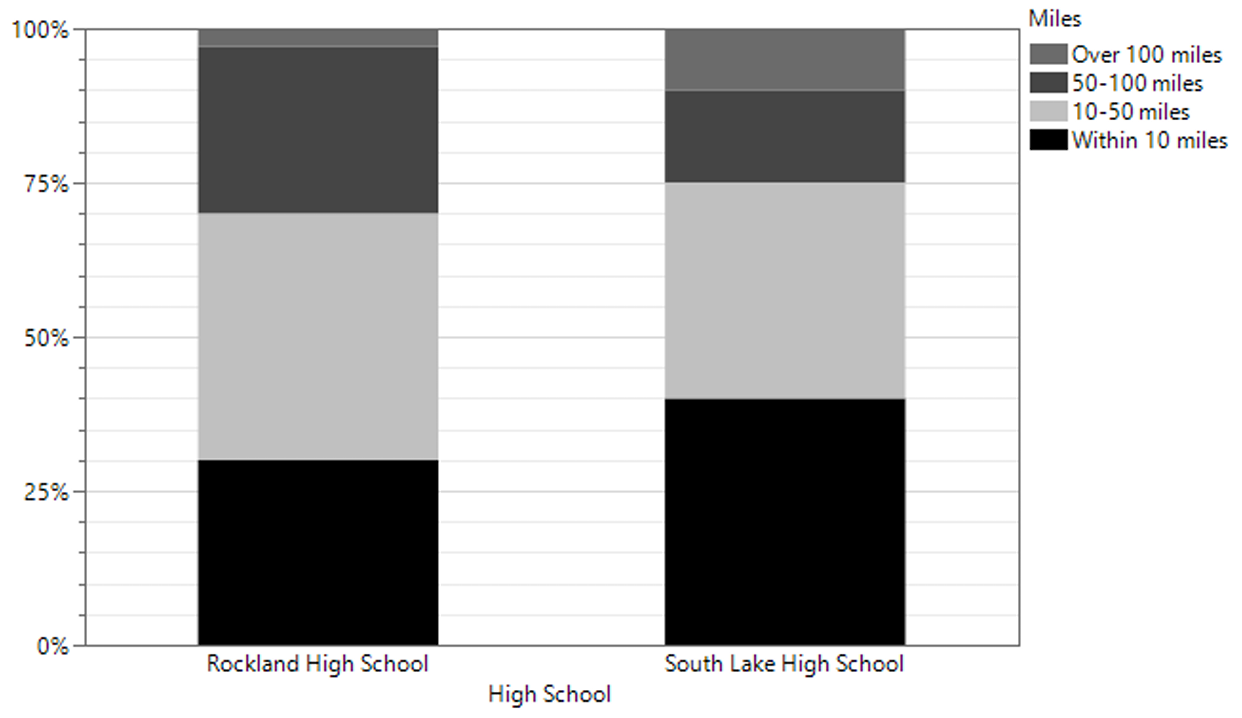
A random sample of 300 seniors from Rockland High School and a random sample of 200 seniors from South Lake High School were asked how far, in miles, their college of choice is from their home. The results are summarized in the following graph:

Which of the following statements about the sampled students is supported by the bar chart?
(A) Within 10 miles was the most popular response from students at both high schools.
(B) Three quarters of the students at Rockland have a college of choice within 50 miles of home.
(C) More students at South Lake High School wish to stay within 10 miles of home than students at Rockland High School who wish to stay within 10 miles of home.
(D) More than twice as many students at Rockland High School wish to be between 50-100 miles from home than students at South Lake High School.
(E) More students at Rockland High School than at South Lake High School wish to be more than 100 miles away from home.
▶️ Answer/Explanation
The bar chart shows percentages, but the sample sizes are different:
\(n_{\text{Rockland}}=300\)
\(n_{\text{South Lake}}=200\)
For students whose college choice is more than 100 miles away:
Rockland: approximately \(2\%\)
\(0.02(300)=6\text{ students}\)
South Lake: approximately \(10\%\)
\(0.10(200)=20\text{ students}\)
So (E) is false.
For students choosing a college within 10 miles:
Rockland: approximately \(30\%\)
\(0.30(300)=90\text{ students}\)
South Lake: approximately \(40\%\)
\(0.40(200)=80\text{ students}\)
So (C) is false.
For students choosing a college 50–100 miles away:
Rockland: approximately \(28\%\)
\(0.28(300)=84\text{ students}\)
South Lake: approximately \(15\%\)
\(0.15(200)=30\text{ students}\)
Since:
\(84 > 2(30)=60\)
more than twice as many students at Rockland chose colleges 50–100 miles away compared with South Lake.
Therefore, the statement supported by the graph is choice (D).
✅ Answer: (D)
Question
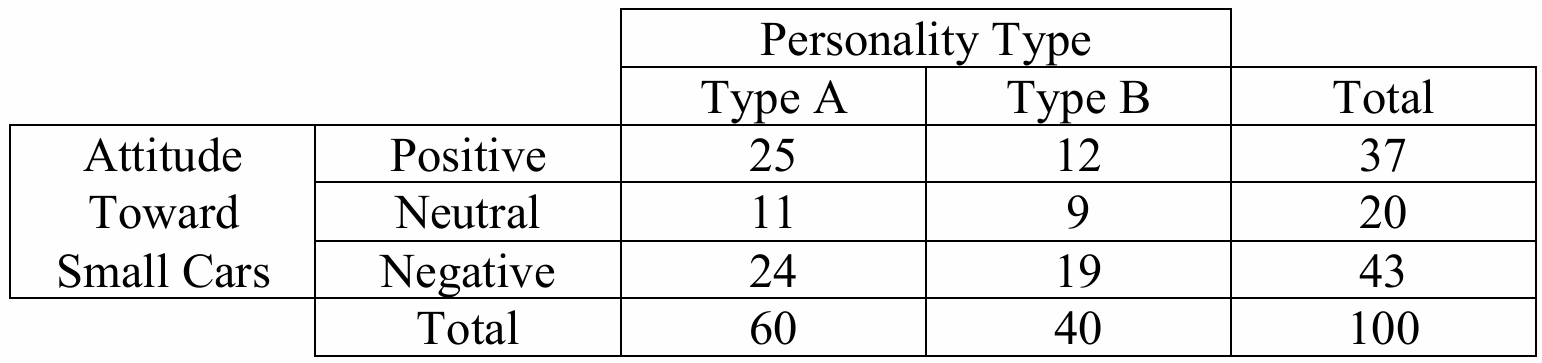
One hundred people were interviewed and classified according to their attitude toward small cars and their personality type. The results are shown in the table below.

Which of the following is true?
(A) Of the three attitude groups, the group with the negative attitude has the highest proportion of type A personality types.
(B) Of the three attitude groups, the group with the neutral attitude has the highest proportion of type B personality types.
(C) For each personality type, more than half of the 100 respondents have a neutral attitude toward small cars.
(D) The proportion that has a positive attitude toward small cars is higher among people with a type B personality type than among people with a type A personality type.
(E) More than half of the 100 respondents have a type A personality type and a positive attitude toward small cars.
▶️ Answer/Explanation
Compute the proportion of Type B personalities within each attitude group.
Positive: \( \frac{12}{37}\approx0.324 \)
Neutral: \( \frac{9}{20}=0.45 \)
Negative: \( \frac{19}{43}\approx0.442 \)
The neutral attitude group has the largest proportion of Type B personalities since:
\( 0.45 > 0.442 > 0.324 \)
Therefore, statement (B) is true. The remaining statements are false when the corresponding proportions are calculated from the table.
✅ Answer: (B)
Question
(B) The conclusion is correct because the elementary school had the larger relative frequency for small bottles.
(C) The conclusion is incorrect because the middle school sold \(x\) small bottles while the elementary school sold \(0.5x\) small bottles.
(D) The conclusion is incorrect because the elementary school sold \(3x\) small bottles while the middle school sold \(x\) small bottles.
▶️ Answer/Explanation
The elementary school sold \(0.5x\) small bottles.
The middle school sold three times as many total bottles, so the middle school sold \(3x\) total bottles.
Since the middle school proportions were equal for all three sizes, the middle school sold
\(\frac{1}{3}(3x)=x\) small bottles.
Since \(x>0.5x\), the middle school sold more small bottles than the elementary school.
✅ Answer: (C)
