Home / AP® Exam / AP® Statistics / AP Statistics 2.6 Conditional Probability- Exam Style Questions – MCQs

AP Statistics 2.6 Conditional Probability- Exam Style Questions - MCQs - New Syllabus

Question 

The Pew Research Center conducted a survey in 2018 with a random sample of U.S. adults and the following probabilities were estimated. You may assume all probability statements and questions are about U.S. adults in 2018.

  • The probability they had not read a book in the past year was 0.22.
  • The probability of being in age group 18-44 was 0.44.
  • The probability of being in age group 18-44 and having not read a book in the past year was 0.12.
  • The probability of being in age group 45 or more and having not read a book in the past year was 0.10.

Consider the events “not reading a book in the past year” and “age group 18-44.” Are these events independent?

(A) No, because if we know they are aged 18-44, their probability of not reading a book in the past year increased from 0.22 to 0.27.
(B) No, because if we know they are aged 18-44, their probability of not reading a book in the past year decreased from 0.22 to 0.10.
(C) No, because they can be both aged 18-44 and not read a book in the past year at the same time, with a probability of 0.10.
(D) Yes, because the probability of not reading a book in the past year is 0.22 and that should not be affected by how old they are.
(E) Yes, because the probability of not reading a book in the past year is 0.22 and the probability they are aged 18-44 is 0.44.

▶️ Answer/Explanation

To determine whether the events are independent, compare the overall probability of not reading a book to the conditional probability given that a person is aged 18–44.

Let:

\(P(\text{No Book})=0.22\)
\(P(18\text{–}44)=0.44\)
\(P(\text{No Book} \cap 18\text{–}44)=0.12\)

Compute the conditional probability:

\(P(\text{No Book}\mid 18\text{–}44)=\frac{0.12}{0.44}\approx0.273\)

Since:

\(0.273 \ne 0.22\)

knowing that a person is aged 18–44 changes the probability of not reading a book in the past year. Therefore, the events are not independent.

The probability increases from 0.22 to approximately 0.27, which matches choice (A).

Answer: (A)

Question 

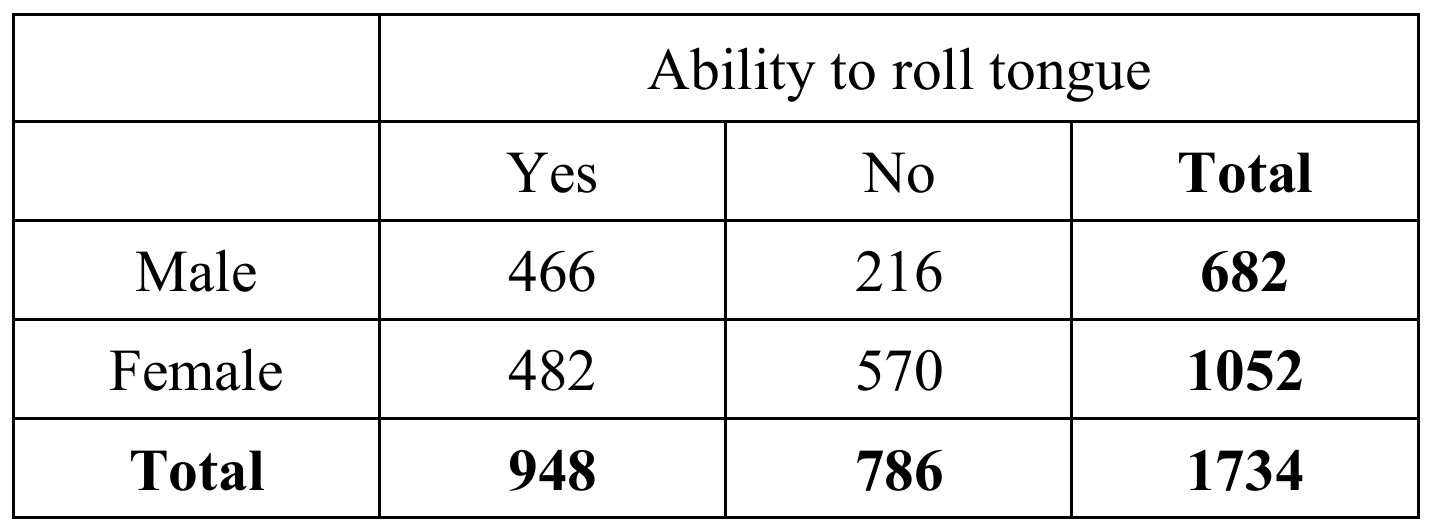
In a study to estimate the proportion of people who are able to roll their tongue, data were collected on 1734 individuals. The results are shown in the table below.

Suppose one person is selected at random from this sample. If the person is a male, what is the probability that the person can roll his tongue?

(A) 0.269

(B) 0.393

(C) 0.492

(D) 0.683

(E) 0.719

▶️ Answer/Explanation

Since we are told that the selected person is a male, this is a conditional probability problem.

The probability that a male can roll his tongue is:

\(P(\text{Roll Tongue} \mid \text{Male})=\frac{\text{Number of males who can roll tongue}}{\text{Total number of males}}\)

\(=\frac{466}{682}\)

\(=0.6833\approx0.683\)

Therefore, the probability that a randomly selected male can roll his tongue is approximately 0.683.

Answer: (D)

Question

The Fizzy Bath Company has produced bath fizzies that have a cash prize in every bath fizzy. Let \(X\) represent the dollar value of the cash prize in a randomly selected bath fizzy. The probability distribution of \(X\) is shown in the table.
Probability Distribution of Cash Prize \(X\)
Cash prize, \(x\)\(\$1\)\(\$5\)\(\$10\)\(\$20\)\(\$50\)\(\$100\)
Probability of cash prize, \(P(X=x)\)\(0.68\)\(0.20\)\(0.05\)\(0.05\)\(0.01\)\(0.01\)
What is the probability that a randomly selected bath fizzy contains \(\$100\), given that it contains at least \(\$10\)?
(A) \(\dfrac{0.01}{0.12}\approx0.0833\)
(B) \(\dfrac{0.01}{0.32}\approx0.0313\)
(C) \(\dfrac{0.12}{0.01}=12\)
(D) \(\dfrac{0.01}{1}=0.01\)
▶️ Answer/Explanation
We want \(P(X=100\mid X\ge10)\). Use the conditional probability formula:
\(P(X=100\mid X\ge10)=\dfrac{P(X=100\text{ and }X\ge10)}{P(X\ge10)}\)
Since \(X=100\) is already included in the event \(X\ge10\), the numerator is \(P(X=100)=0.01\).
\(P(X\ge10)=0.05+0.05+0.01+0.01=0.12\)
Therefore,
\(P(X=100\mid X\ge10)=\dfrac{0.01}{0.12}\approx0.0833\)

This is also equal to \(\dfrac{1}{12}\).

Answer: (A)
Scroll to Top