
AP Statistics 2.9 Parameters of Random Variables- Exam Style Questions - MCQs - New Syllabus
Question
Super Express Mart has a “speedy checkout” lane for people who have 6 items or less. The random variable S is the number of items purchased by a person in the “speedy checkout” lane. S follows the distribution shown in the table below.
![]()
The mean of S is 3.84. Which of the following statements is the best interpretation of the mean?
(A) If a person is to be randomly selected from the “speedy checkout” lane, the number of items purchased by that person is 3.84 items.
(B) Since a person who goes through the “speedy checkout” lane can’t buy 3.84 items, the mean number of items purchased by a person in the “speedy checkout” should be 4.
(C) Most people who go through the “speedy checkout” get 3 or 4 items.
(D) If a few people are randomly selected from the “speedy checkout” lane, the average number of items they purchased would be 3.84 items.
(E) The average number of items purchased by all people using the “speedy checkout” lane is 3.84 items.
▶️ Answer/Explanation
The mean of a random variable represents its long-run average value. It does not mean that every individual observation will equal the mean, nor does it require the mean to be a whole number.
A value of:
\(E(S)=3.84\)
means that if we consider all customers using the speedy checkout lane (or a very large number of such customers), the average number of items purchased per customer would be approximately 3.84 items.
Choices (A), (B), and (C) incorrectly interpret the mean for individual customers, while (D) refers only to a few people rather than the long-run average. Therefore, the best interpretation is that the overall average number of items purchased is 3.84.
✅ Answer: (E)
Question
Random variable \(X\) is normally distributed with mean 10 and standard deviation 3, and random variable \(Y\) is normally distributed with mean 9 and standard deviation 4. If \(X\) and \(Y\) are independent, which of the following describes the distribution of \(Y-X\)?
(A) Normal with mean 1 and standard deviation \(-1\)
(B) Normal with mean \(-1\) and standard deviation \(-1\)
(C) Normal with mean \(-1\) and standard deviation \(5\)
(D) Normal with mean \(1\) and standard deviation \(7\)
(E) Normal with mean \(-1\) and standard deviation \(7\)
▶️ Answer/Explanation
The difference of two independent normal random variables is also normally distributed.
First find the mean:
\( \mu_{Y-X}=\mu_Y-\mu_X \)
\( \mu_{Y-X}=9-10=-1 \)
Next find the variance:
\( \sigma^2_{Y-X}=\sigma_Y^2+\sigma_X^2 \)
\( \sigma^2_{Y-X}=4^2+3^2=16+9=25 \)
Therefore,
\( \sigma_{Y-X}=\sqrt{25}=5 \)
So \(Y-X\) follows a normal distribution with mean \(-1\) and standard deviation \(5\).
✅ Answer: (C)
Question

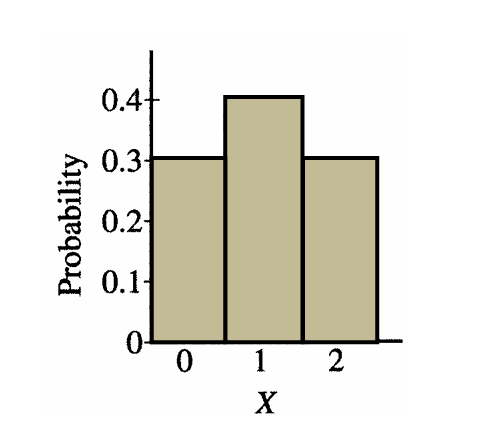
A game of chance is played in which \(X\), the number of points scored in each game, has the distribution shown above. Which of the following is true for the sampling distribution of the sum, \(Y\), of the scores when the game is played twice?
(A) \(Y\) takes on values 0, 1, 2 with respective probabilities 0.3, 0.4, and 0.3.
(B) \(Y\) takes on values 0, 2, 4 according to a binomial distribution with mean equal to 2.
(C) \(Y\) takes on values 0, 2, 4 with respective probabilities 0.3, 0.4, and 0.3.
(D) \(Y\) takes on values 0, 1, 2, 3, 4 according to a binomial distribution with mean equal to 2.
(E) \(Y\) takes on values 0, 1, 2, 3, 4 with respective probabilities 0.09, 0.24, 0.34, 0.24, and 0.09.
▶️ Answer/Explanation
From the graph:
\( P(X=0)=0.3 \)
\( P(X=1)=0.4 \)
\( P(X=2)=0.3 \)
Let
\( Y=X_1+X_2 \)
where the game is played twice independently.
Calculate the probabilities for each possible sum:
\( P(Y=0)=0.3(0.3)=0.09 \)
\( P(Y=1)=0.3(0.4)+0.4(0.3)=0.24 \)
\( P(Y=2)=0.3(0.3)+0.4(0.4)+0.3(0.3) \) \( =0.09+0.16+0.09=0.34 \)
\( P(Y=3)=0.4(0.3)+0.3(0.4)=0.24 \)
\( P(Y=4)=0.3(0.3)=0.09 \)
Therefore, \(Y\) takes values \(0,1,2,3,4\) with probabilities:
\( 0.09,\;0.24,\;0.34,\;0.24,\;0.09 \)
which matches choice (E).
✅ Answer: (E)
