Home / AP® Exam / AP® Statistics / 3.4 Potential Problems with Sampling- FRQs

AP Statistics 3.4 Potential Problems with Sampling- FRQs - Exam Style Questions

Question

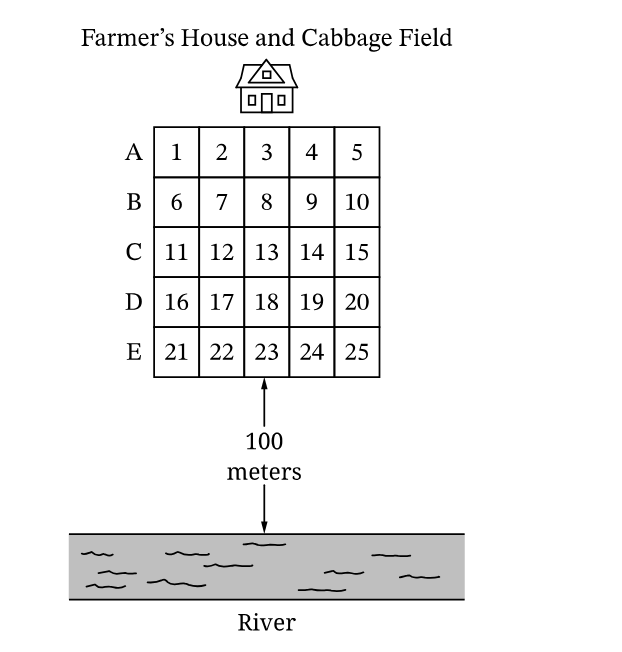
Aphids are tiny insects that feed on plants such as cabbage plants. A farmer wants to reduce the number of aphids in a cabbage field. A river is located \(100\) meters south of the cabbage field. The farmer divides the field into \(25\) regions of equal size, as shown in the diagram. Each region has approximately the same number of cabbage plants.

The farmer would like to estimate the proportion of cabbage plants in the field that are affected by aphids and believes that the extent of aphid damage is greater for the regions in the cabbage field closer to the river. To obtain the estimate, the farmer is considering three sampling methods.

Sampling method I: Select region \(3\), which is closest to the farmer’s house and farthest from the river. Examine every cabbage plant in the region for aphid damage.
Sampling method II: Randomly select one row (A, B, C, D, or E). For every region in the selected row, examine every cabbage plant for aphid damage.
Sampling method III: Randomly select one region from each of rows A, B, C, D, and E. For each selected region, examine every cabbage plant for aphid damage.

(a) Explain whether sampling method I is an appropriate sampling method for the farmer to use to estimate the proportion of cabbage plants in the field that are damaged by aphids.

(b) Using sampling method II, the farmer randomly selected row E and examined every cabbage plant in row E. If the farmer’s belief is correct, determine whether the selection of row E is likely to provide an overestimate or an underestimate of the proportion of cabbage plants in the field that are damaged by aphids. Justify your answer.

(c) Using the information provided in the diagram of the cabbage field, describe how to implement sampling method III, which requires a random selection of one region from each of rows A, B, C, D, and E.

Most-appropriate topic codes (CED):

TOPIC 3.2: Introduction to Planning a Study – part (a), part (b), part (c)
TOPIC 3.3: Random Sampling and Data Collection – part (a), part (c)
TOPIC 3.4: Potential Problems with Sampling – part (a), part (b)
▶️ Answer/Explanation
Detailed solution

(a)
Sampling method I is not an appropriate sampling method for the farmer to use to estimate the proportion of cabbage plants in the field that are affected by aphids. This method is a convenience sample that selects only region \(3\), which is farthest from the river. Since the farmer believes aphid damage varies with distance from the river, this single region is unlikely to be representative of the entire field, and the sampling process does not use random selection.
Final Answer: Not appropriate

(b)
The selection of row E is likely to provide an overestimate of the proportion of all cabbage plants in the field that are damaged by aphids. If the farmer’s belief is correct that aphid damage is greater for regions closer to the river, then row E (being closest to the river) is likely to have a greater proportion of damaged cabbage plants than regions farther from the river.
Final Answer: Overestimate

(c)
To implement sampling method III, the farmer should use a stratified random sampling approach. For each row (A, B, C, D, and E), randomly select one region from that row. This can be done by writing the region numbers for each row on same-size slips of paper (row A: \(1\)-\(5\), row B: \(6\)-\(10\), row C: \(11\)-\(15\), row D: \(16\)-\(20\), row E: \(21\)-\(25\)), placing them in separate containers, mixing well, and drawing one slip from each container. Alternatively, use a random number generator to select one number from each row’s range. This ensures one region is randomly selected from each row, and all cabbage plants in those selected regions are examined for aphid damage.
Final Answer: Use stratified random sampling with one region from each row

Scroll to Top