
AP Statistics 3.5 Setting Up a Test for a Population Proportion- Exam Style Questions - MCQs - New Syllabus
Question
The State of Pennsylvania believes more than 50 percent of the wells along the Susquehanna River are contaminated with coliform bacteria. The state’s environmental agency randomly selected 100 wells and tested the null hypothesis that the proportion of all wells that are contaminated is 50 percent or less against the alternative that the proportion of all wells that are contaminated is more than 50 percent.
Suppose that 56 percent of the 100 wells were contaminated, resulting in a p-value of 0.115. Which of the following situations would be an example of a Type I Error?
(A) The state’s environmental agency incorrectly decides that 56% of all wells are contaminated.
(B) The state’s environmental agency incorrectly decides more than 50% of all wells are contaminated.
(C) The state’s environmental agency incorrectly decides 50% or less of all wells are contaminated.
(D) The p-value was computed incorrectly and the state’s environmental agency incorrectly decides that 50% or less of all wells are contaminated.
(E) The p-value was computed incorrectly and the state’s environmental agency incorrectly decides different than 50% of all wells are contaminated.
▶️ Answer/Explanation
The hypotheses are:
\(H_0: p \leq 0.50\)
\(H_a: p > 0.50\)
A Type I Error occurs when the null hypothesis is actually true, but we incorrectly reject it. In this context, that means concluding that more than 50% of the wells are contaminated when in reality 50% or fewer are contaminated.
Therefore, a Type I Error would be the environmental agency incorrectly deciding that more than 50% of all wells are contaminated. The actual p-value and sample result are not important for identifying the definition of a Type I Error.
✅ Answer: (B)
Question
Betty is planning to survey people at a local flea market as they enter the market. She will ask them if they are looking to buy furniture items to flip (i.e. items to refurbish and resell). Betty plans to perform a hypothesis test to see if over 50% of the attendees are looking for items to flip. Which of the following statements is true regarding the independence condition for testing hypotheses?
(A) If Betty takes a random sample, the independence condition is met.
(B) If Betty takes a random sample and the sample is less than 10% of those in attendance, then the independence condition is met.
(C) If Betty randomly assigns people to the flip and not-flip groups, then the independence condition is met.
(D) If the number of people who plan to flip and the number of people who don’t plan to flip are both greater than or equal to 10, then the independence condition is met.
(E) If Betty surveys more than 30 people, then the independence condition is met.
▶️ Answer/Explanation
For inference involving a population proportion, the independence condition is typically satisfied when a random sample is selected and the sample size is less than 10% of the population size.
This is known as the 10% condition, which helps ensure that individual responses are approximately independent when sampling without replacement.
Choice (D) refers to the Large Counts Condition, not the Independence Condition. Choices (A), (C), and (E) do not by themselves guarantee independence.
Therefore, the correct statement is that Betty should take a random sample that is less than 10% of the population being studied.
✅ Answer: (B)
Question
A used clothing consignment store advertises that over 80% of their consignors sell over 75% of their consigned items within 3 months. A random sample of 100 consignors was collected. In this sample 87 out of the 100 consignors had sold over 75% of their consigned items within 3 months.
Two students ran the following hypothesis test based on the information provided above.
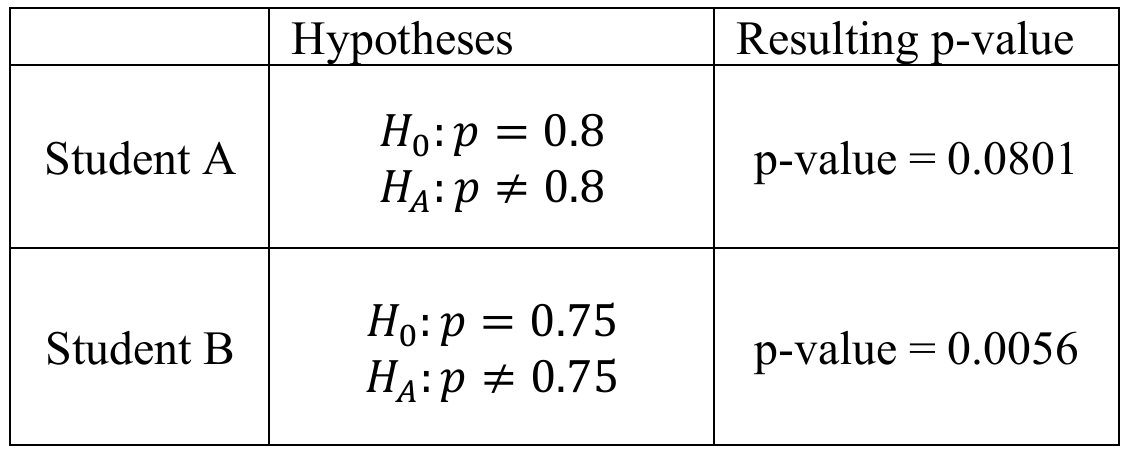
Determine if there is statistical evidence at the alpha = 0.05 level of significance to support the stores advertising claim that more than 80% of consignors sell over 75% of their consigned items within 3 months.
(A) There is not statistically significant evidence to support the store’s claim since the p-value of 0.0801 is greater than the significance level of 0.05.
(B) There is statistically significant evidence to support the store’s claim since the p-value of 0.04 is less than the significance level of 0.05.
(C) There is statistically significant evidence to support the store’s claim since the p-value of 0.0056 is less than the significance level of 0.05.
(D) There is statistically significant evidence to support the store’s claim since the p-value of 0.0028 is less than the significance level of 0.05.
(E) There is not statistically significant evidence to support the store’s claim since the p-value of 0.9599 is greater than the significance level of 0.05.
▶️ Answer/Explanation
The store’s claim is that more than 80% of consignors meet the condition, so the appropriate hypotheses are:
\(H_0:p=0.80\)
\(H_A:p>0.80\)
Student A reported a two-sided p-value of 0.0801. For the correct one-sided test, the p-value is half of this value:
\(p\text{-value}=\frac{0.0801}{2}=0.04005\approx0.04\)
Since \(0.04 < 0.05\), there is sufficient statistical evidence to support the store’s advertising claim. Therefore, choice (B) is correct.
✅ Answer: (B)