
AP Statistics 3.9 Sampling Distributions for the Difference Between Sample Proportions- Exam Style Questions - FRQs - New Syllabus
Question
Most-appropriate topic codes (AP Statistics):
• Topic \(3.13\) — Carrying Out a Test for the Difference Between Two Population Proportions (Part \(\mathrm{b}\): test statistic, \(p\)-value, and conclusion)
• Topic \(3.9\) — Sampling Distributions for the Difference Between Sample Proportions (Part \(\mathrm{a}\): large counts condition for inference)
• Topic \(1.13\) — Experimental Design (Part \(\mathrm{a}\): random assignment of treatments)
▶️ Answer/Explanation
Let \(p_A\) = true proportion of patients who survive at least one year if treated with the cardiopump.
Let \(p_B\) = true proportion of patients who survive at least one year if treated with CPR.
(a)
The two conditions required for a two-sample \(z\)-test comparing proportions in an experiment are:
Condition 1 — Random assignment of treatments: Before the study began, a coin was tossed to determine which treatment was assigned to even-numbered days and which to odd-numbered days. This coin toss serves as a reasonable approximation to randomly assigning the two treatments to the available subjects, so this condition is satisfied.
Condition 2 — Sufficiently large sample sizes: All four counts (successes and failures for each group) must be at least 5. Checking:
\(n_A \hat{p}_A = 37 \geq 5, \quad n_A(1-\hat{p}_A) = 754 – 37 = 717 \geq 5\)
\(n_B \hat{p}_B = 15 \geq 5, \quad n_B(1-\hat{p}_B) = 746 – 15 = 731 \geq 5\)
All four values are well above 5, so the large sample condition is satisfied.
(b)
Step 1 — Hypotheses:
\(H_0: p_A = p_B \quad \text{(or } p_A – p_B = 0\text{)}\)
\(H_a: p_A > p_B \quad \text{(or } p_A – p_B > 0\text{)}\)
Step 2 — Test: Two-sample \(z\)-test for proportions (one-sided).
Step 3 — Compute the test statistic:
First, compute the pooled sample proportion:
\(\hat{p} = \frac{n_A \hat{p}_A + n_B \hat{p}_B}{n_A + n_B} = \frac{37 + 15}{754 + 746} = \frac{52}{1500} \approx 0.0347\)
Now compute the \(z\)-statistic:
\(z = \frac{\hat{p}_A – \hat{p}_B}{\sqrt{\hat{p}(1-\hat{p})\left(\dfrac{1}{n_A} + \dfrac{1}{n_B}\right)}}\)
\(z = \frac{\dfrac{37}{754} – \dfrac{15}{746}}{\sqrt{(0.0347)(1 – 0.0347)\left(\dfrac{1}{754} + \dfrac{1}{746}\right)}} \approx 3.066\)
The corresponding one-sided \(p\)-value is:
\(p\text{-value} = P(Z > 3.066) \approx 0.0011\)
Step 4 — Conclusion:
Since the \(p\)-value of \(0.0011\) is much less than any reasonable significance level (such as \(\alpha = 0.05\) or \(\alpha = 0.01\)), we reject \(H_0\).
There is strong statistical evidence that the proportion of patients who survive at least one year is higher when treated with the cardiopump than when treated with CPR — that is, the cardiopump has a significantly higher survival rate than CPR.
Question
Most-appropriate topic codes (AP Statistics):
• Topic 3.12 — Setting Up a Test for the Difference Between Two Population Proportions (Part b)
• Topic 3.13 — Carrying Out a Test for the Difference Between Two Population Proportions (Part b)
• Topic 3.9 — Sampling Distributions for the Difference Between Sample Proportions (Part b)
▶️ Answer/Explanation
(a)
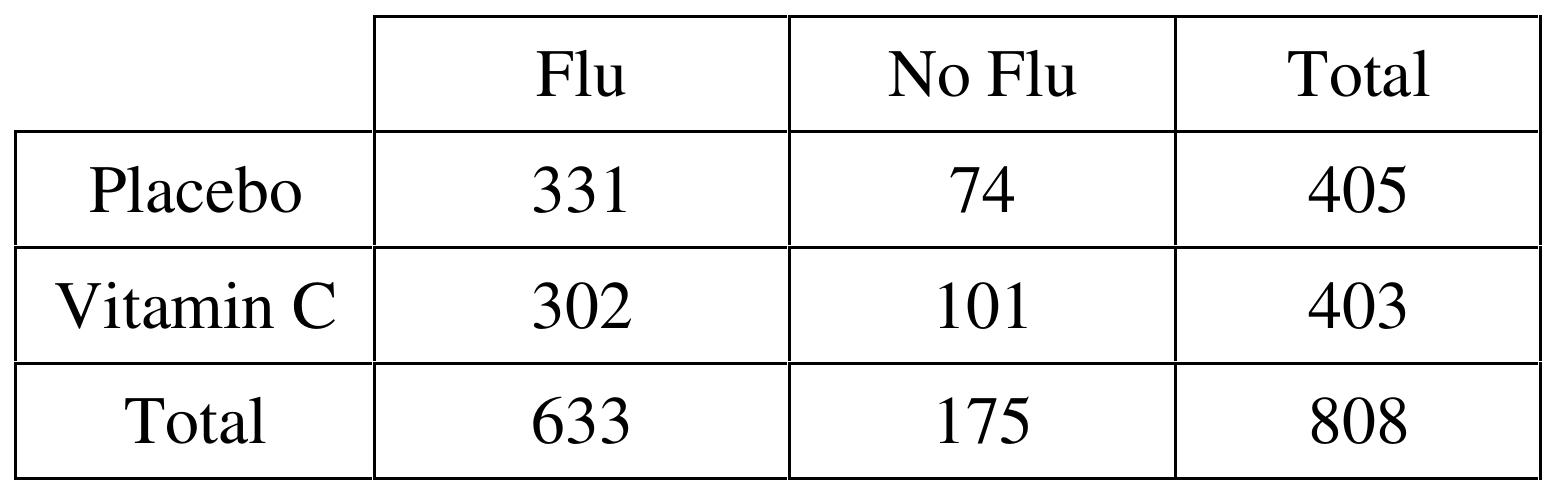
This study is an experiment, not an observational study.
In an experiment, the researchers deliberately impose a treatment on the subjects — here, the researchers assigned subjects to either the vitamin C group or the placebo group, rather than simply observing what subjects naturally chose to do.
Crucially, subjects were randomly assigned to the two treatment groups, which is the hallmark of a well-designed experiment and allows for causal conclusions to be drawn.
The use of a placebo and blind evaluation by a physician further strengthen this as a controlled experiment.
(b)
The health expert could use a two-proportion \(z\)-test to support this claim.
Let \(p_T\) be the true proportion of students (in the population of volunteers) who contract the flu when taking vitamin C, and let \(p_C\) be the true proportion who contract the flu when taking a placebo.
The hypotheses are:
\( H_0: p_T – p_C = 0 \quad \text{(vitamin C has no effect on flu occurrence)} \)
\( H_a: p_T – p_C < 0 \quad \text{(vitamin C reduces flu occurrence)} \)
Equivalently, this can be written as \(H_0: p_T = p_C\) versus \(H_a: p_T < p_C\), where a one-sided alternative is used because the claim is specifically that vitamin C reduces the occurrence of flu.