Home / AP® Exam / AP® Statistics / 5.3 The Central Limit Theorem- FRQs

AP Statistics 5.3 The Central Limit Theorem- FRQs - Exam Style Questions

Question

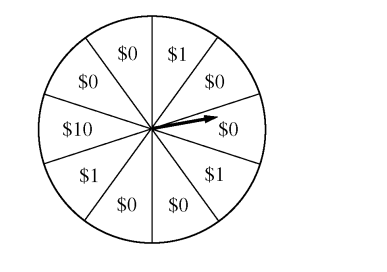
A charity fundraiser has a Spin the Pointer game that uses a spinner like the one illustrated in the figure below.
A donation of \( \$2 \) is required to play the game. For each \( \$2 \) donation, a player spins the pointer once and receives the amount of money indicated in the sector where the pointer lands on the wheel. The spinner has an equal probability of landing in each of the \( 10 \) sectors.
(a) Let \( X \) represent the net contribution to the charity when one person plays the game once. Complete the table for the probability distribution of \( X \).
\( x \)\( \$2 \)\( \$1 \)\( -\$8 \)
\( P(x) \)   
(b) What is the expected value of the net contribution to the charity for one play of the game?
(c) The charity would like to receive a net contribution of \( \$500 \) from this game. What is the fewest number of times the game must be played for the expected value of the net contribution to be at least \( \$500 \)?
(d) Based on last year’s event, the charity anticipates that the Spin the Pointer game will be played \( 1,000 \) times. The charity would like to know the probability of obtaining a net contribution of at least \( \$500 \) in \( 1,000 \) plays of the game. The mean and standard deviation of the net contribution to the charity in \( 1,000 \) plays of the game are \( \$700 \) and \( \$92.79 \), respectively. Use the normal distribution to approximate the probability that the charity would obtain a net contribution of at least \( \$500 \) in \( 1,000 \) plays of the game.

Most-appropriate topic codes (CED):

TOPIC 4.7: Introduction to Random Variables and Probability Distributions — part (a)
TOPIC 4.8: Mean and Standard Deviation of Random Variables — part (b)
TOPIC 4.8: Mean and Standard Deviation of Random Variables — part (c)
TOPIC 5.3: The Central Limit Theorem — part (d)
▶️ Answer/Explanation
Detailed solution

(a)
Counting the sectors: \( \$2 \) appears in \( 6 \) sectors, \( \$1 \) appears in \( 3 \) sectors, and \( -\$8 \) appears in \( 1 \) sector.
Thus: \( P(\$2) = \frac{6}{10} = 0.6 \), \( P(\$1) = \frac{3}{10} = 0.3 \), \( P(-\$8) = \frac{1}{10} = 0.1 \).
\[ \boxed{\begin{array}{|c|c|c|c|} \hline x & \$2 & \$1 & -\$8 \\ \hline P(x) & 0.6 & 0.3 & 0.1 \\ \hline \end{array}} \]

(b)
\[E(X) = \$2(0.6) + \$1(0.3) + (-\$8)(0.1) = \$1.20 + \$0.30 – \$0.80 = \$0.70\]
\(\boxed{\$0.70}\)

(c)
Let \( n \) be the number of plays. Expected contribution \( = 0.70n \).
Set \( 0.70n \geq 500 \) ⇒ \( n \geq \frac{500}{0.70} \approx 714.286 \).
The smallest integer greater than \( 714.286 \) is \( 715 \).
\(\boxed{715}\)

(d)
Let \( S \) be the total net contribution from \( 1,000 \) plays.
\( S \) is approximately normal with mean \( \mu = 700 \) and standard deviation \( \sigma = 92.79 \).
We want \( P(S \geq 500) \).
Compute \( z = \frac{500 – 700}{92.79} \approx -2.155 \).
\( P(S \geq 500) = P(Z \geq -2.155) = 1 – P(Z < -2.155) \approx 1 – 0.0156 = 0.9844 \).
\(\boxed{0.9844}\)

Scroll to Top