Home / AP® Exam / Pre AP Biology / Pre AP Biology

CELLS 1.1 Biomolecules- Pre AP Biology Study Notes - New Syllabus.

CELLS 1.1 Biomolecules- Pre AP Biology Study Notes

CELLS 1.1 Biomolecules- Pre AP Biology Study Notes – New Syllabus.

LEARNING OBJECTIVE

CELLS 1.1(a) Differentiate between the major macromolecules based on their structure and/or function.
CELLS 1.2(a) Explain the role macromolecules play in supporting cellular function.

Key Concepts: 

  • CELLS 1.1.1 The four classes of organic macromolecules are proteins, carbohydrates, lipids, and nucleic acids. Each class has unique chemical structures.
    a. These organic macromolecules are primarily made up of just a few elements—carbon, hydrogen, nitrogen, oxygen, sulfur, and phosphorus.
    b. Most macromolecules are polymers that are made up of specific, smaller subunits called monomers.

  • CELLS 1.2.1 Each class of macromolecule carries out specific functions in biological systems.
    a. Carbohydrates serve as the primary source of energy for organisms in the forms of glycogen and starch, and as structural support in plant cell walls in the form of cellulose.
    b. Lipids are used as a source of energy and as building blocks of biological membranes.
    c. Proteins are responsible for numerous cellular functions, such as catalyzing reactions, providing structure, and aiding in cell transport and signaling.
    d. Nucleic acids are responsible for storing and transferring genetic information in the form of DNA and RNA.

Pre AP Biology-Concise Summary Notes- All Topics

Differentiation of Major Macromolecules Based on Structure and Function

🌱 Introduction

Living cells are made up of four major classes of organic macromolecules.
Although all macromolecules are carbon-based, they differ clearly in their chemical structure and biological function.

📌 What Does “Differentiate” Mean in Biology?

To differentiate means to:

  • Compare structure
  • Compare monomers
  • Compare elements
  • Compare functions
  • Identify unique roles of each macromolecule

🧬 Overview of the Four Major Macromolecules

MacromoleculeBasic Role
CarbohydratesEnergy and structural support
LipidsEnergy storage and membranes
ProteinsCellular work and regulation
Nucleic acidsGenetic information

1. Carbohydrates

Structural Characteristics

  • Elements present: Carbon, Hydrogen, Oxygen
  • Hydrogen to oxygen ratio is usually 2:1
  • Built from repeating monosaccharides
  • Form long chains called polysaccharides

Examples of monomers:

  • Glucose
  • Fructose

Functional Characteristics

Carbohydrates mainly function as energy molecules.

Functions:

  • Immediate energy for cells (glucose)
  • Energy storage
  • Glycogen in animals
  • Starch in plants
  • Structural support
  • Cellulose in plant cell walls

Key point:
Carbohydrates provide short-term, quickly available energy.

2. Lipids

Structural Characteristics

  • Elements present: Carbon, Hydrogen, Oxygen
  • Contain much less oxygen than carbohydrates
  • Not true polymers
  • Composed of fatty acids and glycerol
  • Hydrophobic (do not dissolve in water)

📌 Examples:

  • Fats
  • Oils
  • Phospholipids
  • Steroids

⚙️ Functional Characteristics

Lipids perform long-term energy storage and structural roles.

Functions:

  • Store large amounts of energy
  • Form cell membranes (phospholipid bilayer)
  • Provide insulation and protection
  • Act as hormones (steroids)

Key point:
Lipids store more energy per gram than carbohydrates.

3. Proteins

Structural Characteristics

  • Elements present: Carbon, Hydrogen, Oxygen, Nitrogen
  • Sometimes contain Sulfur
  • Built from amino acid monomers
  • Amino acids are linked by peptide bonds
  • Fold into complex 3-dimensional shapes

Important:
Protein structure determines protein function.

⚙️ Functional Characteristics

Proteins are responsible for most activities within the cell.

Functions:

  • Enzymes speed up chemical reactions
  • Structural proteins provide support
  • Transport proteins move substances
  • Signaling proteins enable communication
  • Defense proteins protect against pathogens

Key point:
Proteins are the working molecules of the cell.

4. Nucleic Acids

Structural Characteristics

  • Elements present: Carbon, Hydrogen, Oxygen, Nitrogen, Phosphorus
  • Built from nucleotide monomers
  • Each nucleotide has:
  • Sugar
  • Phosphate group
  • Nitrogenous base

Types:

  • DNA
  • RNA

⚙️ Functional Characteristics

Nucleic acids handle genetic information.

Functions:

  • DNA stores hereditary information
  • RNA transfers genetic instructions and helps make proteins

Key point:
Without nucleic acids, cells cannot control or reproduce.

📊 Comparison Table: Structure and Function

FeatureCarbohydratesLipidsProteinsNucleic Acids
Main elementsC, H, OC, H, OC, H, O, N (S)C, H, O, N, P
MonomerMonosaccharideNone (fatty acids)Amino acidNucleotide
PolymerPolysaccharideNot true polymersPolypeptidePolynucleotide
Main functionQuick energy, structureLong-term energy, membranesEnzymes, cell functionsGenetic information
ExampleGlucosePhospholipidEnzymeDNA

🧠 How They Differ Clearly

  • Carbohydrates focus on energy and structure
  • Lipids focus on energy storage and membranes
  • Proteins focus on cellular processes
  • Nucleic acids focus on information storage
  • Each macromolecule has a unique structure that matches its function

📦 Quick Recap
All macromolecules are carbon-based
Carbohydrates provide quick energy and support
Lipids store energy and form membranes
Proteins perform most cellular tasks
Nucleic acids store and transmit genetic information
Structure determines function in all macromolecules

Role of Macromolecules in Supporting Cellular Function

🌱 Introduction

Cells are the basic units of life, but they cannot survive or function on their own without macromolecules.
Each class of macromolecule performs specific roles that allow cells to obtain energy, maintain structure, regulate processes, and store information.
Macromolecules work together to support all cellular functions essential for life.

📌 What Does “Supporting Cellular Function” Mean?

Supporting cellular function includes:

  • Supplying energy
  • Maintaining cell structure
  • Regulating chemical reactions
  • Enabling communication
  • Storing and using genetic information

Without macromolecules, cells cannot:

  • Grow
  • Repair
  • Reproduce
  • Respond to their environment

🧬 Role of Each Macromolecule in Cells

1. Carbohydrates and Cellular Function

Energy Supply
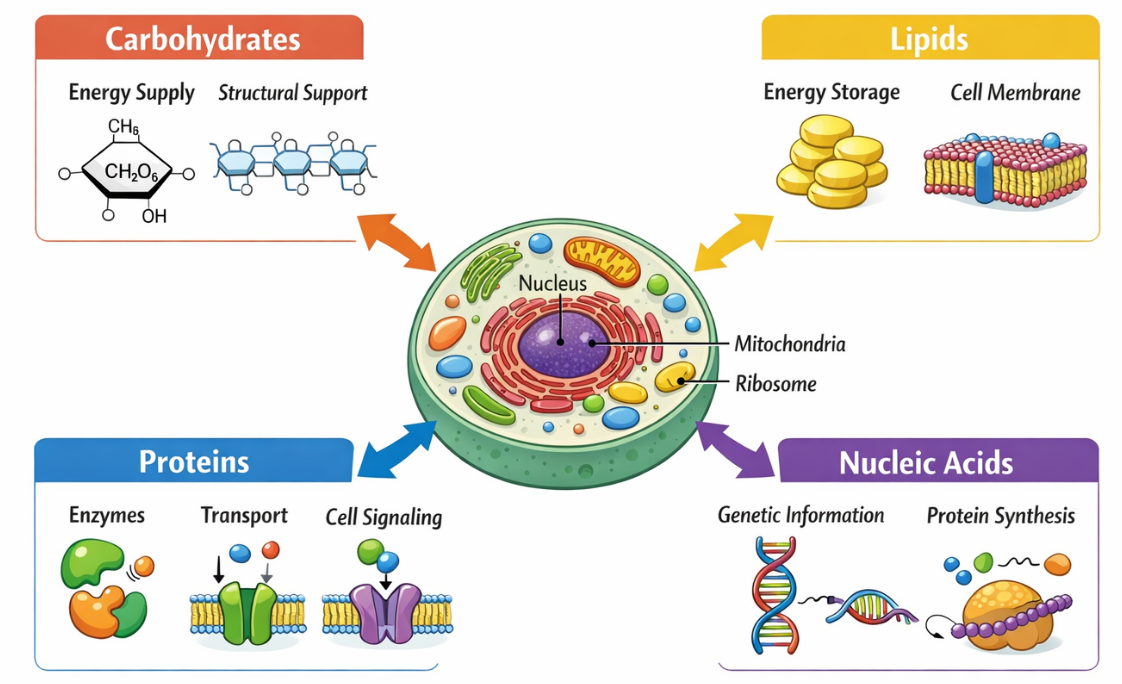
Carbohydrates are the primary and immediate energy source for cells.

  • Glucose is broken down during cellular respiration
  • Releases energy needed for:
  • Active transport
  • Cell division
  • Biosynthesis

Key point:
Cells rely on carbohydrates for quick and efficient energy.

Structural Support

Some carbohydrates provide physical support to cells.

  • Cellulose forms plant cell walls
  • Maintains cell shape
  • Prevents cell bursting

This structural role is essential for plant cell stability.

2. Lipids and Cellular Function

Long-Term Energy Storage

Lipids store large amounts of energy.

  • Used when carbohydrate reserves are low
  • Provide sustained energy for cells

Important note:
Lipids yield more energy per gram than carbohydrates.

Cell Membrane Formation

Lipids are critical for forming biological membranes.

  • Phospholipids form the cell membrane
  • Create a selectively permeable barrier
  • Control movement of substances in and out of the cell

Without lipids, cells cannot maintain internal balance.

Protection and Insulation

Lipids also:

  • Protect organs
  • Insulate cells
  • Maintain temperature stability

3. Proteins and Cellular Function

Proteins are the most diverse and functionally important macromolecules in cells.

Enzymes (Catalysis)

  • Enzymes are proteins
  • Speed up chemical reactions
  • Make metabolism efficient

Key idea:
Without enzymes, reactions would be too slow to sustain life.

Structural Support

Proteins help maintain cell shape and structure.

  • Form cytoskeleton components
  • Strengthen tissues

Transport

Proteins move substances:

  • Across membranes
  • Within cells

Examples:

  • Channel proteins
  • Carrier proteins

Cell Signaling and Communication

Proteins act as:

  • Receptors
  • Signaling molecules

Allow cells to:

  • Detect signals
  • Respond to their environment

Defense

Some proteins:

  • Recognize pathogens
  • Protect cells from infection

4. Nucleic Acids and Cellular Function

Genetic Information Storage

Nucleic acids control cell identity and activity.

  • DNA stores genetic instructions
  • Determines cell structure and function

Protein Synthesis

Nucleic acids guide protein production.

  • RNA carries instructions from DNA
  • Ensures correct proteins are made

Key point:
Without nucleic acids, cells cannot:

  • Make proteins
  • Divide
  • Pass on traits

🔄 How Macromolecules Work Together in Cells

Macromolecules do not act alone.

Example of coordination:

  • DNA stores instructions
  • RNA transfers information
  • Proteins perform the function
  • Carbohydrates and lipids supply energy

Cellular function depends on integration of all macromolecules.

📊 Summary Table: Macromolecules and Cellular Roles

MacromoleculeRole in Cellular Function
CarbohydratesImmediate energy, structure
LipidsLong-term energy, membranes
ProteinsEnzymes, transport, signaling
Nucleic acidsGenetic control, protein synthesis

🧠 Key Statements

  • Each macromolecule has a specific cellular role
  • Structure determines function
  • Cells require all four macromolecules to survive

📦 Quick Recap 
Carbohydrates supply quick energy and support
Lipids store energy and form membranes
Proteins control and regulate cellular activities
Nucleic acids store and use genetic information
All macromolecules work together to sustain life

Scroll to Top