
Role of ATP in Supporting Processes in Biological Systems
🌱 Introduction
All biological systems need a constant supply of energy to survive and function.
Cells cannot use energy directly from food molecules. Instead, energy from food is first converted into a usable form.
That usable form of energy is ATP (Adenosine Triphosphate).
ATP acts as the immediate energy source that powers nearly all cellular activities.
📌 What Is ATP?
ATP is a high-energy organic molecule present in all living cells.
Basic structure of ATP:
- Adenine (nitrogenous base)
- Ribose (5-carbon sugar)
- Three phosphate groups
📌 Important point:
The energy of ATP is stored in the bonds between the phosphate groups, especially the bond between the second and third phosphate.
🔋 Why ATP Is Called the “Energy Currency” of the Cell
ATP is called the energy currency because:
- It stores energy temporarily
- It transfers energy to where it is needed
- It releases energy quickly
- It can be recycled repeatedly
Just like money is exchanged to get work done, ATP is exchanged to get cellular work done.
🔄 How ATP Releases Energy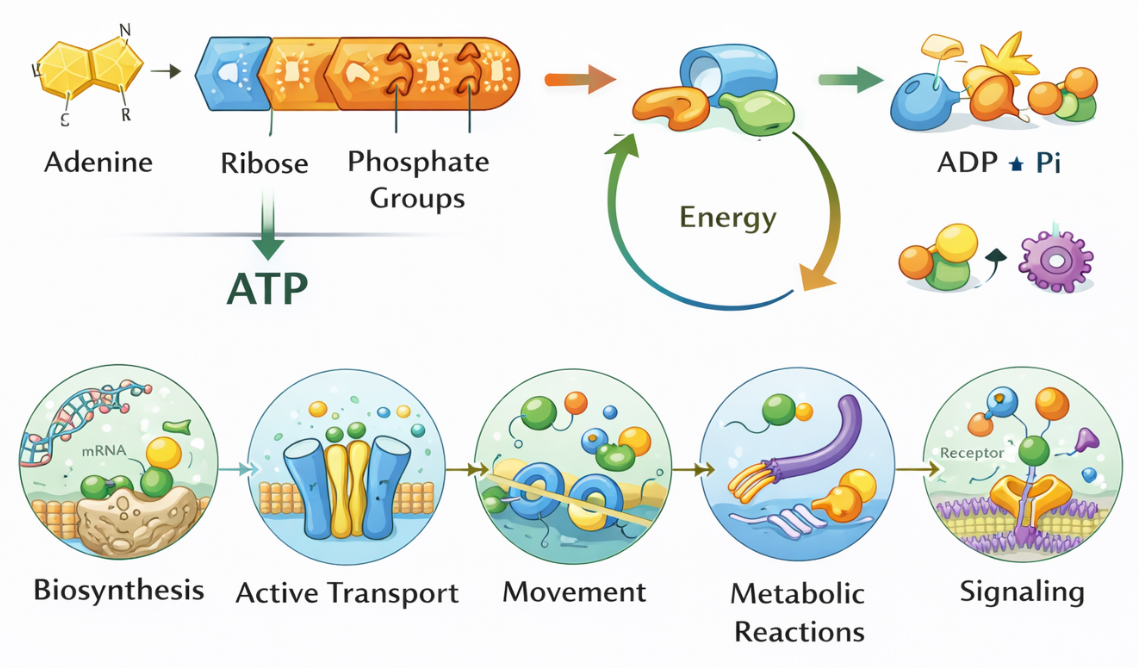
ATP releases energy when its terminal phosphate bond is broken.
ATP → ADP + Pi + energy
Where:
- ADP = Adenosine diphosphate
- Pi = Inorganic phosphate
This reaction releases energy that is immediately used by the cell.
Important note:
- ATP is not stored in large amounts
- It is constantly made and used inside cells
⚙️ Role of ATP in Supporting Cellular Processes
ATP supports all major cellular functions by coupling energy-releasing reactions with energy-requiring processes.
1. ATP and Biosynthesis
Cells constantly build complex molecules.
ATP provides energy for:
- Protein synthesis
- DNA replication
- RNA synthesis
- Formation of carbohydrates and lipids
Key point:
Without ATP, cells cannot build or repair structures.
2. ATP and Active Transport
Many substances move against their concentration gradient, which requires energy.
ATP powers:
- Ion pumps
- Membrane transport proteins
- Maintenance of internal cell conditions
Example idea:
Maintaining different ion concentrations inside and outside the cell.
3. ATP and Cellular Movement
ATP supplies energy for movement at the cellular and organism level.
ATP is required for:
- Muscle contraction
- Beating of cilia
- Movement of flagella
- Vesicle transport inside cells
Important:
Movement stops immediately when ATP is unavailable.
4. ATP and Metabolic Reactions
ATP activates molecules to make reactions occur faster.
Roles include:
- Activating enzymes
- Driving endergonic reactions
- Regulating metabolic pathways
ATP ensures that cellular metabolism proceeds efficiently.
5. ATP and Cell Signaling
ATP supports:
- Signal transduction pathways
- Phosphorylation of proteins
- Cellular responses to stimuli
Key point:
ATP allows cells to sense and respond to their environment.
🧠 ATP as a Coupling Molecule
Many cellular reactions are energy-requiring.
ATP works by:
- Releasing energy from its phosphate bond
- Transferring a phosphate group to another molecule
This process is called energy coupling.
ATP couples exergonic reactions with endergonic cellular processes.
🔁 ATP Recycling in Cells
ATP is continuously regenerated.
- ADP is converted back to ATP
- Energy comes from breakdown of macromolecules
- This maintains a steady ATP supply
Key point:
Cells depend on continuous ATP regeneration, not storage.
🧪 Importance of ATP in Biological Systems
ATP is essential because:
- It works in all types of cells
- It functions under normal cellular conditions
- It delivers energy in small, controlled amounts
- It supports both simple and complex life forms
Without ATP, biological systems cannot function.
📊 Summary Table: Role of ATP
| Cellular Process | Role of ATP |
|---|---|
| Biosynthesis | Provides energy to build molecules |
| Active transport | Moves substances across membranes |
| Movement | Powers muscle and cellular motion |
| Metabolism | Drives chemical reactions |
| Signaling | Enables cell communication |
🧠 Key Statements
- ATP is the immediate energy source for cells
- Energy is released when ATP loses a phosphate group
- ATP supports biosynthesis, transport, movement, and regulation
- ATP is constantly recycled in cells
📦 Quick Recap
ATP is the energy currency of the cell
Energy is stored in phosphate bonds
ATP releases energy by converting to ADP
ATP powers biosynthesis and transport
ATP supports movement and signaling
ATP links energy release to cellular work
Continuous ATP supply is essential for life
Why Different Species Demonstrate Diverse Energy and Nutrient Requirements
🌱 Introduction
Not all organisms need the same amount or type of energy and nutrients.
A bacterium, a plant, a bird, and a human all survive on very different energy budgets.
Differences in energy and nutrient requirements among species arise from variations in metabolism, body structure, activity level, and ecological role.
📌 What Are Energy and Nutrient Requirements?
Energy requirement → amount of ATP an organism needs to survive and function
Nutrient requirement → types of molecules an organism must obtain to make ATP and build tissues
These requirements are shaped by how an organism lives and interacts with its environment.
🧬 Reasons for Diversity in Energy and Nutrient Requirements
1. Differences in Metabolic Rate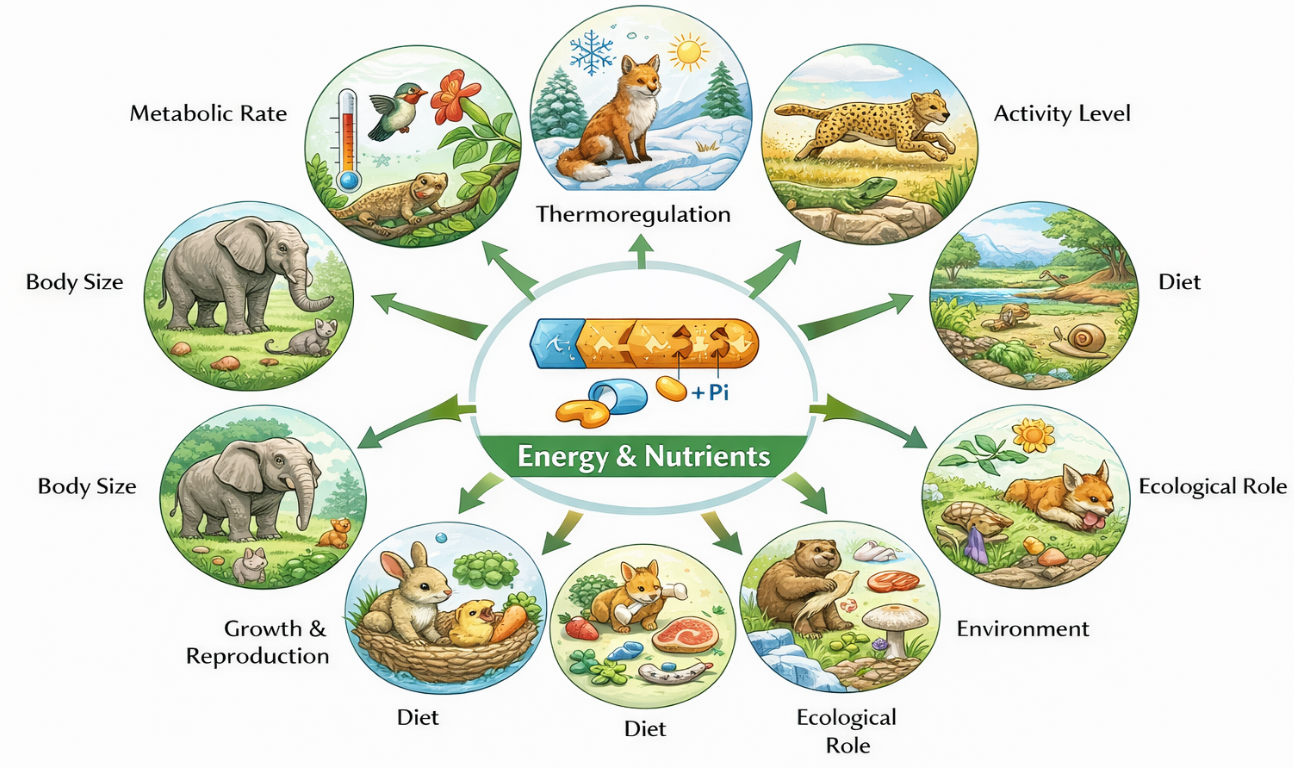
Metabolic rate is the speed at which organisms convert energy from nutrients into ATP.
High metabolic rate:
- Faster chemical reactions
- Greater ATP demand
- Higher energy intake required
Low metabolic rate:
- Slower reactions
- Lower ATP demand
📌 Example idea:
Birds have higher metabolic rates than reptiles.
2. Thermoregulation Strategy
Organisms differ in how they regulate body temperature.
Endotherms:
- Maintain constant body temperature
- Use energy to generate heat
- Require more energy-rich food
Ectotherms:
- Rely on environmental heat
- Use less energy internally
- Lower energy requirements
This explains why mammals need more calories than reptiles of similar size.
3. Activity Level and Lifestyle
Energy needs increase with physical activity.
Highly active species:
- Require more ATP
- Need frequent energy intake
Less active species:
- Lower ATP demand
📌 Example idea:
Predatory birds require more energy than sedentary organisms.
4. Body Size and Structure
Body size affects total energy needs.
Larger organisms:
- Higher total energy demand
- More cells to maintain
Smaller organisms:
- Higher energy use per unit mass
- Faster metabolism
📌 Important point:
Energy requirement depends on both size and metabolic efficiency.
5. Nutritional Strategy and Diet
Different species obtain energy from different nutrient sources.
Autotrophs:
- Use light or chemical energy
- Build organic molecules themselves
Heterotrophs:
- Consume organic molecules
- Depend on diet composition
📌 Dietary differences:
- Herbivores → carbohydrates
- Carnivores → proteins and lipids
- Omnivores → mixed nutrients
This leads to different nutrient requirements.
6. Ecological Role in the Ecosystem
An organism’s role determines how it obtains and uses energy.
| Role | Energy Source |
|---|---|
| Producers | Sunlight or chemicals |
| Primary consumers | Plant material |
| Secondary consumers | Other animals |
| Decomposers | Dead organic matter |
Each role requires different nutrients and energy intake.
7. Growth, Development, and Reproduction
Life stage also affects energy needs.
- Growing organisms need more energy
- Reproduction requires additional nutrients
- Developmental stages have different demands
Energy needs are not constant throughout life.
8. Environmental Conditions
Habitat influences energy requirements.
- Cold environments increase energy demand
- Resource-poor environments limit intake
- Extreme conditions require adaptations
Species evolve energy strategies suited to their environment.
📊 Summary Table: Factors Affecting Energy and Nutrient Requirements
| Factor | Effect on Requirements |
|---|---|
| Metabolic rate | Determines ATP demand |
| Thermoregulation | Affects energy use |
| Activity level | Increases ATP need |
| Body size | Influences total energy |
| Diet type | Determines nutrient intake |
| Ecological role | Shapes energy strategy |
| Life stage | Alters energy demand |
| Environment | Modifies requirements |
📦 Quick Recap
Energy needs vary among species
Metabolism and activity affect ATP demand
Endotherms require more energy
Body size influences energy use
Diet determines nutrient requirements
Ecological role shapes energy strategy
Environment and life stage affect needs
Using Data to Predict Energy Requirements of Diverse Species
🌱 Introduction
Different species need different amounts of energy because their bodies and lifestyles are different.
If you can read data (mass, metabolic rate, activity, temperature, diet), you can predict which species needs more energy and why.
📌 What “Energy Requirement” Means Here
Energy requirement means the amount of energy (ATP/calories) an organism must obtain per day to:
- Maintain life processes (basal needs)
- Move, hunt, grow, reproduce
- Maintain temperature (in some species)
📊 Types of Data You May Be Given
Common data in questions:
- Body mass (kg or g)
- Metabolic rate (oxygen consumption, CO₂ release, heat production)
- Activity level (resting vs active)
- Thermoregulation (endotherm vs ectotherm)
- Environment (cold vs warm)
- Diet composition (carb vs lipid rich)
- Population and growth stage (juvenile vs adult)
📌 Use these clues to predict higher or lower energy demand.
🧠 Step-by-Step Method to Predict Energy Requirements
Step 1: Identify the variables given
Example: Species A and B with body mass and oxygen consumption.
Step 2: Link the variable to energy use
- Oxygen consumption is linked to cellular respiration
- Higher oxygen use = higher ATP production = higher energy need
Step 3: Compare species using rules
Use the prediction rules below.
Step 4: Write conclusion with reason
Not just “A needs more energy”.
Write “A needs more energy because its metabolic rate is higher based on data.”
🔥 Prediction Rules You Must Apply
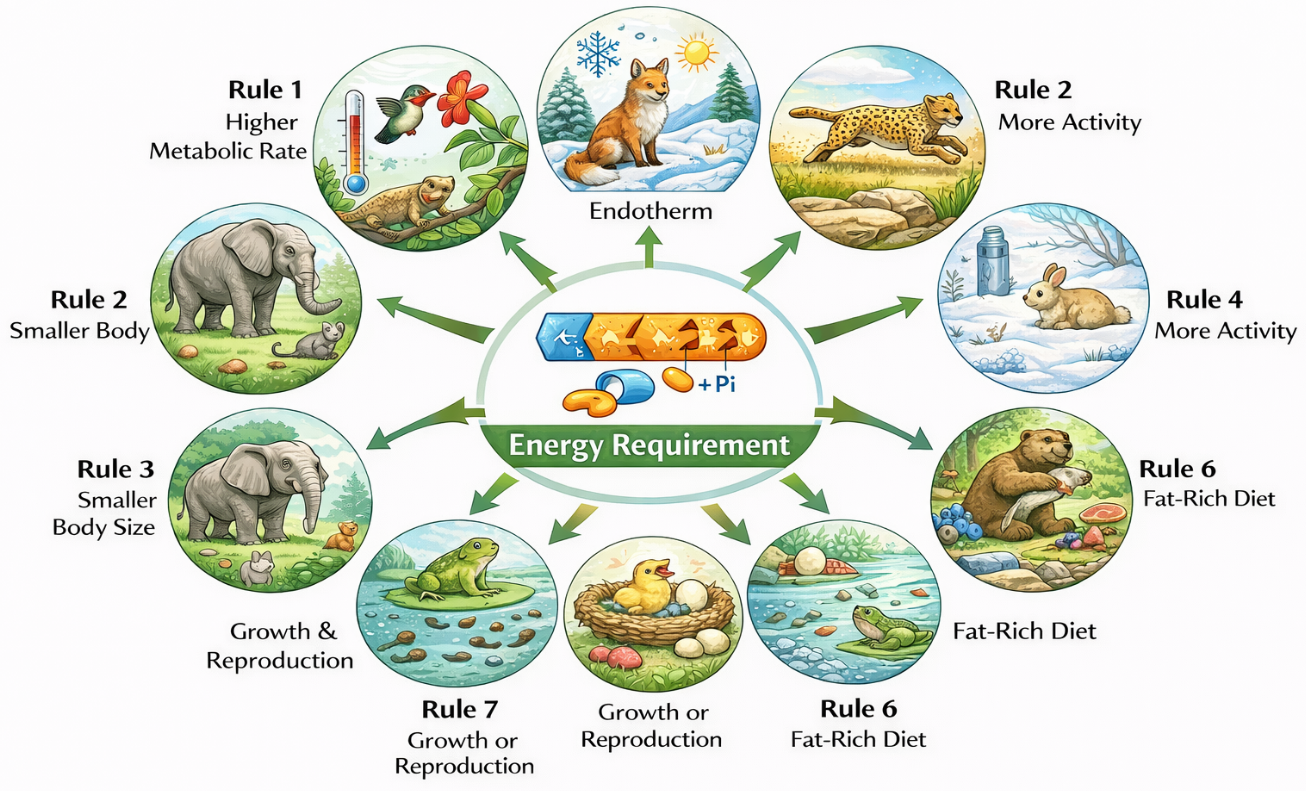
Rule 1: Higher Metabolic Rate = Higher Energy Requirement
Metabolic rate data may be shown as:
- Oxygen consumption (mL O₂/hour)
- CO₂ production
- Heat production
- ATP turnover rate
If Species A has higher O₂ consumption than Species B
Species A needs more energy.
Rule 2: Smaller Animals Use More Energy Per Gram
- Small animals lose heat quickly
- Faster metabolism
- High respiration rate
Data clue:
If two species are compared per kg or per g, the smaller one often shows higher values.
Rule 3: Endotherms Need More Energy Than Ectotherms
Endotherms (birds, mammals):
- Produce heat internally
- High metabolic rate
- High energy intake
Ectotherms (fish, reptiles, amphibians):
- Depend on environment for heat
- Lower metabolic rate
- Lower energy intake
If the question compares a bird and a lizard of similar mass
Bird needs more energy.
Rule 4: More Activity = More Energy Requirement
If the data includes:
- Distance travelled
- Time spent hunting/flying
- Movement level
More activity means:
- More ATP needed for muscle contraction
- More respiration
Active predator > slow sedentary organism
Rule 5: Colder Environment Increases Energy Demand
- Endotherms burn more fuel to stay warm
- Even ectotherms may need more energy if they remain active
If data shows the same species in winter vs summer
Winter energy requirement is higher.
Rule 6: Diet Composition Affects Energy Gained
Energy from macromolecules differs:
- Lipids provide the most energy
- Carbohydrates provide quick but less energy
- Proteins are not preferred as main fuel
If a species eats a fat-rich diet, it can meet energy needs with less food mass.
Rule 7: Growth and Reproduction Increase Energy Need
Juveniles and reproducing individuals require extra energy for:
- Building tissues
- Producing gametes
- Pregnancy or egg-laying
If data includes age or reproductive status
Growing or reproducing organism needs more energy.
🧪 Common Data Formats and How to Use Them
1. Oxygen Consumption Data
Example table format:
| Species | O₂ consumption (mL O₂/hour) |
|---|---|
| A | 60 |
| B | 20 |
Prediction:
- Species A needs more energy because it has higher oxygen use
- Higher cellular respiration = more ATP demand
2. Heat Production Data
Heat production reflects metabolic activity.
Higher heat output = higher energy usage.
3. Food Intake Data
- If species eats more grams of food per day:
- Higher energy demand
- Or lower energy content of food
Always check if diet differs.
📊 Mini Practice Comparison Table
| Feature/Data | Species A | Species B | Who Needs More Energy? |
|---|---|---|---|
| Body mass | Smaller | Larger | A (per gram) |
| Thermoregulation | Endotherm | Ectotherm | A |
| Activity | High | Low | A |
| O₂ consumption | Higher | Lower | A |
| Environment | Colder | Warmer | A |
Conclusion pattern:
Species A requires more energy because its metabolic rate is higher due to endothermy, activity level, and higher oxygen consumption.
📊 Summary Table: Data Clue → Prediction
| Data Clue Seen | What It Suggests |
|---|---|
| Higher O₂ consumption | Higher energy requirement |
| Higher CO₂ production | Higher energy requirement |
| Higher heat output | Higher metabolic rate |
| Endotherm | Higher energy need |
| Smaller size (per gram) | Higher energy use |
| Higher activity | Higher energy need |
| Colder habitat | Higher energy need |
| Growth/reproduction stage | Higher energy need |
📦 Quick Recap
Use data like O₂ consumption, heat output, activity, body mass
Higher metabolic rate = higher energy requirement
Endotherms need more energy than ectotherms
Smaller animals often need more energy per gram
Cold environments and high activity raise energy needs
Growth and reproduction increase energy demand
Always support prediction using evidence from data