
Evidence That All Biological Systems Demonstrate Shared Characteristics
🌱 Introduction
Biological systems on Earth show huge diversity.
Some organisms are unicellular, while others are multicellular and highly complex.
Despite these differences, all biological systems share fundamental characteristics at the cellular level.
All living systems are made of cells that share common structural and functional features, providing evidence of shared characteristics and common origin.
📌 What Are “Shared Characteristics” in Biology?
Shared characteristics are features found in all living organisms, regardless of size, habitat, or complexity.
These similarities show that:
- Life follows common biological principles
- Organisms are related through evolution
- Cells operate using similar mechanisms
🧬 The Cell as the Basic Unit of Life
Meaning of “Basic Unit of Biological Systems”
A cell is the smallest unit capable of performing all life processes, such as:
- Metabolism
- Growth
- Response to stimuli
- Reproduction
Since all biological systems are composed of cells, shared cellular features = shared biological characteristics.
🧪 Evidence That All Biological Systems Share Characteristics
1. Presence of a Plasma Membrane in All Cells
All cells are surrounded by a plasma (cell) membrane.
Structural evidence: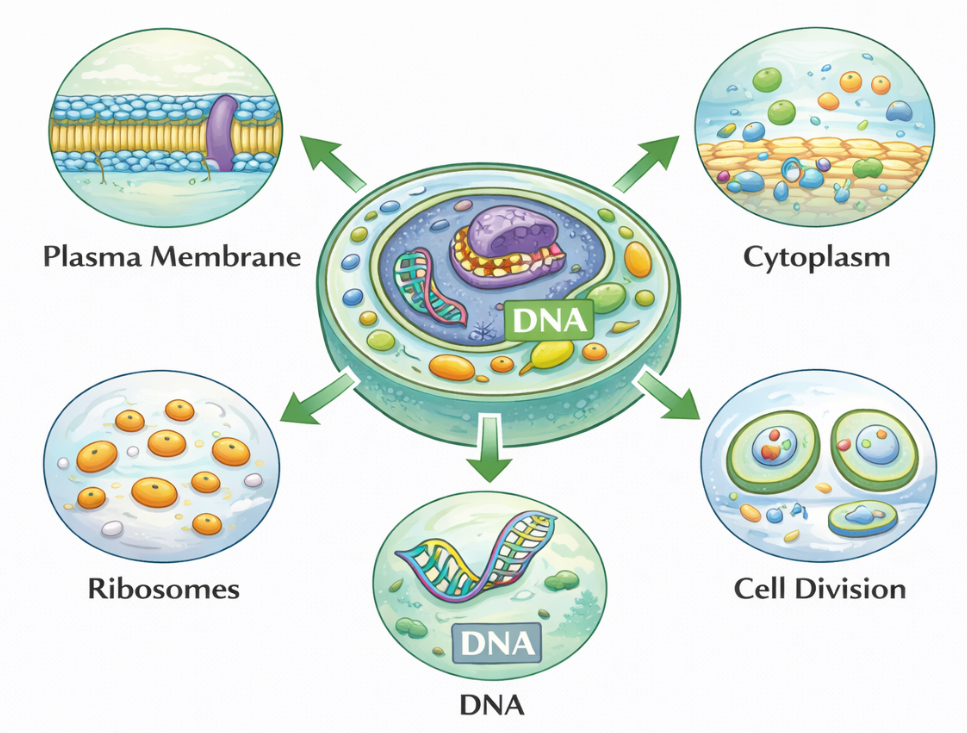
- Composed mainly of lipids and proteins
- Flexible and selectively permeable
Functional evidence:
- Regulates movement of substances into and out of the cell
- Maintains internal balance (homeostasis)
Why this supports the claim:
From bacteria to plant and animal cells, every biological system relies on a plasma membrane to survive, showing a shared structural feature.
2. Cytoplasm Is Present in All Cells
Cytoplasm is the semi-fluid internal environment of the cell.
Functional evidence:
- Contains enzymes and molecules needed for metabolism
- Site of many biochemical reactions
Why this supports the claim:
All biological systems perform metabolic reactions in cytoplasm, proving a shared functional environment across all life forms.
3. Ribosomes Are Found in All Cells
Ribosomes are small molecular structures made of RNA and proteins.
Functional evidence:
- Ribosomes synthesize proteins
- Proteins are essential for structure, enzymes, and regulation
Why this supports the claim:
Because all cells need proteins, ribosomes are universal, showing a shared mechanism for protein production.
4. Genetic Material Is Present in All Cells
All cells contain genetic material (DNA) that stores information.
Structural evidence:
- Prokaryotes: DNA is found in cytoplasm
- Eukaryotes: DNA is enclosed in a nucleus
Functional evidence:
- Controls cell activities
- Directs protein synthesis
- Passed from parent cell to daughter cells
Why this supports the claim:
The use of DNA as genetic material across all biological systems shows a shared informational system.
5. All Cells Arise from Preexisting Cells
New cells are produced by division of existing cells.
Evidence:
- Cell division observed in prokaryotes and eukaryotes
- No evidence of spontaneous cell formation
Why this supports the claim:
All biological systems follow the same rule of reproduction, supporting shared origin and continuity of life.
🧠 Connection to Cell Theory
These shared characteristics support cell theory, which states:
- All living organisms are made of cells
- The cell is the basic unit of life
- All cells arise from preexisting cells
This theory applies universally, reinforcing the idea of shared biological characteristics.
🧬 Structural and Functional Similarities as Evidence
| Shared Feature | Structural Evidence | Functional Evidence |
|---|---|---|
| Plasma membrane | Present in all cells | Regulates exchange |
| Cytoplasm | Found in all cells | Metabolic reactions |
| Ribosomes | Universal structures | Protein synthesis |
| DNA | Same genetic molecule | Information storage |
| Cell division | Occurs in all life | Continuity of life |
🧠 Why This Evidence Is Strong
- Observed across all domains of life
- Applies to unicellular and multicellular organisms
- Supported by microscopy and molecular studies
These similarities cannot be explained by chance, but by shared biological principles and evolutionary history.
📦 Quick Recap
All biological systems are made of cells
All cells have a plasma membrane
Cytoplasm is present in all cells
Ribosomes synthesize proteins in all cells
DNA stores genetic information in all cells
All cells come from preexisting cells
These shared features support cell theory
Using Models to Compare and Contrast Cell Structures of Different Cells
🌱 Introduction
Cells are the basic structural and functional units of life, but not all cells are the same.
Different types of cells have different structures depending on what functions they perform.
📌 What Does “Using Models” Mean Here?
A model is a simplified representation used to:
- Show cell structures clearly
- Compare similarities and differences
- Explain how structure supports function
Common models used:
- Labeled diagrams
- Comparison tables
- Structural grouping charts
🧬 Types of Cells Commonly Compared
- Prokaryotic cells
- Eukaryotic cells
- Plant cells
- Animal cells
1. Prokaryotic vs Eukaryotic Cells 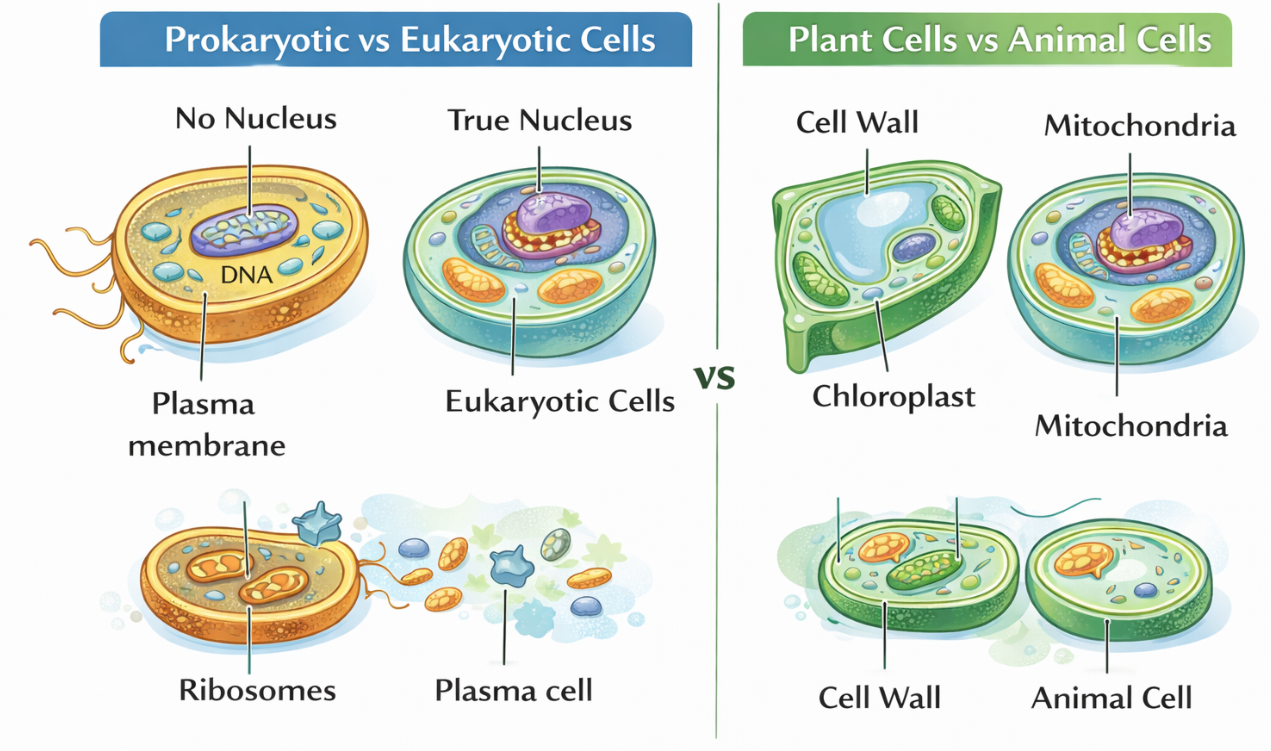
Prokaryotic Cells
Examples: bacteria
Structural features:
- No nucleus
- DNA is free in cytoplasm
- No membrane-bound organelles
- Smaller and simpler
Structures present:
- Plasma membrane
- Cytoplasm
- Ribosomes
- Genetic material (DNA)
- Cell wall (most)
Eukaryotic Cells
Examples: plant and animal cells
Structural features:
- True nucleus present
- DNA enclosed in nucleus
- Membrane-bound organelles present
- Larger and more complex
📊 Model 1: Prokaryotic vs Eukaryotic Cells
| Feature | Prokaryotic Cell | Eukaryotic Cell |
|---|---|---|
| Nucleus | Absent | Present |
| DNA location | Cytoplasm | Nucleus |
| Organelles | Absent | Present |
| Cell size | Smaller | Larger |
| Ribosomes | Present | Present |
| Plasma membrane | Present | Present |
Conclusion:
Both cell types share basic features, but eukaryotic cells are more structurally complex.
2. Plant Cells vs Animal Cells
Both are eukaryotic, but they differ due to their roles.
Plant Cells
Unique structures:
- Cell wall (cellulose)
- Chloroplasts
- Large central vacuole
Functional significance:
- Cell wall provides rigidity
- Chloroplasts perform photosynthesis
- Vacuole maintains turgor pressure
Animal Cells
Unique structures:
- No cell wall
- No chloroplasts
- Smaller vacuoles (if present)
- More varied shapes
Functional significance:
- Flexibility allows movement
- Specialized for diverse functions
📊 Model 2: Plant vs Animal Cells
| Feature | Plant Cell | Animal Cell |
|---|---|---|
| Cell wall | Present | Absent |
| Chloroplasts | Present | Absent |
| Vacuole | Large central | Small or absent |
| Shape | More regular | More variable |
| Mitochondria | Present | Present |
| Nucleus | Present | Present |
Conclusion:
Structural differences reflect autotrophic vs heterotrophic lifestyles.
3. Comparing Cell Structures by Functional Categories
Energy Transfer Structures
| Structure | Cell Type | Function |
|---|---|---|
| Mitochondria | Plant & animal | ATP production |
| Chloroplasts | Plant only | Photosynthesis |
Plants have both because they make and use energy.
Protein Production Structures
| Structure | Cell Type | Function |
|---|---|---|
| Ribosomes | All cells | Protein synthesis |
| Rough ER | Eukaryotes | Protein processing |
| Golgi apparatus | Eukaryotes | Protein packaging |
Prokaryotes rely only on ribosomes.
Storage and Recycling Structures
| Structure | Cell Type | Function |
|---|---|---|
| Vacuole | Mostly plants | Storage |
| Lysosome | Mostly animals | Waste breakdown |
| Vesicles | Eukaryotes | Transport |
Support and Movement Structures
| Structure | Cell Type | Function |
|---|---|---|
| Cell wall | Plants, bacteria | Support |
| Cytoskeleton | Eukaryotes | Shape, transport |
| Flagella | Some cells | Movement |
📦 Quick Recap
Models simplify complex cell structures
Prokaryotic cells lack nucleus and organelles
Eukaryotic cells contain membrane-bound organelles
Plant cells have cell walls and chloroplasts
Animal cells lack cell walls and chloroplasts
Structure differences relate directly to function
Tables and diagrams are effective comparison models