Home / AP® Exam / Pre AP Biology / Pre AP Biology

CELLS 2.3 Specialized Cells- Pre AP Biology Study Notes - New Syllabus.

CELLS 2.3 Specialized Cells- Pre AP Biology Study Notes

CELLS 2.3 Specialized Cells- Pre AP Biology Study Notes – New Syllabus.

LEARNING OBJECTIVE

CELLS 2.3(a) Explain how cell structures in different types of organisms enable specialized cell functions.
CELLS 2.3(b) Describe how cell structures support an organism’s ecological role.

Key Concepts: 

  • CELLS 2.3.1 Multicellular organisms have specialized cells that perform a wide variety of functions.
    a. During development, cells become specialized and develop into higher-order systems (i.e., tissues, organs).
    b. Specialized cells perform a wide variety of unique functions for organisms (e.g., muscle cells, red blood cells).

  • CELLS 2.3.2 Cell structures can differ across organisms and often give insight into an organism’s ecological role.
    a. Prokaryotes lack a nucleus and membrane-bound organelles, whereas eukaryotes possess a nucleus and complex, membrane-bound organelles.
    b. Within the Eukarya domain, cellular structures and functions differ among organisms.
    1. Plant cells have large, central vacuoles and chloroplasts that enable photosynthesis.
    2. Some cells have rigid cell walls (e.g., fungi, plants).

Pre AP Biology-Concise Summary Notes- All Topics

How Cell Structures in Different Types of Organisms Enable Specialized Cell Functions

🌱 Introduction

In living organisms, cells are not all identical.
As organisms become more complex, their cells become specialized, meaning each type of cell has a specific structure designed for a specific function.
Differences in cell structures allow cells in different organisms to carry out specialized functions efficiently.

📌 What Is Cell Specialization?

Cell specialization (or differentiation) is the process by which cells:

  • Develop unique structures
  • Perform specific functions
  • Contribute to the survival of the organism

In multicellular organisms, specialized cells work together to form:
tissues → organs → organ systems
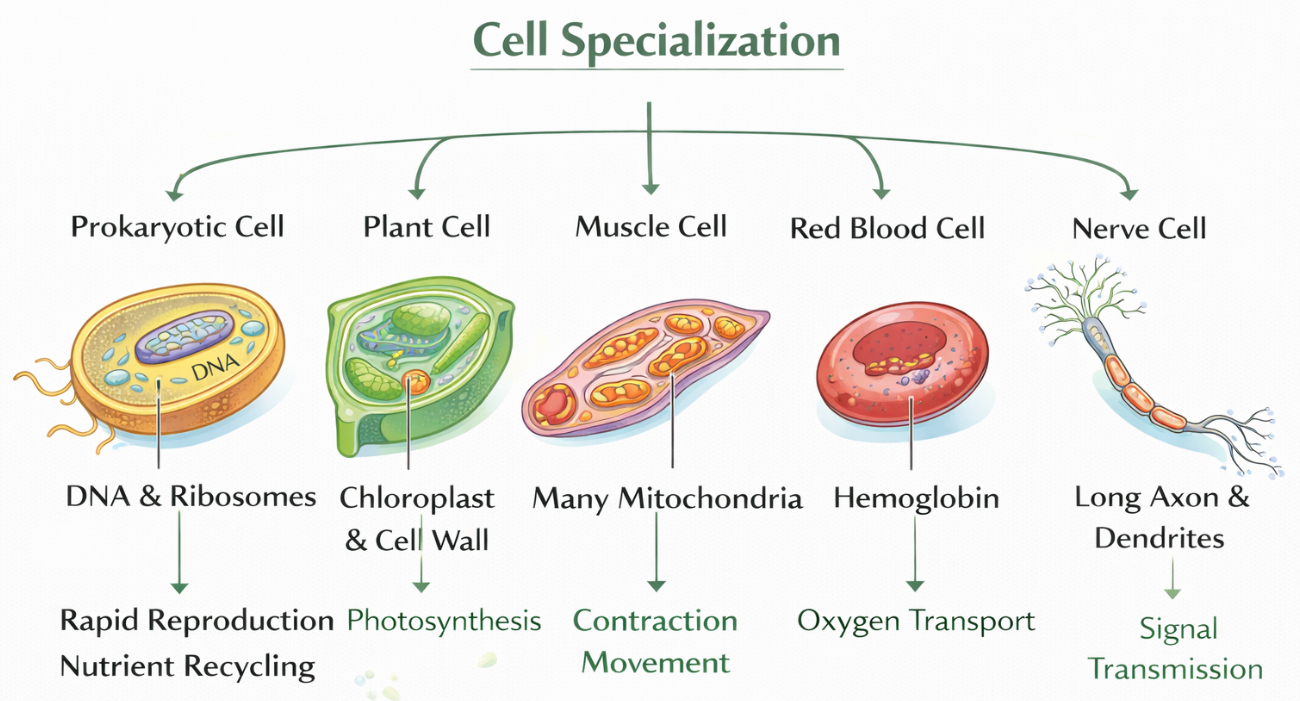
🧬 How Cell Structures Enable Specialized Functions

1. Prokaryotic Cells and Specialized Functions

Structural characteristics:

  • No nucleus
  • No membrane-bound organelles
  • DNA present in cytoplasm
  • Small size
  • Plasma membrane and ribosomes present

How structure enables function:

  • Simple structure allows rapid reproduction
  • Small size allows fast diffusion of materials
  • Efficient metabolism supports survival in diverse environments

Specialized functions:

  • Nutrient recycling
  • Decomposition
  • Photosynthesis (in some bacteria)

Prokaryotic structure enables speed, efficiency, and adaptability.

2. Plant Cells and Specialized Functions

Plant cells are specialized to support photosynthesis and structural support.

Chloroplasts

Structure:

  • Double membrane
  • Contain chlorophyll

Function enabled:

  • Capture light energy
  • Convert light energy into chemical energy

Allows plants to make their own food.

Cell Wall

Structure:

  • Rigid layer made of cellulose

Function enabled:

  • Provides support
  • Maintains shape
  • Prevents cell bursting

Large Central Vacuole

Structure:

  • Large fluid-filled sac

Function enabled:

  • Stores water and nutrients
  • Maintains turgor pressure
  • Supports upright growth

These structures enable plant cells to function as producers.

3. Animal Cells and Specialized Functions

Animal cells are adapted for movement, communication, and transport.

Muscle Cells

Structural adaptations:

  • Long, cylindrical shape
  • Many mitochondria
  • Contractile proteins

Function enabled:

  • Efficient contraction
  • Movement and force generation

Red Blood Cells

Structural adaptations:

  • Biconcave shape
  • No nucleus
  • High hemoglobin content

Function enabled:

  • Increased surface area
  • More space for oxygen transport
  • Flexibility to move through capillaries

Nerve Cells

Structural adaptations:

  • Long axons
  • Branched dendrites

Function enabled:

  • Rapid transmission of signals
  • Long-distance communication

Animal cell structures support active lifestyles and complex behaviors.

4. Fungal Cells and Specialized Functions

Structural characteristics:

  • Rigid cell wall (chitin)
  • No chloroplasts

How structure enables function:

  • Cell wall provides support
  • Absorptive surfaces allow nutrient uptake

Specialized function:
Decomposition and nutrient recycling

5. Eukaryotic Cell Organelles and Specialization

Eukaryotic cells contain membrane-bound organelles, allowing division of labor.

Mitochondria

Structure:

  • Folded inner membrane

Function enabled:

  • Increased surface area for ATP production

Endoplasmic Reticulum (ER)

  • Rough ER → protein synthesis
  • Smooth ER → lipid synthesis

Specialized membranes allow efficient production.

Golgi Apparatus

Function enabled:

  • Modification and packaging of proteins

🧠 Key Concept: Structure Function Relationship

In all organisms:

  • Structure determines function
  • Cells develop features that make their specific jobs efficient

“Specialized cell structures enable cells to perform specific functions essential for the organism.”

📊 Summary Table: Cell Type → Structure → Function

Cell TypeKey StructureSpecialized Function
Prokaryotic cellSimple structureRapid metabolism
Plant cellChloroplastsPhotosynthesis
Plant cellVacuoleSupport
Muscle cellMany mitochondriaMovement
Red blood cellNo nucleusOxygen transport
Nerve cellLong axonSignal transmission
Fungal cellRigid cell wallDecomposition

📦 Quick Recap
Cells become specialized during development
Prokaryotes are adapted for efficiency and survival
Plant cells are specialized for photosynthesis and support
Animal cells are specialized for movement and communication
Fungal cells are specialized for decomposition
Organelles enable division of labor
Structure directly determines function

How Cell Structures Support an Organism’s Ecological Role

🌱 Introduction

Every organism plays a specific role in its ecosystem, called its ecological role.
This role depends on how the organism gets energy, survives, and interacts with other organisms.
The structure of cells directly supports the ecological role of an organism by enabling the functions required for survival in a particular environment.

📌 What Is an Ecological Role?

An ecological role (or niche) describes:

  • How an organism obtains energy
  • How it uses nutrients
  • How it interacts with its environment and other organisms

Examples of ecological roles:

  • Producer
  • Consumer
  • Decomposer

🧬 How Cell Structures Support Ecological Roles

1. Plant Cells Supporting the Role of Producers

Plants are primary producers, meaning they make their own food and support food chains.

Chloroplasts

Structure:

  • Double membrane
  • Contain chlorophyll
  • Internal membranes for light reactions

How structure supports role:

  • Capture light energy
  • Convert light energy into chemical energy

Ecological role supported:

  • Photosynthesis
  • Energy input into ecosystems

Cell Wall

Structure:

  • Rigid layer made of cellulose

How structure supports role:

  • Provides mechanical support
  • Allows plants to grow upright
  • Protects cells

Supports:

  • Stability in terrestrial environments

Large Central Vacuole

Structure:

  • Large fluid-filled compartment

How structure supports role:

  • Maintains turgor pressure
  • Stores water and nutrients

Supports:

  • Survival in varying water conditions

Conclusion for plants:
Plant cell structures allow plants to function as autotrophs and primary producers.

2. Animal Cells Supporting the Role of Consumers

Animals are consumers, relying on other organisms for energy.

Muscle Cells

Structure:

  • Long fibers
  • Many mitochondria

How structure supports role:

  • High ATP production
  • Enables movement to find food or escape predators

Nerve Cells

Structure:

  • Long axons
  • Branched dendrites

How structure supports role:

  • Rapid signal transmission
  • Coordination of movement and responses

Red Blood Cells

Structure:

  • Biconcave shape
  • No nucleus

How structure supports role:

  • Efficient oxygen transport
  • Supports high metabolic activity

Supports:
Active lifestyles of consumers

Conclusion for animals:
Animal cell structures support mobility, coordination, and high energy demand, essential for consumer roles.

3. Fungal Cells Supporting the Role of Decomposers

Fungi act as decomposers, breaking down dead organic matter.

Rigid Cell Wall (Chitin)

Structure:

  • Strong, rigid wall

How structure supports role:

  • Protects cells
  • Maintains shape during absorption

Absorptive Cell Surfaces

Structure:

  • Large surface area

How structure supports role:

  • Efficient absorption of nutrients

Supports:
Recycling nutrients back into the ecosystem

Conclusion for fungi:
Fungal cell structures enable external digestion and nutrient absorption, supporting decomposer roles.

4. Prokaryotic Cells and Ecological Roles

Structural characteristics:

  • No nucleus
  • No membrane-bound organelles
  • Small size

How structure supports role:

  • Simple structure allows fast reproduction
  • Rapid adaptation to changing environments
  • Efficient metabolism

Ecological roles supported:

  • Nutrient cycling
  • Decomposition
  • Photosynthesis (in some bacteria)

5. Cell Structures Reflecting Environmental Adaptation

Cell structures often reflect the environment an organism lives in.

Examples:

  • Thick cell walls for protection
  • Specialized organelles for energy capture
  • Structures that conserve water or store nutrients

These adaptations allow organisms to survive and fulfill their ecological roles.

📊 Summary Table: Cell Structures and Ecological Roles

Organism TypeKey Cell StructuresEcological Role
PlantsChloroplasts, cell wall, vacuoleProducers
AnimalsMuscle, nerve, blood cellsConsumers
FungiRigid cell wallDecomposers
ProkaryotesSimple structureRecyclers, producers

📦 Quick Recap 
Cell structures support organism roles
Plant cells support photosynthesis
Animal cells support movement and sensing
Fungal cells support decomposition
Prokaryotic cells support rapid metabolism
Structure reflects ecological function

Scroll to Top