
How Cell Membranes Maintain Dynamic Homeostasis in Biological Systems
🌿 Introduction
All living cells must keep their internal environment stable to survive.
External conditions like temperature, water concentration, and chemical levels keep changing.
The cell membrane helps the cell adjust continuously to these changes.
This process is called dynamic homeostasis.
📌 Without a properly functioning cell membrane, cells cannot survive.
🧬 Meaning of Dynamic Homeostasis
Homeostasis
- Maintenance of a stable internal environment inside the cell.
Dynamic
- The conditions are not fixed.
- Adjustments happen constantly in response to changes.
So, dynamic homeostasis means continuous regulation of internal conditions despite changing surroundings.
🧫 Why Cell Membranes Are Essential for Homeostasis
The cell membrane forms a boundary between:
- Internal cellular environment
- External environment
But it is not a rigid wall.
It is selectively permeable, allowing controlled exchange.
– This control is the foundation of homeostasis.
🧬 Structure-Based Control of the Cell Membrane
Cell membranes are made of a phospholipid bilayer.
This structure:
- Allows some substances to pass
- Restricts others
Embedded proteins help in specific transport and communication.
📌 Structure directly supports function.
🧫 Major Ways Cell Membranes Maintain Homeostasis
1. Selective Permeability
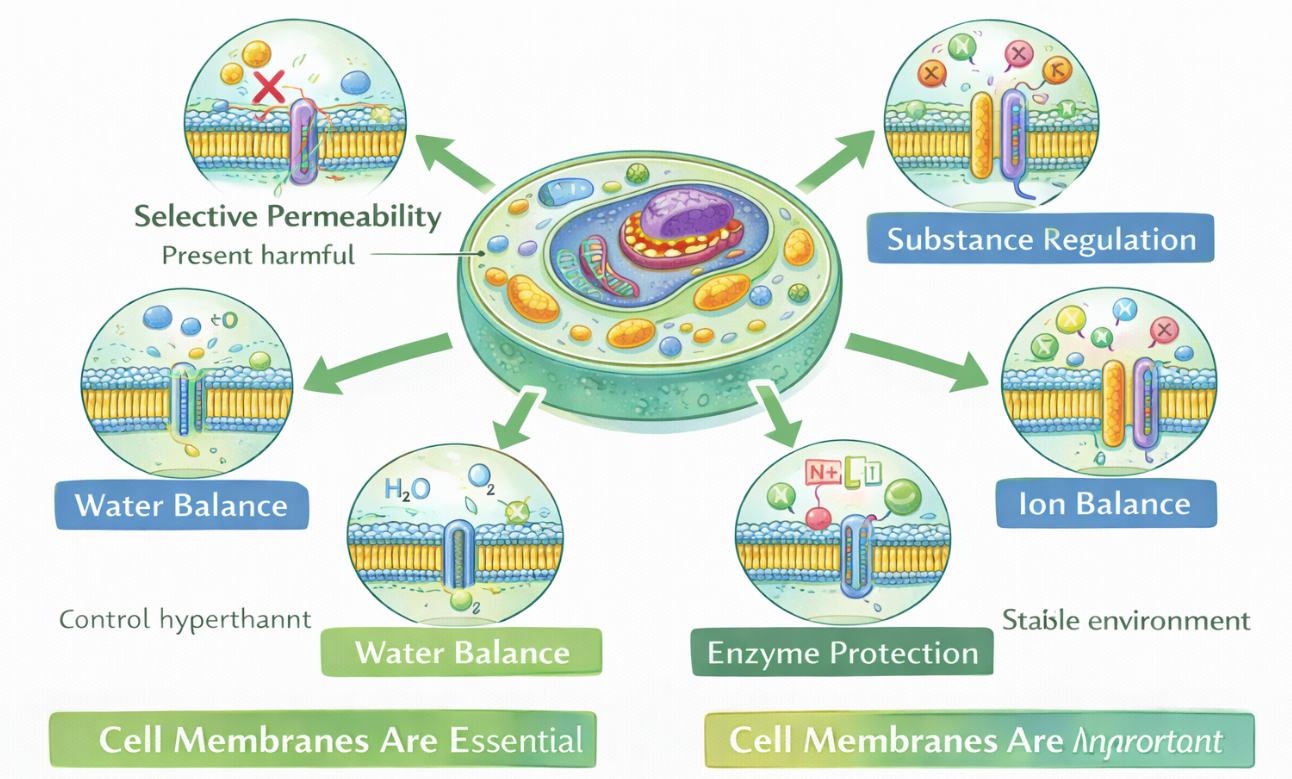
Selective permeability means:
- Small, nonpolar molecules pass easily
- Large or charged molecules need help
- Some substances are blocked completely
📌 Importance:
- Prevents harmful substances from entering
- Prevents loss of essential molecules
- Maintains proper internal composition
This selectivity is critical for balance.
2. Regulation of Substance Movement
The cell membrane controls:
- Entry of nutrients
- Exit of waste products
- Exchange of gases
- Movement of ions
📌 This regulation ensures:
- Nutrients are available when needed
- Toxic wastes do not accumulate
- Internal concentrations remain stable
Example:
- Oxygen enters for respiration
- Carbon dioxide exits as waste
3. Maintenance of Ion Balance
Cells require specific ion concentrations.
Common ions:
- Sodium (Na⁺)
- Potassium (K⁺)
- Calcium (Ca²⁺)
📌 Role of membrane:
- Controls ion movement using membrane proteins
- Maintains electrical and chemical balance
- Prevents sudden ion imbalance
Ion balance is essential for:
- Enzyme activity
- Cell signaling
- Proper cell function
4. Regulation of Water Balance
Water movement affects cell size and shape.
Cell membrane regulates:
- Water entry
- Water exit
📌 Importance:
- Prevents cell bursting
- Prevents cell shrinkage
- Maintains proper internal pressure
Balanced water movement helps cells remain functional.
5. Maintaining Suitable Internal Conditions for Enzymes
Cellular enzymes work only under specific conditions:
- Correct pH
- Proper ion concentration
- Stable chemical environment
📌 Cell membrane helps by:
- Controlling chemical entry and exit
- Preventing drastic internal changes
Without this control, metabolic reactions fail.
6. Cell Communication and Environmental Response
Cell membranes contain receptor proteins.
These proteins detect:
- Chemical signals
- Environmental changes
📌 Based on signals, the cell can:
- Increase or decrease transport
- Adjust metabolic activity
- Respond to stress
This responsiveness keeps the cell adaptive and balanced.
🧠 Why Homeostasis Is Called “Dynamic”
External conditions are never constant.
The membrane continuously:
- Adjusts transport rates
- Modifies permeability
- Responds to signals
📌 Balance is maintained through continuous adjustment, not stillness.
📊 Summary Table
| Aspect | Role in Dynamic Homeostasis |
|---|---|
| Selective permeability | Controls entry and exit of substances |
| Substance regulation | Maintains nutrient and waste balance |
| Ion control | Keeps chemical and electrical balance |
| Water regulation | Prevents bursting or shrinking |
| Enzyme protection | Maintains suitable internal conditions |
| Signal response | Allows adaptation to environment |
⚡ Quick Recap
Cell membranes maintain dynamic homeostasis by
Being selectively permeable
Regulating movement of nutrients, ions, and wastes
Controlling water balance
Supporting enzyme activity
Responding to environmental signals
Models Explaining the Structure and Function of Cell Membrane Components
🌿 Introduction
The cell membrane is not a simple covering.
It is a complex, dynamic structure made of different components.
Scientists use models to explain:
- How the membrane is built
- How each component performs a specific function
📌 The most accepted model is the Fluid Mosaic Model.
🧬 Why Do We Use Models?
Cell membranes are microscopic and cannot be fully understood by observation alone.
Models help us:
- Visualize membrane structure
- Explain how structure supports function
- Predict membrane behavior
Models are simplified representations, not exact copies.
🧫 The Fluid Mosaic Model
Meaning of the Term
Fluid
- Components can move sideways
- Membrane is flexible, not rigid
Mosaic
- Different proteins are scattered like tiles
- Embedded in the lipid layer
This model explains both structure and function together.
🧬 Major Components of the Cell Membrane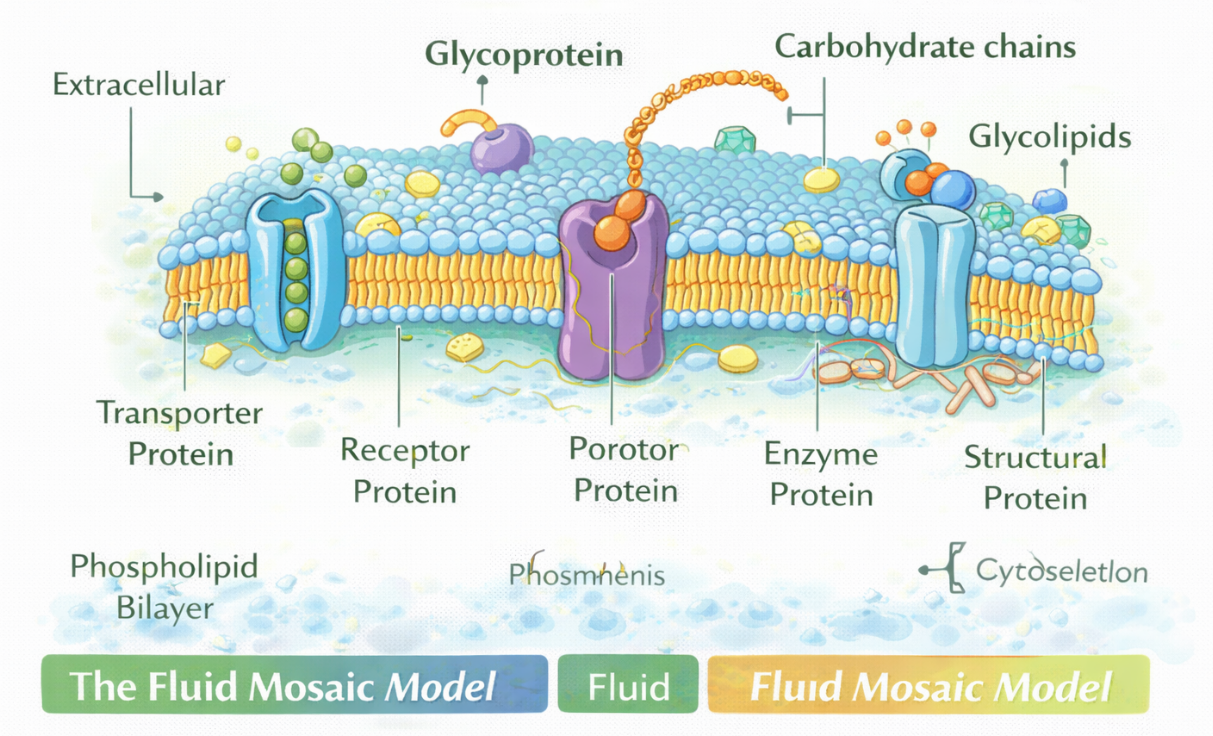
The membrane is mainly made of:
- Phospholipids
- Proteins
- Carbohydrates
- Cholesterol (in animal cells)
Each component has a specific role.
🧪 Phospholipid Bilayer
Structure
- Made of two layers of phospholipids
- Each phospholipid has:
- Hydrophilic head (water-attracting)
- Hydrophobic tail (water-repelling)
- Arrangement:
- Heads face outward toward water
- Tails face inward away from water
Function
- Forms the basic structure of the membrane
- Creates a selectively permeable barrier
- Allows:
- Small nonpolar molecules to pass
- Blocks most charged or large molecules
Structure of phospholipids directly causes selective permeability.
🧫 Membrane Proteins
Proteins are embedded:
- Within the bilayer
- On the inner or outer surface
They are responsible for most membrane functions.
📌 Types of Membrane Proteins
a) Transport Proteins
- Help substances cross the membrane
- Required for:
- Ions
- Large or polar molecules
Function:
- Maintain internal balance
- Support homeostasis
b) Receptor Proteins
- Receive chemical signals from outside
- Bind specific molecules
Function:
- Cell communication
- Environmental response
c) Enzymatic Proteins
- Act as enzymes on the membrane surface
Function:
- Speed up chemical reactions
- Support metabolic pathways
d) Structural Proteins
- Attach membrane to cytoskeleton
- Help maintain cell shape
Function:
- Structural stability
- Organization of the cell
🧬 Carbohydrate Chains
Structure
- Short carbohydrate chains
- Attached to:
- Proteins (glycoproteins)
- Lipids (glycolipids)
- Present only on outer surface of membrane
Function
- Cell-to-cell recognition
- Chemical identification
- Immune system recognition
These carbohydrates act like ID tags for cells.
🧫 Cholesterol (Animal Cells)
Structure
- Found between phospholipids
- Small lipid molecule
Function
- Maintains membrane fluidity
- Prevents membrane from:
- Becoming too rigid in cold
- Becoming too fluid in heat
Helps membrane function under different conditions.
🧠 Linking Structure to Function (VERY IMPORTANT)
| Component | Structural Feature | Functional Role |
|---|---|---|
| Phospholipid bilayer | Hydrophobic core | Selective permeability |
| Proteins | Embedded or surface-bound | Transport, signaling, enzymes |
| Carbohydrates | Surface-attached chains | Cell recognition |
| Cholesterol | Between phospholipids | Membrane stability |
🧬 How the Model Explains Membrane Behavior
Fluid nature allows:
- Shape changes
- Vesicle formation
Mosaic nature allows:
- Multiple functions in one membrane
Dynamic structure supports:
- Homeostasis
- Communication
- Transport
📌 The model explains why membranes are flexible and functional.
⚡ Quick Recap
Cell membrane structure is explained by the Fluid Mosaic Model
Phospholipids form the bilayer and create selective permeability
Proteins perform transport, signaling, and enzymatic roles
Carbohydrates help in cell identification
Cholesterol maintains membrane stability