
Using Data to Investigate Passive Movement Across Cell Membranes
🌿 Introduction
Cells constantly exchange materials with their surroundings.
Many substances move without using energy.
This movement is called passive transport.
Scientists use experimental data to understand:
- Which substances move passively
- How fast they move
- In which direction they move
📌 Passive movement is driven by concentration differences, not ATP.
🧬 What Is Passive Transport?
Passive transport is the movement of substances across the cell membrane without energy use.
Substances move:
- From higher concentration
- To lower concentration
This direction is called the concentration gradient.
🧫 Key Terms You Must Know
Solute
- A substance that is dissolved
- Example: salt, glucose, ions
Solvent
- The substance doing the dissolving
- Example: water
Concentration Gradient
- Difference in concentration between two regions
Passive movement always occurs down the concentration gradient.
🧪 Types of Passive Transport Studied Using Data
Passive transport includes:
- Simple diffusion
- Facilitated diffusion
- Osmosis
Each is supported by experimental data.
🧬 Simple Diffusion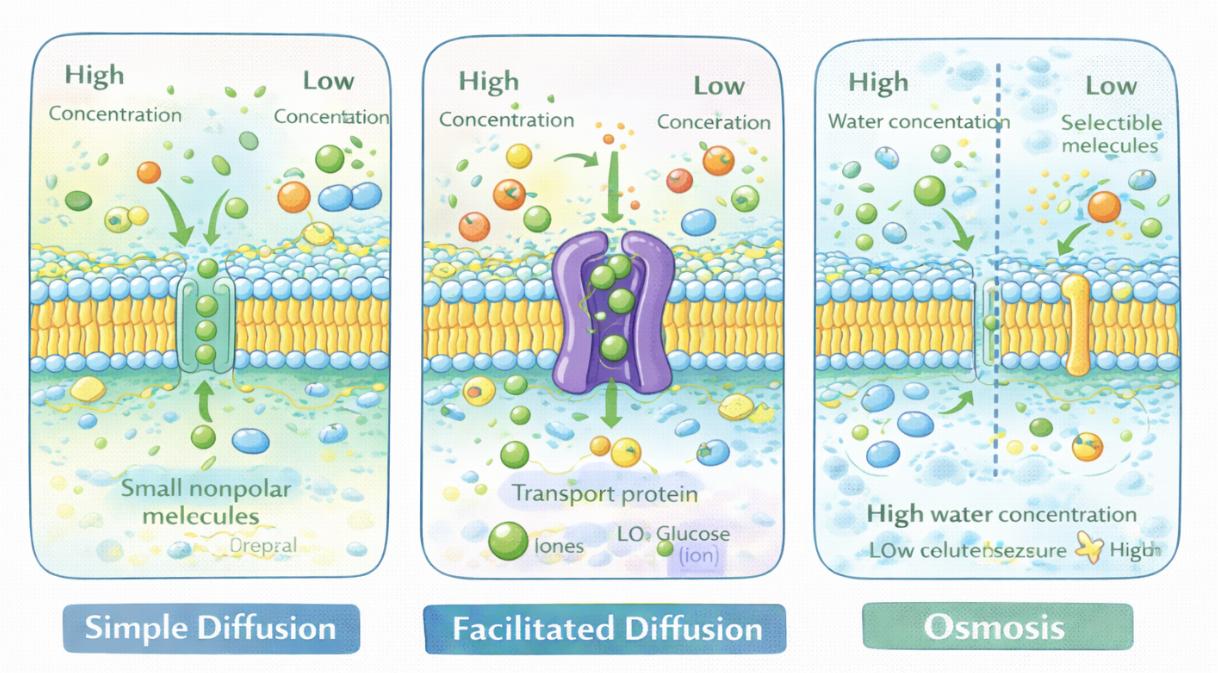
What It Is
- Movement of small, nonpolar molecules
- Directly through the phospholipid bilayer
- No transport protein needed
Examples:
- Oxygen
- Carbon dioxide
📊 What Data Shows
From experiments:
- Higher concentration difference = faster diffusion
- Smaller molecules move faster
- Nonpolar molecules cross easily
Data pattern:
- Rate of diffusion increases as concentration gradient increases
Conclusion from Data
Simple diffusion depends on:
- Concentration gradient
- Molecule size
- Membrane permeability
No energy is involved.
🧬 Facilitated Diffusion
What It Is
- Passive movement of:
- Large
- Polar
- Charged substances
- Uses transport proteins
Examples:
- Glucose
- Ions
📊 What Data Shows
Experimental observations:
- Movement stops if transport proteins are blocked
- Rate increases with concentration gradient
- Rate levels off when proteins are fully used
This leveling off shows protein limitation.
Conclusion from Data
Facilitated diffusion:
- Is passive
- Requires specific membrane proteins
- Depends on concentration gradient
Still no ATP used.
🧬 Osmosis (Movement of Solvent)
What It Is
- Osmosis is the passive movement of water
- Water moves:
- From high water concentration
- To low water concentration
- Across a selectively permeable membrane
📊 What Data Shows
In experiments with cells or membranes:
- Cells swell in hypotonic solutions
- Cells shrink in hypertonic solutions
- Cells remain stable in isotonic solutions
Water movement depends on solute concentration, not water itself.
Conclusion from Data
Osmosis maintains:
- Cell volume
- Internal balance
Direction is predictable using concentration data.
🧪 Factors Affecting Passive Transport (Data-Based)
| Factor | Effect Observed in Data |
|---|---|
| Concentration gradient | Steeper gradient = faster movement |
| Molecule size | Smaller molecules move faster |
| Polarity | Nonpolar moves easily |
| Transport proteins | Required for facilitated diffusion |
| Membrane permeability | Determines what can pass |
🧠 How Scientists Use Data to Investigate Passive Transport
- Measure concentration changes over time
- Compare inside vs outside concentrations
- Observe rate changes under different conditions
These data help predict:
- Direction of movement
- Speed of movement
- Type of passive transport involved
📌 Key Points
- Passive transport never uses ATP
- Always moves down the concentration gradient
- Data often shows:
- Faster movement with greater gradient
- Saturation in facilitated diffusion
- Osmosis involves water only
📊 Summary Table
| Type | Substance | Protein Needed | Energy |
|---|---|---|---|
| Simple diffusion | Small nonpolar | No | No |
| Facilitated diffusion | Large or charged | Yes | No |
| Osmosis | Water | Sometimes | No |
⚡ Quick Recap
Passive transport moves substances without energy
Movement is always from high to low concentration
Simple diffusion does not use proteins
Facilitated diffusion uses proteins but no ATP
Osmosis is water movement based on solute concentration
How Materials Move Into and Out of the Cell Across the Cell Membrane
🌿 Introduction
Cells must constantly take in useful substances and remove wastes.
This movement is essential to:
- Maintain dynamic homeostasis
- Support metabolism
- Keep cells alive
The cell membrane controls all movement across it.
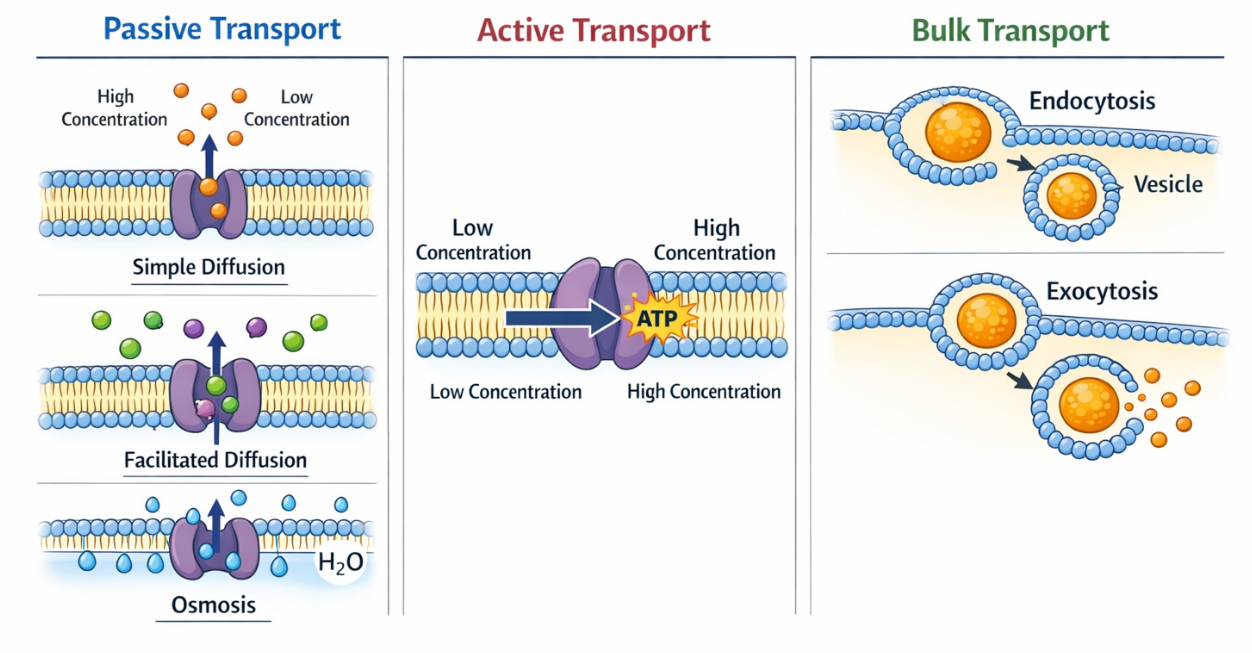
Movement across the membrane occurs through three main mechanisms:
- Passive transport
- Active transport
- Bulk transport
🧬 Role of the Cell Membrane in Transport
The cell membrane is:
- Selectively permeable
- Flexible and dynamic
Its structure allows:
- Some substances to pass easily
- Others to require proteins or energy
Transport depends on:
- Concentration gradient
- Size and charge of molecules
- Energy availability
🧫 Passive Transport (No Energy Required)
Definition
Passive transport is the movement of materials:
- From high concentration
- To low concentration
- Without using cellular energy
Movement occurs along the concentration gradient.
🧬 Types of Passive Transport
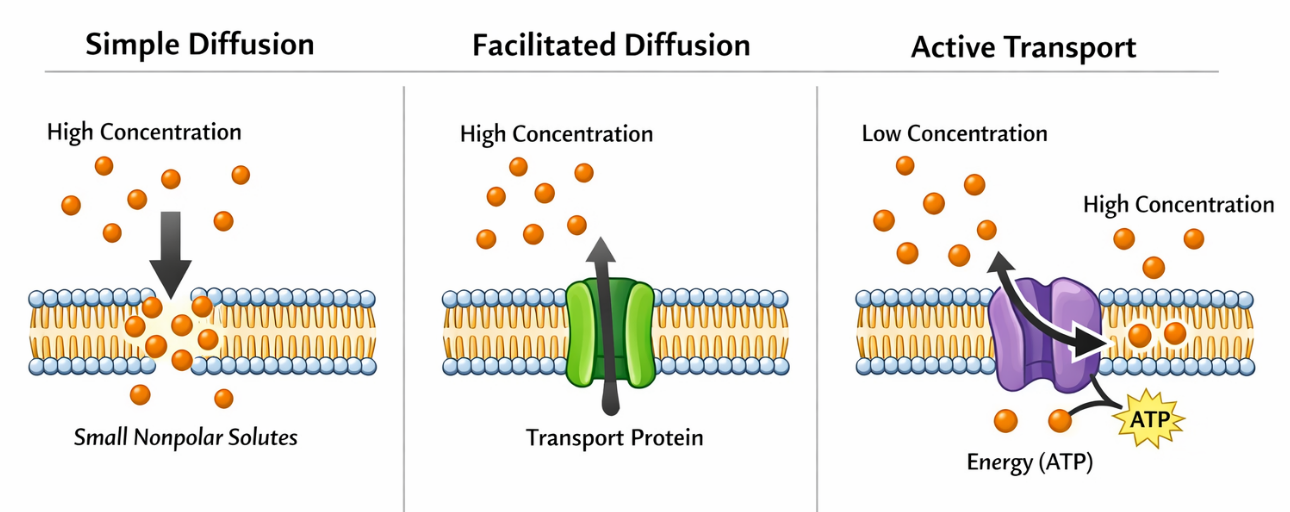
a) Simple Diffusion
How It Works
- Small, nonpolar molecules move directly through the phospholipid bilayer
- No transport protein needed
Examples:
- Oxygen
- Carbon dioxide
Direction
- Always from high concentration to low concentration
b) Facilitated Diffusion
How It Works
- Large, polar, or charged molecules cannot pass through the lipid bilayer
- They move through specific transport proteins
Examples:
- Glucose
- Ions
Important:
- Still passive
- Still no ATP used
c) Osmosis
How It Works
- Osmosis is the passive movement of water across the membrane
- Water moves based on solute concentration
Role:
- Maintains cell volume
- Prevents cell bursting or shrinking
🧫 Active Transport (Energy Required)
Definition
Active transport is the movement of substances:
- From low concentration
- To high concentration
This movement is against the concentration gradient.
Energy is required because this movement does not occur naturally.
🧬 How Active Transport Works
Uses:
- Transport proteins
- Cellular energy (ATP)
Proteins change shape to move substances across.
Examples:
- Ion movement
- Nutrient uptake when internal levels are already high
Importance of Active Transport
Allows cells to:
- Maintain ion gradients
- Accumulate essential substances
- Function even when external concentrations are low
Without active transport, homeostasis fails.
🧫 Bulk Transport (Vesicle-Mediated Transport)
Definition
Bulk transport moves large molecules or large quantities.
Materials cannot pass directly through the membrane.
This transport uses vesicles.
🧬 Types of Bulk Transport
a) Endocytosis (Into the Cell)
- Cell membrane folds inward
- Forms a vesicle around the material
- Material is brought into the cell
Examples:
- Uptake of large nutrients
- Uptake of particles
b) Exocytosis (Out of the Cell)
- Vesicles fuse with the membrane
- Contents are released outside the cell
Examples:
- Waste removal
- Secretion of substances
🧠 Comparing the Transport Mechanisms
| Transport Type | Direction | Energy | Protein | Example |
|---|---|---|---|---|
| Passive transport | High to low | No | Sometimes | Oxygen diffusion |
| Active transport | Low to high | Yes | Yes | Ion movement |
| Bulk transport | Large movement | Yes | Vesicles | Endocytosis |
🧠 How These Processes Maintain Homeostasis
- Passive transport balances concentrations
- Active transport maintains gradients
- Bulk transport handles large materials
Together, they ensure:
- Nutrient supply
- Waste removal
- Stable internal conditions
📌Key Points
- Passive transport does not use ATP
- Active transport requires energy
- Bulk transport uses vesicles
- Always mention concentration gradient
⚡ Quick Recap
Materials move across the membrane by
Passive transport (diffusion, facilitated diffusion, osmosis)
Active transport (energy-dependent movement)
Bulk transport (endocytosis and exocytosis)
Using Representations and Models to Predict the Movement of Solutes Into or Out of the Cell
🌿 Introduction
Cells do not randomly gain or lose substances.
Every movement of a solute across the cell membrane follows predictable biological rules.
To understand and predict this movement, biologists use models and representations such as diagrams, concentration tables, and gradient descriptions.
These models allow us to:
- Visualize solute distribution
- Compare internal and external conditions
- Predict direction, mechanism, and energy requirement of transport
🧬 What Are Representations and Models in Cell Transport?
In cell transport, representations include:
- Diagrams showing solute concentration inside and outside a cell
- Tables comparing solute levels across a membrane
- Graphs showing concentration change over time
- Written descriptions of concentration gradients
These models help answer three critical questions:
- Will the solute move or not?
- In which direction will it move?
- What type of transport is required?
🧠 Fundamental Principle Behind All Predictions
Core Biological Rule
Solutes naturally move from a region of higher concentration to a region of lower concentration.
This movement occurs without energy and is passive.
If a solute moves from lower to higher concentration, energy is required.
Every prediction begins with identifying the concentration gradient.
🧫 Step-by-Step Method to Predict Solute Movement
Step 1: Identify the Solute
Determine:
- Is the solute small or large?
- Is it polar, nonpolar, or charged?
This step tells us whether the solute can pass through the phospholipid bilayer directly or needs assistance.
Step 2: Compare Concentrations Across the Membrane
Carefully examine:
- Solute concentration inside the cell
- Solute concentration outside the cell
Ask:
- Where is the concentration higher?
- Where is it lower?
Direction of movement is always predicted from this comparison.
Step 3: Determine Energy Requirement
High → low concentration
→ passive transport
Low → high concentration
→ active transport (energy required)
Never assume energy use unless clearly stated or implied.
Step 4: Predict Direction and Type of Movement
Combine:
- Solute properties
- Concentration gradient
- Energy availability
Then predict:
- Movement into the cell
- Movement out of the cell
- Or no net movement
🧬 Predicting Solute Movement Using Transport Models
🧪 Model 1: Simple Diffusion
Representation
- Solute concentration is higher outside the cell
- Solute concentration is lower inside the cell
- Solute is small and nonpolar
Prediction
- Solute moves into the cell
- Movement continues until concentrations become equal
Biological Reasoning
- The phospholipid bilayer allows small nonpolar molecules to pass freely
- No transport protein or energy is required
🧪 Model 2: Facilitated Diffusion
Representation
- Solute concentration is higher on one side of the membrane
- Solute is large, polar, or charged
- Transport proteins are present
Prediction
- Solute moves down its concentration gradient
- Direction depends on which side has higher concentration
Biological Reasoning
- The lipid bilayer blocks polar and charged solutes
- Transport proteins provide a pathway without using energy
- Movement stops at equilibrium
🧪 Model 3: Active Transport
Representation
- Solute concentration is lower outside and higher inside the cell
- ATP or energy source is available
- Specific transport proteins are shown
Prediction
- Solute moves into the cell against the concentration gradient
Biological Reasoning
- Passive movement cannot occur against the gradient
- Energy is required to pump solutes across the membrane
- This maintains concentration differences essential for cell function
🧬 Predicting Water Movement Using Osmosis Models
Important Concept
Water movement is predicted indirectly by analyzing solute concentration.
Osmosis Prediction Using Solution Models
| External Solution | Solute Concentration Outside | Predicted Water Movement | Effect on Cell |
|---|---|---|---|
| Hypotonic | Lower than inside | Water enters cell | Cell swells |
| Isotonic | Equal to inside | No net movement | Cell remains stable |
| Hypertonic | Higher than inside | Water leaves cell | Cell shrinks |
Water always moves toward the region with higher solute concentration.
🧬 Using Graphs and Data to Predict Movement
Concentration vs Time Graphs
From graphs, predictions are made by observing:
- Steep slope → rapid movement
- Gradual slope → slow movement
- Plateau → equilibrium reached
In facilitated diffusion, a plateau may occur due to protein saturation, not equilibrium.
🧠 Role of Membrane Structure in Prediction
Predictions must always respect membrane structure.
| Membrane Feature | Impact on Solute Movement |
|---|---|
| Phospholipid bilayer | Blocks large and charged solutes |
| Transport proteins | Allow specific solutes to pass |
| Selective permeability | Restricts random movement |
| Vesicles | Enable bulk transport |
Ignoring membrane structure leads to incorrect predictions.
📊 Summary Table: Prediction Logic
| Condition Observed | Model Used | Predicted Movement |
|---|---|---|
| High → low concentration | Diffusion model | Passive movement |
| Low → high concentration | Active transport model | Energy-dependent movement |
| Unequal solute levels | Osmosis model | Water redistribution |
| Large particles | Vesicle model | Bulk transport |
⚡ Quick Recap
Models help visualize solute distribution across membranes
Direction of movement depends on concentration gradients
Passive transport moves solutes down the gradient
Active transport moves solutes against the gradient using energy
Osmosis predictions depend on solute concentration, not water itself