
How Cell Size Affects the Efficiency of Cell Function
🌿 Introduction
All living cells must exchange materials with their environment to survive.
They must:
- Take in oxygen, nutrients, and water
- Remove carbon dioxide and metabolic wastes
- Maintain internal balance for metabolic reactions
The size of a cell directly affects how efficiently these exchanges occur.
As a result, cell size is not random. It is limited by physical and biological principles, especially diffusion.
🧬 What Does “Cell Efficiency” Mean?
Cell efficiency refers to how effectively a cell can:
- Obtain required substances
- Remove waste products
- Support metabolic activities
- Maintain dynamic homeostasis
For a cell to function efficiently, exchange with the environment must be fast and sufficient.
🧫 Role of Diffusion in Cell Function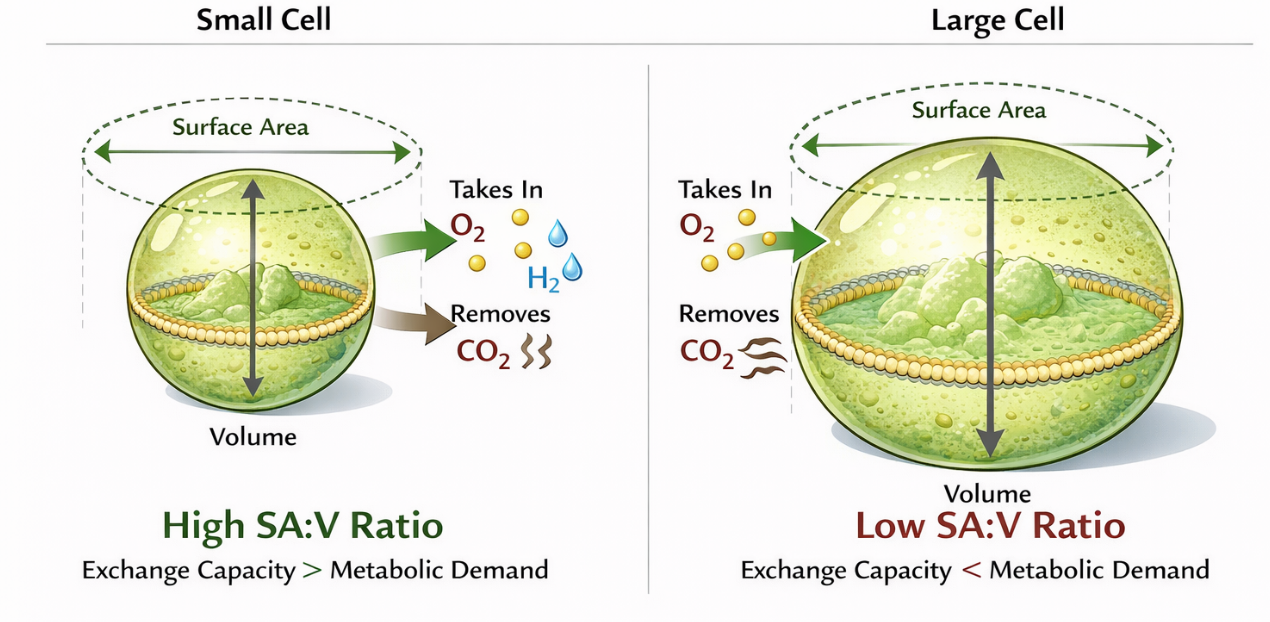
Diffusion is the primary method by which substances move:
- Across the cell membrane
- Within the cytoplasm
Diffusion is:
- Passive
- Driven by concentration gradients
- Limited by distance and available surface area
Therefore, diffusion efficiency determines how well a cell functions.
🧬 Surface Area and Volume
Surface Area
Surface area refers to the cell membrane area.
It determines:
- How much material can enter or leave the cell at a given time
More surface area = more exchange sites.
Volume
Volume refers to the amount of cytoplasm inside the cell.
It determines:
- How much material the cell needs
- How much waste the cell produces
Larger volume = greater metabolic demand.
🧠 Surface Area-to-Volume Ratio
The surface area-to-volume ratio compares:
- Exchange capacity (surface area)
- Metabolic demand (volume)
This ratio is the key factor linking cell size to efficiency.
🧬 Why Small Cells Are More Efficient
High Surface Area-to-Volume Ratio
Small cells have:
- Relatively large surface area
- Relatively small volume
This means:
- Substances can enter and leave quickly
- Diffusion distances are short
- Metabolic demands are easily met
As a result, diffusion is fast and efficient.
Short Diffusion Distance
In small cells:
- The distance from membrane to cell interior is short
- Oxygen and nutrients reach all parts of the cell quickly
- Waste products are removed rapidly
This prevents accumulation of toxic substances.
🧬 What Happens as Cell Size Increases
As a cell grows:
- Volume increases faster than surface area
- Surface area-to-volume ratio decreases
- Diffusion becomes slower and less efficient
This creates serious functional limitations.
🧫 Problems Faced by Large Cells
- Insufficient oxygen reaching inner regions
- Slow nutrient delivery
- Waste accumulation inside the cell
- Difficulty maintaining homeostasis
Eventually, diffusion alone cannot support the cell’s needs.
🧬 Mathematical Reasoning
- Surface area increases with the square of cell size
- Volume increases with the cube of cell size
📌 This mismatch explains why:
- Bigger cells struggle
- Smaller cells function efficiently
🧬 Biological Consequences of Size Limitation
Because of diffusion limits:
- Cells remain small
- Large organisms are multicellular
- Cells divide once they reach a critical size
Cell division restores a high surface area-to-volume ratio.
🧠 Adaptations to Increase Efficiency
Some cells increase efficiency by:
- Changing shape
- Forming folds or extensions
Examples:
- Flattened cells
- Elongated cells
- Membrane infoldings
These adaptations increase surface area without greatly increasing volume.
📊 Summary Table
| Cell Feature | Small Cell | Large Cell |
|---|---|---|
| Surface area | Relatively high | Relatively low |
| Volume | Small | Large |
| SA:V ratio | High | Low |
| Diffusion distance | Short | Long |
| Transport efficiency | High | Low |
📌 Key Points
- Cell size directly affects diffusion efficiency
- High surface area-to-volume ratio supports efficient exchange
- Large cells face diffusion limitations
- Cell division helps restore efficiency
⚡ Quick Recap
Cell efficiency depends on diffusion
Diffusion is most efficient when surface area is high and volume is low
Small cells have a high surface area-to-volume ratio
As cells grow larger, diffusion becomes inefficient
Cells divide to maintain efficient size