
How Organ Systems Work Together to Maintain Homeostasis
🌿 Introduction
In multicellular organisms, individual cells cannot maintain a stable internal environment on their own.
Cells are too far from the external environment, and diffusion alone is not sufficient to meet their needs.
To solve this limitation, multicellular organisms have evolved specialized organ systems that work together to maintain homeostasis.
Homeostasis at the organism level depends on:
- Efficient transport of nutrients and gases
- Removal of metabolic wastes
- Regulation of internal conditions such as water balance and gas levels
📌 No single organ system maintains homeostasis independently.
Homeostasis is maintained through coordination and integration of multiple systems.
🧬 What Is Homeostasis at the Organism Level?
Homeostasis refers to the maintenance of a stable internal environment despite changes in the external environment.
At the organism level, this includes:
- Constant supply of oxygen and nutrients to cells
- Continuous removal of carbon dioxide and nitrogenous wastes
- Regulation of internal fluid balance
These tasks require cooperation between organ systems, not isolated action.
🧫 Why Organ System Coordination Is Necessary
In multicellular organisms:
- Most cells are not in direct contact with the environment
- Substances must travel long distances inside the body
- Waste products must be collected and removed efficiently
Because of this:
- One system prepares substances
- Another system transports them
- Another system removes waste
This division of labor ensures efficiency and survival.
🐾 Coordination of Organ Systems in Animals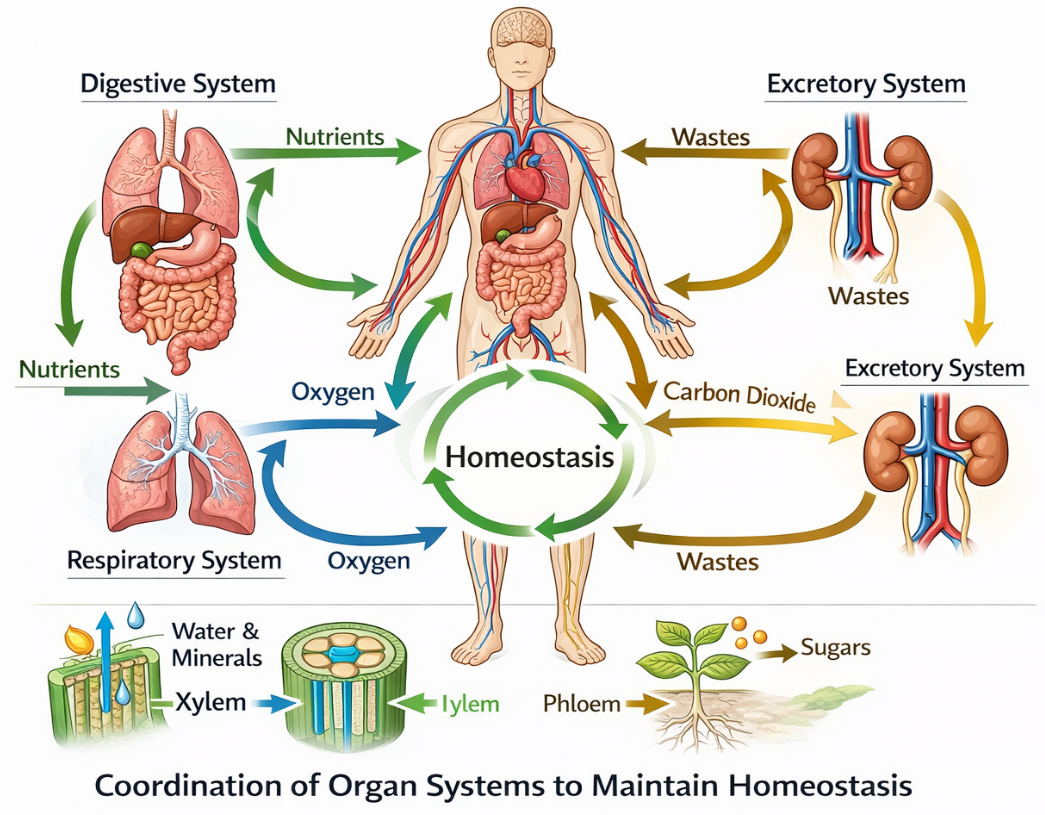
🧬 Digestive System and Homeostasis
Primary Role
Breaks down food into simple molecules (monomers) such as:
- Glucose
- Amino acids
- Fatty acids
These molecules are essential for:
- Cellular respiration
- Growth and repair
- Metabolic reactions
Interaction with Other Systems
- Digested nutrients enter the circulatory system
- Circulatory system delivers these nutrients to body cells
- Cells use nutrients to produce energy and maintain internal balance
📌 Without digestion, cells would lack the raw materials needed for homeostasis.
🫁 Respiratory System and Homeostasis
Primary Role
- Brings oxygen into the body
- Removes carbon dioxide from the body
Oxygen is required for:
- Cellular respiration
- ATP production
Carbon dioxide must be removed because:
- It forms acids in the body
- It disrupts internal pH if accumulated
Interaction with Other Systems
- Oxygen enters the bloodstream through respiratory surfaces
- Circulatory system transports oxygen to all cells
- Carbon dioxide from cells is carried back to the lungs by blood
The respiratory and circulatory systems work as a single functional unit.
🩸 Circulatory System as the Connecting Link
Central Coordinating Role
The circulatory system:
- Connects all organ systems
- Acts as the transport network of the body
It transports:
- Nutrients from the digestive system
- Oxygen from the respiratory system
- Wastes to excretory organs
Importance for Homeostasis
- Ensures every cell receives what it needs
- Ensures wastes are removed before they accumulate
- Maintains stable internal conditions across tissues
Without circulation, coordination between systems would not be possible.
🚰 Excretory System and Homeostasis
Primary Role
- Removes nitrogenous wastes produced during metabolism
- Eliminates toxins from the body
- Regulates water and ion balance
Interaction with Other Systems
- Circulatory system delivers waste products to excretory organs
- Excretory system filters blood
- Useful substances are retained
- Wastes are removed from the body
📌 This system prevents toxic buildup and maintains internal fluid balance.
🧠 Integration of Animal Organ Systems
- Digestive system provides nutrients
- Respiratory system supplies oxygen
- Circulatory system distributes materials
- Excretory system removes wastes
All systems operate simultaneously and dependently.
Failure of one system affects all others and disrupts homeostasis.
🌿 Coordination of Transport Systems in Plants
Plants do not have organs like animals, but they still require:
- Transport of materials
- Removal of wastes
- Maintenance of internal balance
🧬 Vascular Tissue Systems in Plants
Xylem
- Transports water and mineral nutrients
- Moves materials from roots to leaves
- Supports photosynthesis and cell function
Phloem
- Transports sugars produced during photosynthesis
- Moves sugars from leaves to growing and storage tissues
Interaction for Homeostasis
- Xylem supplies water needed for photosynthesis
- Phloem distributes energy-rich sugars
- Cells receive necessary resources to maintain internal balance
🌬️ Waste Removal in Plants
- Oxygen and carbon dioxide produced during photosynthesis and respiration
- Released through stomata in leaves
Efficient gas exchange helps prevent internal imbalance.
📊 Summary Table: Organ System Coordination
| System | Main Function | Contribution to Homeostasis |
|---|---|---|
| Digestive | Breaks food into monomers | Supplies nutrients |
| Respiratory | Gas exchange | Provides oxygen, removes CO₂ |
| Circulatory | Transport | Connects all systems |
| Excretory | Waste removal | Prevents toxic buildup |
| Plant xylem | Water transport | Supports photosynthesis |
| Plant phloem | Sugar transport | Supplies energy to cells |
📌 Key Points
- Homeostasis in multicellular organisms requires system-level coordination
- No organ system works alone
- Circulatory system links all transport processes
- Disruption in one system affects overall balance
⚡ Quick Recap
Multicellular organisms maintain homeostasis through coordinated organ systems
Digestive and respiratory systems supply materials
Circulatory system transports substances to all cells
Excretory system removes wastes and regulates balance
Plants use xylem, phloem, and stomata for transport and waste removal
Predicting the Consequences of a Disruption in Homeostasis
🌿 Introduction
Homeostasis is the ability of an organism to maintain a stable internal environment despite changes in the external environment.
In multicellular organisms, this stability depends on the continuous coordination of organ systems.
When homeostasis is disrupted, internal conditions move outside the optimal range, leading to reduced efficiency of cells, tissues, and organs.
If the disruption is severe or prolonged, it can result in disease, organ failure, or death.
🧬 What Does “Disruption in Homeostasis” Mean?
A disruption in homeostasis occurs when:
- Internal conditions are no longer regulated properly
- Organ systems fail to perform their roles
- Feedback mechanisms cannot restore balance
Examples of disrupted internal conditions include:
- Low oxygen levels
- Accumulation of metabolic waste
- Imbalanced water or ion levels
- Insufficient nutrient supply
Even a small disruption can affect the entire organism.
🧠 Why Disruption Has Widespread Effects
In multicellular organisms:
- Cells depend on organ systems for survival
- Organ systems depend on each other to function
- Failure in one system places stress on all others
Because systems are interconnected, homeostatic disruption spreads rather than remaining localized.
🐾 Consequences of Disrupted Homeostasis in Animal Systems
1. Digestive System Failure
Nature of Disruptio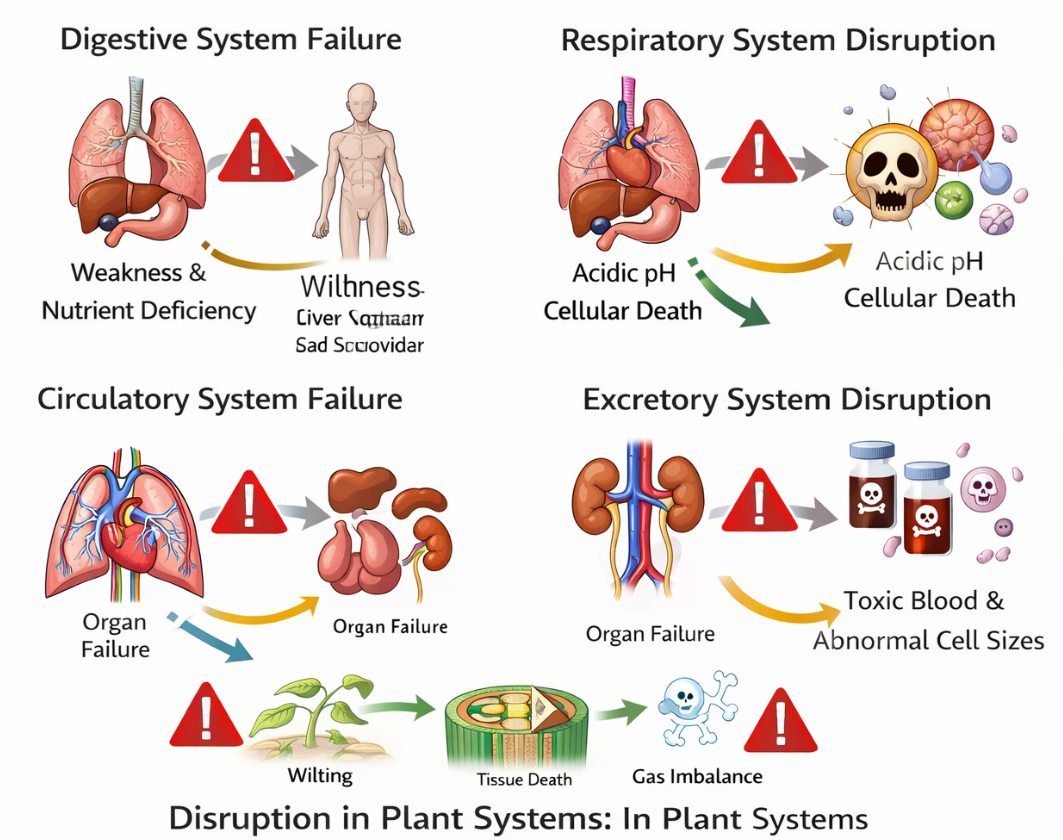
- Inability to digest food properly
- Poor absorption of nutrients
Predicted Consequences
- Cells do not receive sufficient glucose, amino acids, or fatty acids
- Reduced ATP production
- Impaired growth, repair, and metabolism
Long-term consequence: Weakness, weight loss, and system-wide energy deficiency.
2. Respiratory System Disruption
Nature of Disruption
- Reduced oxygen intake
- Incomplete removal of carbon dioxide
Predicted Consequences
- Decreased cellular respiration
- Reduced ATP production
- Carbon dioxide buildup lowers internal pH
📌 Result:
Enzyme activity is disrupted
Cells lose efficiency and may die
3. Circulatory System Failure
Nature of Disruption
- Poor transport of oxygen, nutrients, and wastes
- Reduced blood flow to tissues
Predicted Consequences
- Cells become oxygen-starved
- Nutrient delivery slows
- Waste products accumulate in tissues
System-wide effect: Multiple organs begin to fail due to lack of supply and waste buildup
4. Excretory System Disruption
Nature of Disruption
- Failure to remove nitrogenous wastes
- Inability to regulate water and ion balance
Predicted Consequences
- Toxic substances accumulate in blood
- Water imbalance leads to cell swelling or shrinkage
- Ionic imbalance interferes with cell signaling and enzyme function
📌Result: Rapid breakdown of internal chemical stability
🧠 Chain Reaction of Homeostatic Failure
Disruption in one system leads to:
- Cellular stress
- Reduced metabolic efficiency
- Tissue dysfunction
- Organ system failure
- Organism-level breakdown
Homeostasis fails in a cascade, not in isolation.
🌿 Consequences of Disrupted Homeostasis in Plants
Plants also depend on internal balance for survival.
🧬 Disruption of Water Transport (Xylem)
Nature of Disruption
- Reduced water uptake or transport
Predicted Consequences
- Reduced photosynthesis
- Loss of turgor pressure
- Wilting and tissue damage
🧬 Disruption of Sugar Transport (Phloem)
Nature of Disruption
- Sugars not transported from leaves
Predicted Consequences
- Starvation of non-photosynthetic tissues
- Reduced growth
- Eventual tissue death
🌬️ Disruption of Gas Exchange
Nature of Disruption
- Stomata unable to regulate gas exchange
Predicted Consequences
- Oxygen and carbon dioxide imbalance
- Reduced photosynthesis or respiration
- Metabolic stress in plant cells
🧠 Predictive Reasoning
To predict consequences of homeostatic disruption:
- Identify which system is affected
- Determine what substance is not regulated
- Predict cellular-level effects
- Extend to tissue, organ, and organism level
📌 Predictions must always follow cause → effect → outcome logic.
📊 Summary Table: Disruption and Consequences
| System Affected | Homeostatic Role | Consequence of Disruption |
|---|---|---|
| Digestive | Nutrient supply | Energy deficiency |
| Respiratory | Gas exchange | Low ATP, pH imbalance |
| Circulatory | Transport | Organ failure |
| Excretory | Waste removal | Toxic buildup |
| Plant xylem | Water transport | Wilting |
| Plant phloem | Sugar transport | Tissue starvation |
⚡ Quick Recap
Homeostasis maintains internal stability
Disruption leads to inefficient cellular function
Failure in one organ system affects others
Waste buildup and resource shortage damage cells
Severe disruption can lead to death