
Benefits of Tropisms and Taxes in Response to External Stimuli
🌿 Introduction
All organisms live in environments that are constantly changing.
Light intensity, water availability, chemical conditions, food location, and gravity are never perfectly stable.
To survive and function efficiently, organisms must detect external stimuli and respond in ways that:
- Improve survival
- Support growth and reproduction
- Maintain dynamic homeostasis
These responses occur mainly through:
- Tropisms in plants (growth-based responses)
- Taxes in animals (movement-based responses)
These responses are adaptive, meaning they provide clear biological benefits.
🧬 External Stimuli and Biological Responses
An external stimulus is any environmental factor that causes an organism to respond.
Examples include:
- Light
- Gravity
- Water
- Chemicals
- Touch
- Food availability
- pH changes
📌 Organisms show:
- Positive responses → toward the stimulus
- Negative responses → away from the stimulus
Both types are beneficial depending on the situation.
🌱 Tropisms in Plants: Benefits of Directional Growth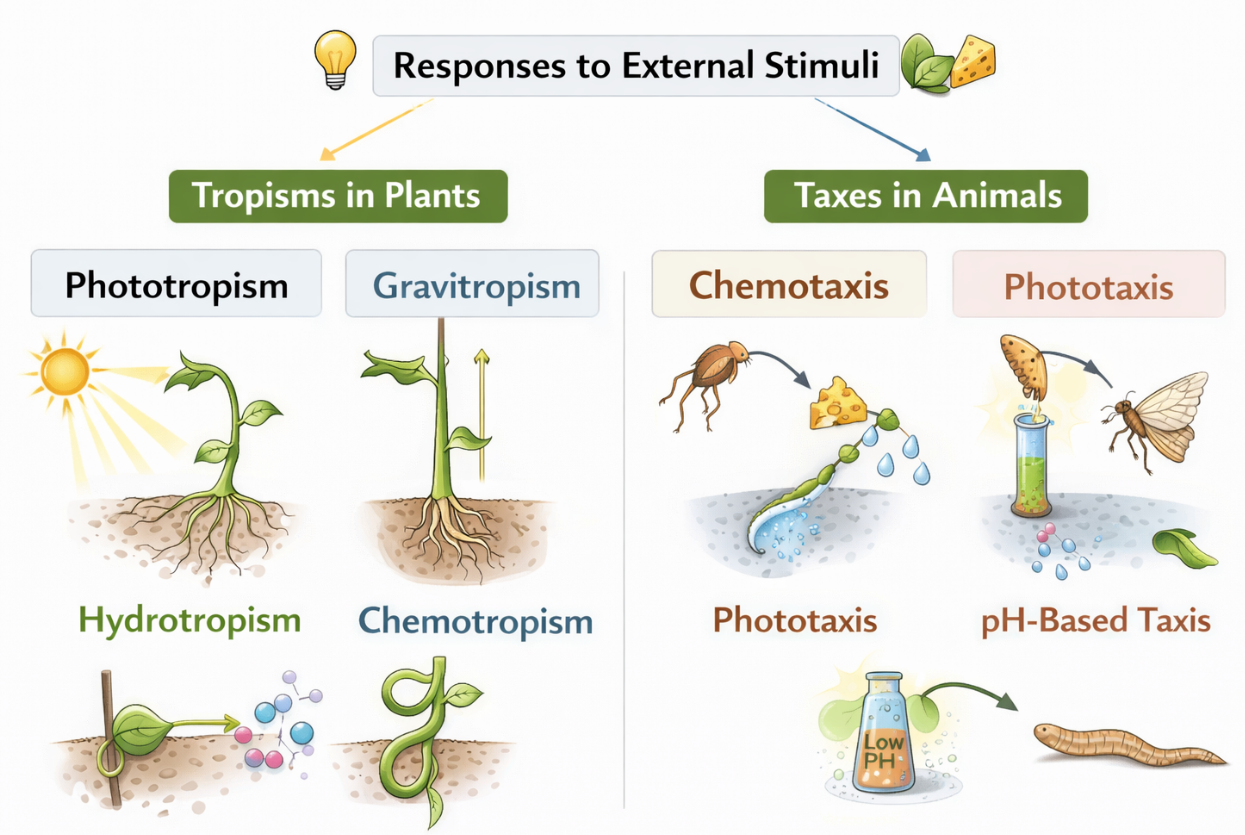
Plants cannot move from place to place.
Instead, they respond to stimuli by altering the direction of growth.
This growth response is called a tropism.
🧬 Phototropism (Response to Light)
Nature of the Response
- Shoots grow toward light (positive phototropism)
Biological Benefit
- Maximizes light absorption
- Increases rate of photosynthesis
- Ensures sufficient sugar production for growth and repair
📌Benefit to homeostasis: Adequate energy production maintains internal balance.
🧬 Gravitropism (Response to Gravity)
Nature of the Response
- Roots grow downward (positive gravitropism)
- Shoots grow upward (negative gravitropism)
Biological Benefit
- Roots penetrate soil for water absorption and mineral uptake
- Shoots grow upward for light exposure and efficient gas exchange
📌 Benefit to homeostasis: Proper orientation ensures balanced resource acquisition.
🧬 Hydrotropism (Response to Water)
Nature of the Response
- Roots grow toward regions with higher water concentration
Biological Benefit
- Ensures continuous water supply
- Supports photosynthesis
- Maintains transport of nutrients
- Maintains cell turgidity
📌 Benefit to homeostasis: Prevents dehydration and loss of internal pressure.
🧬 Chemotropism (Response to Chemicals)
Nature of the Response
- Growth toward or away from specific chemicals
Biological Benefit
- Roots grow toward nutrient-rich zones
- Reproductive structures respond to chemical signals
📌 Benefit to homeostasis: Improves nutrient uptake and reproductive success.
🧬 Thigmotropism (Response to Touch)
Nature of the Response
- Growth in response to physical contact
Biological Benefit
- Climbing plants attach to support structures
- Improves access to light without thick stems
📌 Benefit to homeostasis: Conserves energy while maximizing photosynthesis.
🐾 Taxes in Animals: Benefits of Directional Movement
Animals maintain homeostasis by actively moving toward or away from stimuli.
This movement-based response is called a taxis.
1. Chemotaxis (Response to Chemicals or Food)
Nature of the Response
- Movement toward food sources
- Movement away from harmful chemicals
Biological Benefit
- Ensures nutrient intake
- Avoids toxic environments
📌 Benefit to homeostasis: Maintains energy levels and internal chemical balance.
2. Phototaxis (Response to Light)
Nature of the Response
- Movement toward or away from light depending on species
Biological Benefit
- Helps organisms locate favorable environments
- Avoids excessive light that may cause damage
📌 Benefit to homeostasis: Protects cells and supports normal physiological activity.
3. pH-Based Taxis
Nature of the Response
- Movement away from extreme pH conditions
Biological Benefit
- Prevents enzyme denaturation
- Protects internal biochemical reactions
📌 Benefit to homeostasis: Maintains optimal internal pH conditions.
🧠 Why Tropisms and Taxes Are Essential for Homeostasis
They help organisms:
- Locate resources
- Avoid harmful conditions
- Maintain internal balance
Responses are:
- Directional
- Regulated
- Adaptive
📌 Without these responses, organisms would fail to maintain stable internal conditions.
🌍 Comparison: Tropisms vs Taxes
| Feature | Tropisms | Taxes |
|---|---|---|
| Type of response | Growth-based | Movement-based |
| Seen in | Plants | Animals |
| Speed | Slow | Rapid |
| Purpose | Resource optimization | Survival and balance |
| Relation to homeostasis | Indirect but essential | Direct and immediate |
⚡ Quick Recap
Tropisms help plants grow toward favorable conditions
Taxes help animals move toward resources or away from harm
Responses are directional and stimulus-specific
These responses improve survival and efficiency
Maintaining homeostasis is the ultimate goal
Predicting How an Organism Responds to External Environmental Changes to Maintain Homeostasis
🌿 Introduction
The external environment of an organism is never constant.
Changes in light, temperature, water availability, chemical conditions, food supply, or pH occur continuously.
To survive, organisms must detect these changes and respond appropriately so that their internal environment remains stable.
This ability to respond is essential for maintaining dynamic homeostasis.
🧬 What Does “Predicting a Response” Mean in Biology?
Predicting a biological response involves logical reasoning, not memorization.
To make a correct prediction, we must:
- Identify the external stimulus
- Understand how the organism detects the stimulus
- Predict the type of response (growth or movement)
- Explain how the response restores or maintains homeostasis
📌 Every correct prediction follows a stimulus → response → homeostasis pathway.
🌱 Predicting Responses in Plants
Plants cannot move from place to place.
They respond to environmental changes by altering the direction or rate of growth through tropisms.
1. Change in Light Availability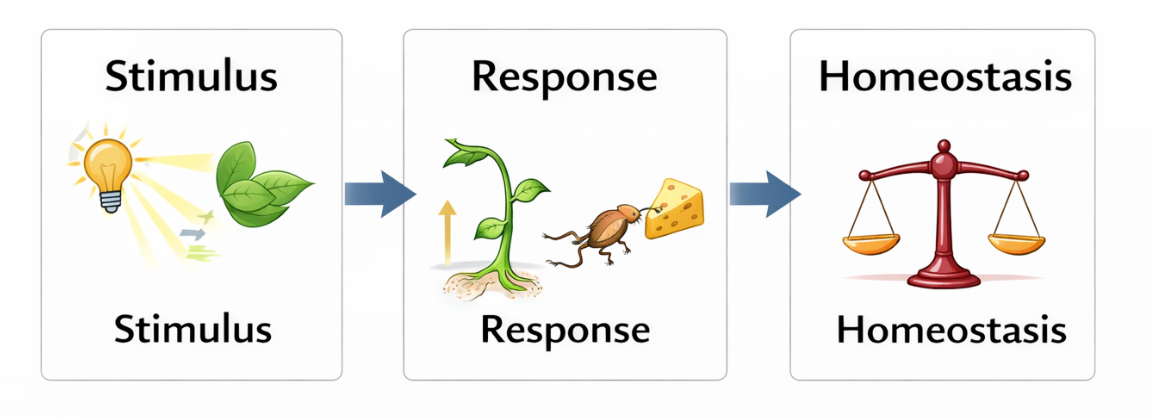
Environmental Change
- Light source shifts direction
- Light intensity becomes uneven
Predicted Response
- Shoots bend and grow toward the light (positive phototropism)
Homeostatic Benefit
- Increased light absorption
- Enhanced photosynthesis
- Adequate sugar production for cellular respiration
📌 Prediction logic: Light changes → growth toward light → energy balance maintained
2. Change in Water Availability in Soil
Environmental Change
- Uneven distribution of water in soil
Predicted Response
- Roots grow toward regions with higher moisture (positive hydrotropism)
Homeostatic Benefit
- Continuous water uptake
- Maintains turgor pressure
- Supports nutrient transport and photosynthesis
📌 Prediction logic: Water shortage → directional root growth → internal water balance maintained
3. Change in Gravity Orientation
Environmental Change
- Seed germinates in soil regardless of orientation
Predicted Response
- Roots grow downward (positive gravitropism)
- Shoots grow upward (negative gravitropism)
Homeostatic Benefit
- Roots access water and minerals
- Shoots access light and air
📌 Prediction logic: Gravity stimulus → correct organ orientation → efficient resource acquisition
4. Mechanical Contact with Objects
Environmental Change
- Plant shoot touches a support structure
Predicted Response
- Growth around the object (thigmotropism)
Homeostatic Benefit
- Plant gains support
- Better exposure to light
- Reduced energy cost for thick stem growth
🐾 Predicting Responses in Animals
Animals maintain homeostasis mainly through movement-based responses called taxes.
These responses are usually rapid and involve the nervous system.
5. Change in Food Availability
Environmental Change
- Food concentration increases in one direction
Predicted Response
- Animal moves toward the food source (positive chemotaxis)
Homeostatic Benefit
- Nutrient intake restored
- Energy balance maintained
- Supports metabolism and growth
📌 Prediction logic: Food signal → movement toward food → internal energy balance restored
6. Change in Light Intensity
Environmental Change
- Light becomes too intense or too weak
Predicted Response
- Movement away from harmful light or toward suitable light (positive or negative phototaxis depending on species)
Homeostatic Benefit
- Prevents cellular damage
- Maintains normal physiological activity
7. Change in pH or Chemical Conditions
Environmental Change
- Surrounding environment becomes too acidic or alkaline
Predicted Response
- Movement away from extreme pH conditions (negative chemotaxis)
Homeostatic Benefit
- Protects enzyme structure
- Maintains optimal internal pH
📌 Prediction logic: Chemical stress → avoidance movement → biochemical stability maintained
🧠 Why These Responses Maintain Homeostasis
All predicted responses:
- Reduce environmental stress
- Restore internal balance
- Protect cellular processes
- Improve survival chances
📌 The goal is not comfort but internal stability.
📊 Summary Table: Prediction Logic
| External Change | Organism | Predicted Response | Homeostatic Benefit |
|---|---|---|---|
| Uneven light | Plant | Phototropism | Increased photosynthesis |
| Low soil water | Plant | Hydrotropism | Water balance |
| Food source detected | Animal | Chemotaxis | Energy balance |
| Extreme pH | Animal | Negative taxis | Enzyme protection |
| Mechanical contact | Plant | Thigmotropism | Structural support |
⚡ Quick Recap
Environmental changes disturb internal balance
Organisms detect stimuli and respond directionally
Plants use tropisms to adjust growth
Animals use taxes to move toward or away from stimuli
These responses restore and maintain homeostasis