
Importance of the Growth Phases in the Cell Cycle
🌿 Introduction
The cell cycle is the ordered sequence of events through which a cell grows, prepares, and divides.
Although cell division often receives the most attention, the growth phases of the cell cycle are far more critical for proper cell function and survival.
Cells do not divide immediately.
They spend most of their time growing, synthesizing materials, and checking for errors.
These preparation stages ensure that when division occurs, it is accurate, controlled, and successful.
Without proper growth phases, cell division would be faulty and harmful.
🧬 Overview of Growth Phases in the Cell Cycle
The cell cycle consists of:
- Interphase (growth and preparation)
- Cell division (mitosis and cytokinesis)
About 90 percent of the cell cycle is spent in interphase.
Interphase is not a resting phase.
It is the most metabolically active and essential period of the cell cycle.
🧫 Interphase and Its Growth Phases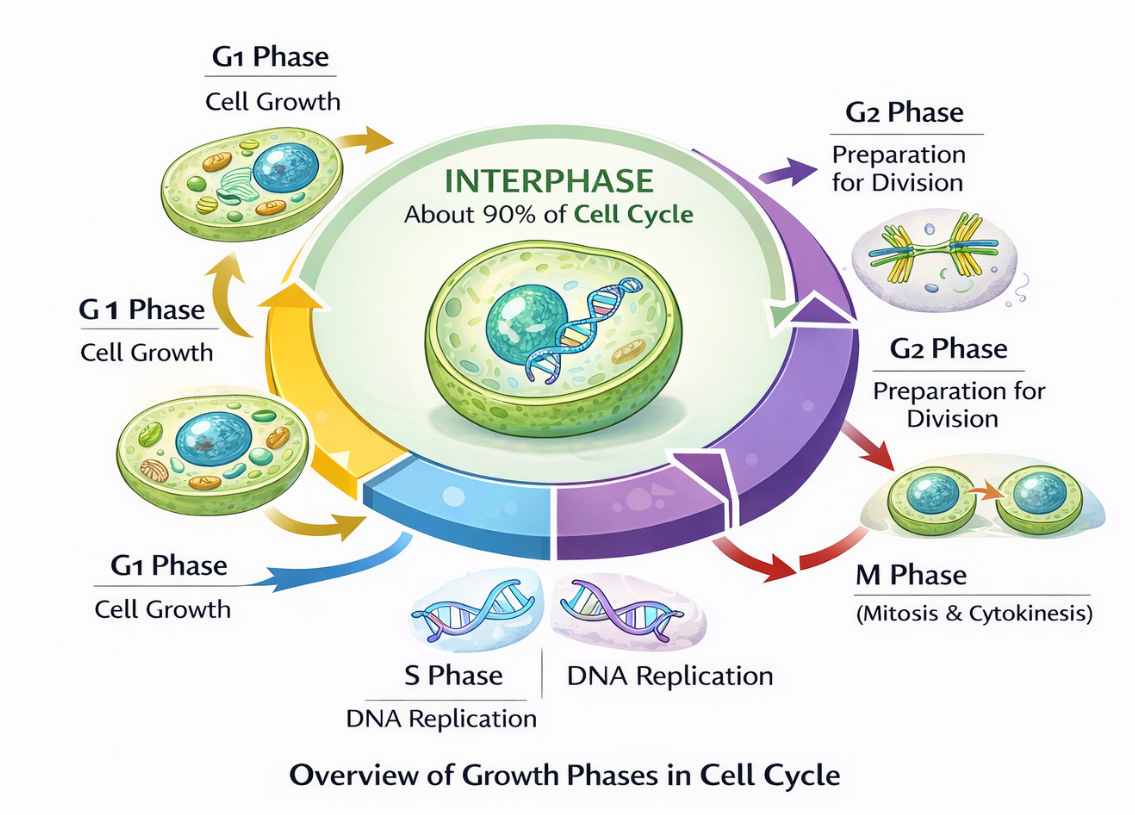
Interphase is divided into three stages:
- G1 phase (first growth phase)
- S phase (DNA synthesis phase)
- G2 phase (second growth phase)
Each phase plays a distinct and essential role in preparing the cell for division.
🧬 G1 Phase: Cell Growth and Normal Function
What Happens in G1 Phase
- The cell increases in size
- Produces:
- New organelles
- Structural proteins
- Enzymes needed for metabolism
- Carries out normal cellular functions
📌 This phase establishes the basic cellular machinery.
Why G1 Phase Is Important
- Ensures the cell has:
- Enough cytoplasm
- Sufficient organelles
- Adequate energy reserves
- Allows the cell to respond to internal and external signals
A cell that skips or shortens G1 would:
- Be too small
- Lack essential components
- Produce weak or nonfunctional daughter cells
G1 Checkpoint Significance
At the end of G1, the cell checks:
- Cell size
- Nutrient availability
- DNA condition
📌 Only cells that pass this checkpoint proceed to DNA replication.
This prevents damaged or unprepared cells from dividing.
🧬 S Phase: DNA Replication and Genetic Preparation
What Happens in S Phase
- DNA uncoils
- Each DNA molecule is replicated
- Each chromosome becomes:
- Two identical DNA copies
- Still attached together
This duplication ensures genetic continuity.
Why S Phase Is Important
- Guarantees that:
- Each daughter cell receives a complete genome
- Maintains genetic stability across generations of cells
Errors during this phase can cause:
- Mutations
- Genetic disorders
- Loss of cell function
Relationship to Growth Phases
DNA replication requires:
- Proteins
- Enzymes
- Energy
These resources are produced mainly during G1 and G2.
📌 This shows why growth phases are essential before and after DNA synthesis.
🧬 G2 Phase: Final Growth and Preparation for Division
What Happens in G2 Phase
- The cell grows further
- Produces proteins required for:
- Chromosome movement
- Cell division machinery
- Organelles are duplicated further
The cell prepares for the physical process of division.
Why G2 Phase Is Important
- Ensures the cell:
- Has sufficient materials for mitosis
- Can divide evenly
- Prevents unequal distribution of components
Skipping G2 would result in:
- Incomplete division
- Abnormal daughter cells
G2 Checkpoint Significance
At the end of G2, the cell verifies:
- DNA has been fully and correctly replicated
- No DNA damage is present
- Cell size is adequate
📌 Only cells that pass this checkpoint enter mitosis.
🧠 Overall Importance of Growth Phases
- Cells are physically large enough to divide
- Cellular components are duplicated properly
- DNA is accurately copied
- Errors are detected before division
Growth phases protect the organism from:
- Faulty cell division
- Genetic instability
- Disease development
🧬 What Happens If Growth Phases Are Disrupted
If growth phases are skipped or shortened:
- Cells divide prematurely
- Daughter cells lack essential components
- DNA errors go unchecked
This can lead to:
- Cell death
- Tissue malfunction
- Uncontrolled cell division
📊 Summary Table: Importance of Growth Phases
| Phase | Main Function | Importance |
|---|---|---|
| G1 | Cell growth and organelle synthesis | Builds cellular foundation |
| S | DNA replication | Ensures genetic continuity |
| G2 | Final growth and preparation | Enables accurate division |
⚡ Quick Recap
Growth phases prepare the cell for successful division
G1 builds cell size and organelles
S phase duplicates DNA accurately
G2 ensures readiness for mitosis
Proper growth phases prevent faulty cell division
Regulation of the Cell Cycle
🌿 Introduction
Cell division is a powerful process.
It allows organisms to grow, repair tissues, and replace damaged or dead cells.
However, cell division must be carefully controlled.
If cells divide too slowly, tissues cannot repair properly.
If cells divide too rapidly or uncontrollably, it can lead to serious disorders.
Therefore, the cell cycle is regulated by internal and external control mechanisms that ensure:
- Cells divide only when needed
- DNA is accurately copied
- Damaged or abnormal cells do not continue dividing
📌 Regulation ensures order, accuracy, and safety in cell division.
🧬 What Does “Regulation of the Cell Cycle” Mean?
Regulation of the cell cycle refers to the control of progression through different phases of the cycle.
This control determines:
- When a cell should grow
- When it should replicate DNA
- When it should divide
- When it should stop dividing
📌 Regulation prevents errors and maintains genetic and cellular stability.
🧫 Why Cell Cycle Regulation Is Necessary
Cell cycle regulation is essential because:
- DNA must be copied once and only once
- Cells must be large enough before division
- Division must not occur if DNA is damaged
- Cells must respond to the needs of the organism
Without regulation, cells could divide with:
- Incomplete DNA
- Damaged chromosomes
- Insufficient cellular components
🧬 Major Control Points of the Cell Cycle (CHECKPOINTS)
The cell cycle is regulated at specific points called checkpoints.
These checkpoints act like inspection stages where the cell evaluates whether it is ready to proceed.
🧬 G1 Checkpoint (Restriction Point)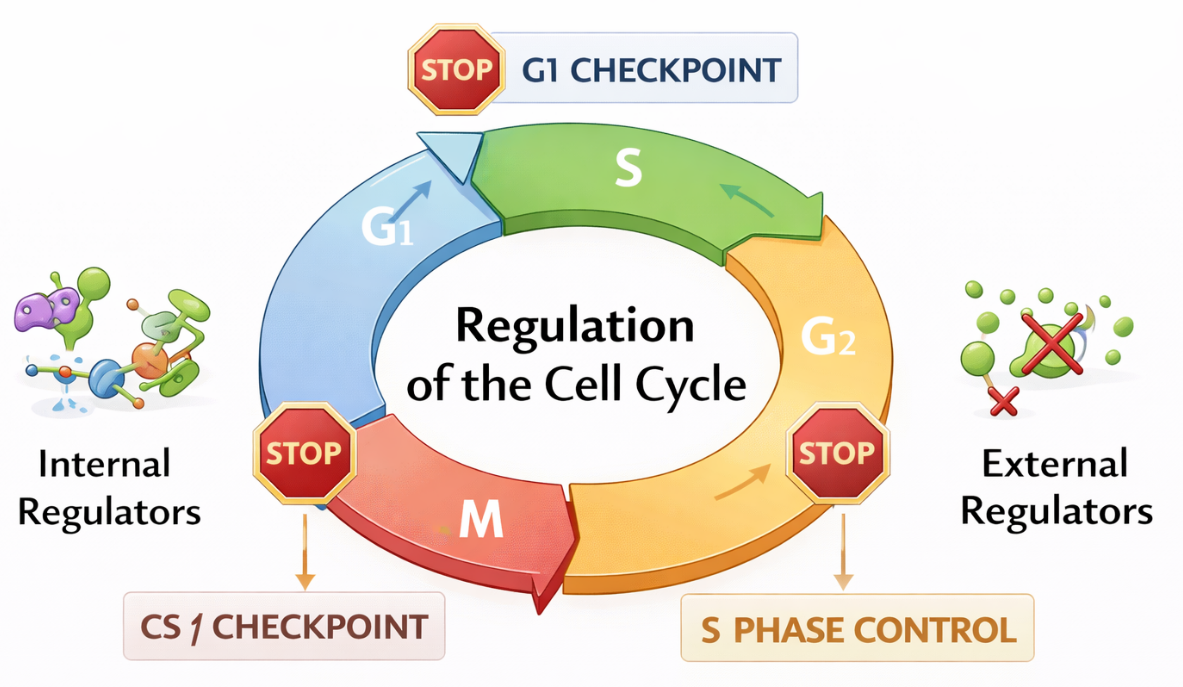
What the Cell Checks
At the end of G1 phase, the cell checks:
- Cell size
- Availability of nutrients
- Energy levels
- DNA integrity
Importance of the G1 Checkpoint
Determines whether the cell will:
- Continue to divide
- Pause the cycle
- Enter a non-dividing state
This checkpoint prevents cells that are:
- Too small
- Nutrient-deficient
- DNA-damaged
from entering DNA replication.
🧬 S Phase Regulation
What Is Controlled During S Phase
- DNA replication is tightly regulated
- Each DNA molecule is copied only once
This prevents:
- DNA duplication errors
- Unequal genetic material in daughter cells
Importance of S Phase Control
- Ensures genetic information remains stable
- Prevents mutations caused by incomplete or repeated replication
🧬 G2 Checkpoint
What the Cell Checks
At the end of G2 phase, the cell verifies:
- DNA replication is complete
- No DNA damage is present
- Cell size is sufficient for division
Importance of the G2 Checkpoint
- Prevents cells with damaged or unreplicated DNA from entering mitosis
- Ensures accurate chromosome separation during division
📌 Cells that fail this checkpoint do not divide until problems are corrected.
🧬 Internal Regulators of the Cell Cycle
Internal regulators are molecules inside the cell that respond to events occurring within the cell.
They:
- Allow the cycle to proceed only when earlier steps are completed
- Ensure correct sequence of events
Example role: DNA must be fully replicated before mitosis begins
🧬 External Regulators of the Cell Cycle
External regulators respond to signals from outside the cell.
They control:
- Whether a cell should divide
- How fast the cell cycle progresses
Examples of external signals:
- Growth signals that stimulate division
- Inhibitory signals that stop division when cells are crowded
📌 These signals ensure cell division matches the needs of the organism.
🧠 Role of Cell Cycle Regulation in Preventing Disease
Proper regulation:
- Prevents uncontrolled cell division
- Maintains tissue organization
- Protects genetic information
Loss of regulation can lead to:
- Uncontrolled cell division
- Formation of abnormal cell masses
- Failure of tissues to function properly
Regulation is essential for organism survival.
🧬 What Happens When Regulation Fails
If checkpoints fail or signals are ignored:
- Damaged cells continue dividing
- Mutations accumulate
- Cells lose normal growth control
This disrupts tissue homeostasis and overall organism balance.
📊 Summary Table: Cell Cycle Regulation
| Regulatory Point | What Is Checked | Purpose |
|---|---|---|
| G1 checkpoint | Cell size, nutrients, DNA | Prevents unprepared cells from dividing |
| S phase control | DNA replication accuracy | Maintains genetic stability |
| G2 checkpoint | DNA completeness, damage | Ensures safe entry into mitosis |
| Internal regulators | Completion of previous steps | Maintains correct sequence |
| External regulators | Environmental signals | Matches division to organism needs |
⚡ Quick Recap
The cell cycle is tightly regulated to ensure accuracy
Checkpoints control progression through the cycle
G1 and G2 checkpoints are critical control points
Internal regulators ensure correct order of events
External regulators align cell division with organism needs