
Why Chromosome Duplication Must Occur Prior to Mitotic Division
🌿 Introduction
Mitosis is the process by which a single parent cell divides to form two genetically identical daughter cells.
For mitosis to achieve this goal, the genetic material of the cell must be accurately copied before division begins.
This copying of genetic material is known as chromosome duplication, and it occurs during the S phase of interphase, before mitosis starts.
📌 Chromosome duplication is not optional.
Without it, mitosis cannot maintain genetic stability or proper cell function.
🧬 What Are Chromosomes and Why They Matter
Chromosomes are structures made of:
- DNA
- Associated proteins
They carry:
- Genes
- Instructions for cell structure and function
Each cell requires:
- A complete and correct set of chromosomes
- To perform metabolism
- To maintain homeostasis
- To survive and function properly
📌 Therefore, chromosome number and content must be preserved during cell division.
🧫 What Happens During Chromosome Duplication
Before mitosis:
- DNA uncoils
- Each chromosome is replicated
After replication:
- Each chromosome consists of two identical DNA copies
- These copies remain attached together
These identical copies ensure genetic consistency.
Duplication occurs once per cell cycle to avoid genetic imbalance.
🧬 Purpose of Chromosome Duplication Before Mitosis
1. Ensures Equal Distribution of Genetic Material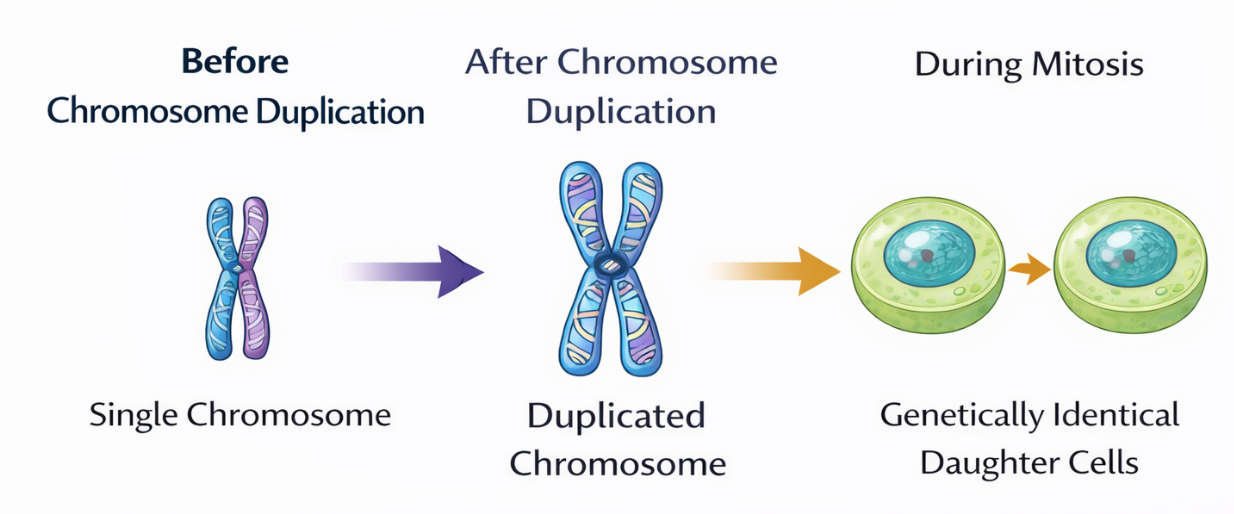
Biological Requirement
Mitosis produces:
- Two daughter cells
- Each must receive the same genetic information as the parent cell
Without duplication:
- Only one copy of each chromosome would exist
- Division would split genetic material unevenly
Duplication ensures there is enough DNA to be shared equally.
Consequence Without Duplication
If chromosomes were not duplicated:
- One daughter cell would lack essential genes
- The other might receive incomplete instructions
- Cells would be nonfunctional or die
2. Maintains Genetic Identity of Daughter Cells
Why Genetic Identity Is Important
In multicellular organisms:
- Cells must perform specialized roles
- All somatic cells must carry the same genome
Chromosome duplication ensures:
- Daughter cells are genetically identical to:
- Each other
- The parent cell
This genetic consistency maintains tissue structure and function.
3. Supports Proper Chromosome Separation During Mitosis
Role in Mitotic Phases
During mitosis:
- Chromosomes must be:
- Aligned
- Separated accurately
- Each daughter nucleus must receive one copy of each chromosome
Duplication allows:
- One copy to move to each side of the cell
Without duplication, chromosomes could not separate evenly.
4. Prevents Loss of Genetic Information
Importance of Complete DNA Sets
Each chromosome contains:
- Essential genes
- Regulatory sequences
If duplication does not occur:
- Some genes would be lost during division
- Cellular instructions would be incomplete
Loss of genetic material disrupts:
- Protein synthesis
- Cell regulation
- Metabolic pathways
5. Enables Growth, Repair, and Replacement in Multicellular Organisms
Role of Mitosis
Mitosis is required for:
- Growth
- Repair of damaged tissues
- Replacement of dying cells
All new cells must:
- Carry the same genetic blueprint
Chromosome duplication ensures that newly formed cells can:
- Function properly
- Integrate into existing tissues
🧬 What Happens If Chromosomes Are Not Properly Duplicated
Failure of duplication leads to:
- Unequal chromosome distribution
- Genetically defective daughter cells
- Cellular malfunction
Long-term consequences include:
- Tissue damage
- Developmental abnormalities
- Loss of organismal homeostasis
Accurate duplication is essential for organism survival.
📊 Summary Table: Importance of Chromosome Duplication
| Aspect | Why Duplication Is Necessary |
|---|---|
| Equal division | Ensures both daughter cells receive full DNA |
| Genetic identity | Maintains identical genomes |
| Chromosome separation | Allows accurate movement during mitosis |
| Genetic stability | Prevents loss of genes |
| Tissue function | Supports growth and repair |
⚡ Quick Recap
Chromosomes must duplicate before mitosis
Duplication ensures equal DNA distribution
Each daughter cell receives a full genome
Genetic identity is preserved
Accurate duplication supports growth and repair
Using Models to Explain the Phases of Mitosis
🌿 Introduction
Mitosis is the process by which a parent cell nucleus divides to form two genetically identical daughter nuclei.
To understand mitosis clearly, biologists use models and representations such as diagrams, phase sequences, and chromosome movement patterns.
These models help explain:
- What happens to chromosomes
- How the nucleus divides accurately
- How genetic information is preserved
📌 Mitosis is a controlled, stepwise process, not a single event.
🧬 What Does “Using Models” Mean in Mitosis?
In mitosis, models represent:
- Chromosome shape and position
- Nuclear membrane changes
- Spindle fiber attachment
- Direction of chromosome movement
A correct model always shows:
- Duplicated chromosomes
- Clear phase sequence
- Equal separation of genetic material
🧫 Overview of Mitotic Phases
Mitosis occurs in four main phases, always in the same order:
- Prophase
- Metaphase
- Anaphase
- Telophase
Each phase prepares the cell for the next, ensuring accuracy and genetic stability.
🧬 Prophase – Chromosome Condensation and Preparation
What a Prophase Model Shows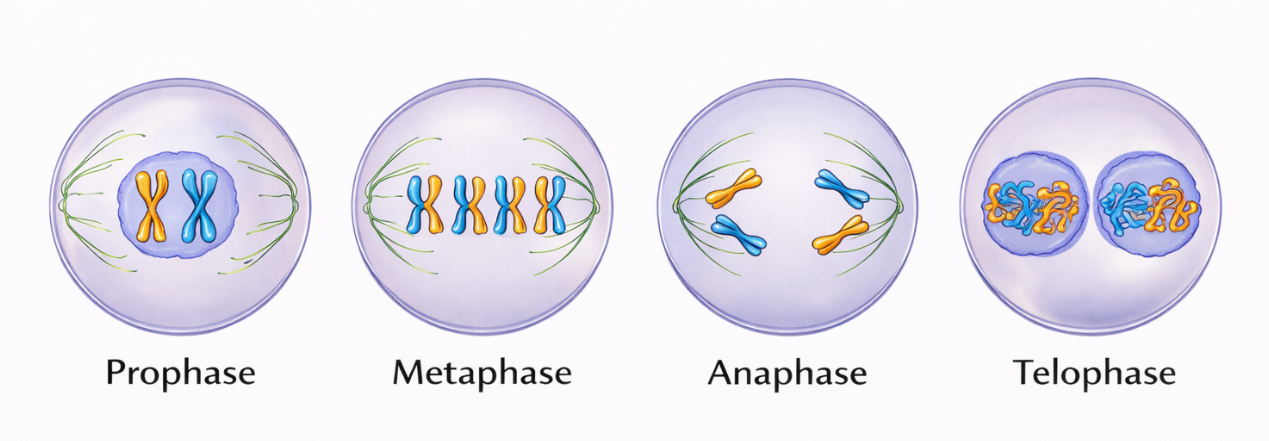
- Chromosomes condense and become visible
- Each chromosome consists of:
- Two identical DNA copies joined together
- Nuclear membrane begins to break down
- Spindle fibers start forming from opposite sides
Chromosomes appear short, thick, and X-shaped in models.
🧠 Why Prophase Is Important
- Condensed chromosomes prevent DNA tangling
- Breakdown of nuclear membrane allows spindle fibers access
- Spindle formation prepares for chromosome movement
Without proper prophase events, chromosomes cannot be separated accurately.
🧬 Metaphase – Alignment at the Cell Center
What a Metaphase Model Shows
- Chromosomes line up at the center of the cell
- Spindle fibers attach to chromosomes
- Each chromosome is connected to both sides of the cell
This central alignment forms a straight line across the cell.
Metaphase Checkpoint
At this stage, the cell checks:
- All chromosomes are properly aligned
- Spindle fibers are correctly attached
- Each chromosome can be pulled evenly
If errors are detected, the cell does not proceed.
🧠 Why Metaphase Is Critical
- Proper alignment ensures equal chromosome separation
- Prevents one daughter cell from receiving extra or missing chromosomes
This checkpoint protects genetic stability.
🧬 Anaphase – Chromosome Separation
What an Anaphase Model Shows
- Identical DNA copies separate
- Spindle fibers shorten
- One copy moves to each side of the cell
Chromosomes now appear as single units, not X-shaped.
🧠 Why Anaphase Is Important
- Guarantees each daughter nucleus receives:
- One complete set of chromosomes
- Prevents genetic imbalance
Failure in this phase leads to unequal genetic distribution.
🧬 Telophase – Formation of Two New Nuclei
What a Telophase Model Shows
- Chromosomes reach opposite ends of the cell
- Chromosomes begin to uncoil
- Nuclear membranes reform around each set
- Spindle fibers break down
Two distinct nuclei become visible.
Why Telophase Completes Mitosis
- Restores nuclear structure
- Protects genetic material
- Marks the end of nuclear division
At this point, mitosis is complete.
🧠 How Models Show Genetic Continuity
A correct mitosis model demonstrates:
- Chromosome duplication before division
- Equal chromosome separation
- Formation of two identical nuclei
This explains how:
- Growth occurs
- Damaged cells are replaced
- Genetic information remains unchanged
Accurate models reflect order, symmetry, and control.
📊 Summary Table: Mitosis Phases Using Models
| Phase | Model Focus | Key Event |
|---|---|---|
| Prophase | Condensed chromosomes | Preparation for division |
| Metaphase | Chromosome alignment | Checkpoint for accuracy |
| Anaphase | Chromosome separation | Equal distribution |
| Telophase | Two nuclei form | Completion of mitosis |
⚡ Quick Recap
Mitosis occurs in four ordered phases
Models show chromosome position and movement
Prophase prepares chromosomes
Metaphase aligns and checks chromosomes
Anaphase separates DNA
Telophase forms two nuclei
Predicting Consequences if Cell Cycle Regulation Is Altered
🌿 Introduction
The cell cycle is a tightly controlled process that ensures cells grow, replicate DNA accurately, and divide only when appropriate.
This regulation maintains:
- Genetic stability
- Tissue structure
- Proper organism function
- Overall homeostasis
When cell cycle regulation is altered, the consequences are not limited to a single cell.
They affect tissues, organ systems, and ultimately the entire organism.
📌 Altered regulation can mean:
- Uncontrolled division
- Failure to divide
- Division with damaged DNA
- Skipping checkpoints
Each situation leads to predictable biological consequences.
🧬 What Does “Altered Regulation” Mean?
Cell cycle regulation can be altered if:
- Checkpoints fail
- Internal regulators malfunction
- External signals are ignored
- DNA damage is not repaired
This disrupts the controlled progression through:
- G1 phase
- S phase
- G2 phase
- Mitosis
📌 Regulation protects the organism from harmful cell division.
🧠 Major Consequence 1: Uncontrolled Cell Division
What Happens When Checkpoints Fail
- If the G1 or G2 checkpoints do not function properly:
- Cells divide without verifying DNA integrity
- Damaged DNA is passed to daughter cells
- Cells ignore growth-inhibiting signals
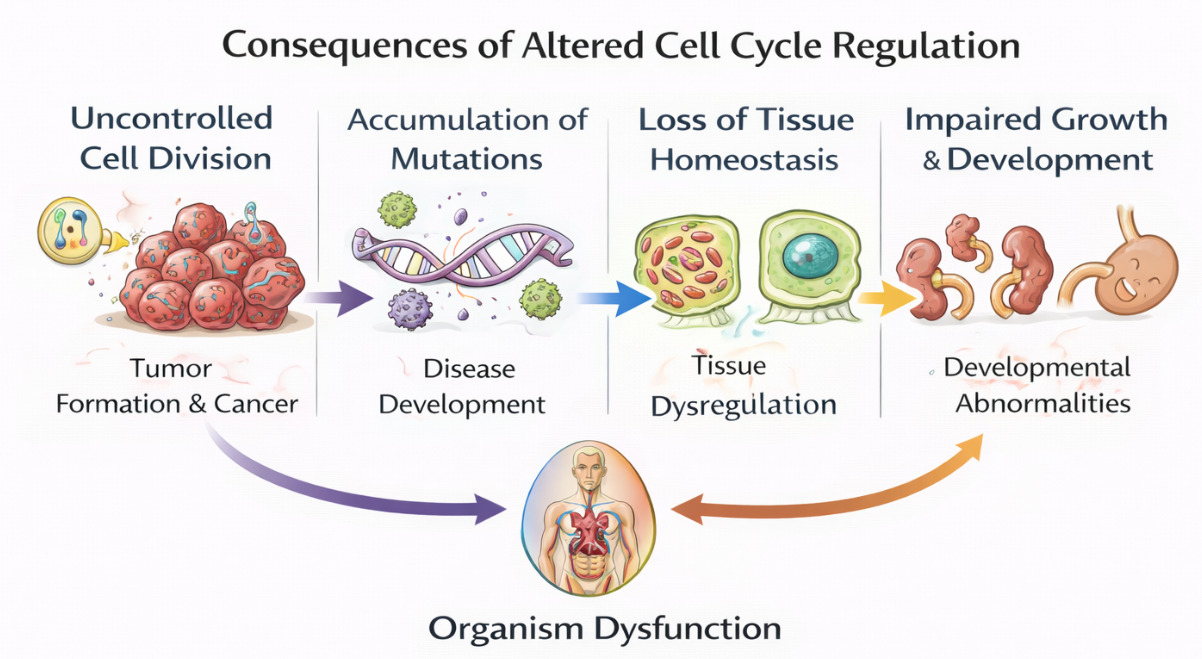
This leads to continuous, uncontrolled cell division.
Biological System Consequence
Uncontrolled division results in:
- Formation of abnormal cell masses
- Disruption of tissue organization
- Competition for nutrients and oxygen
📌 This is the basis for cancer development.
Cancer cells:
- Divide without regulation
- Ignore signals to stop dividing
- Continue replicating damaged DNA
🧬 Major Consequence 2: Accumulation of Mutations
If DNA Damage Is Not Repaired
- When regulation fails:
- Cells proceed through S phase with damaged DNA
- Errors become permanent mutations
- Mutations accumulate over time
Biological System Impact
Accumulated mutations may:
- Alter protein structure
- Disrupt metabolic pathways
- Interfere with cell communication
Over time this leads to:
- Loss of normal cell function
- Tissue dysfunction
- Increased risk of disease
🧬 Major Consequence 3: Loss of Tissue Homeostasis
Tissues rely on a balance between:
- Cell division
- Cell death
If regulation is altered:
Excessive Division
- Tissue becomes overcrowded
- Normal structure is disrupted
- Organ function declines
Insufficient Division
- Damaged cells are not replaced
- Healing slows
- Tissue degenerates
Either imbalance disrupts homeostasis.
🧬 Major Consequence 4: Impaired Growth and Development
During development:
- Cells must divide in a precise pattern
- Timing of division is critical
If regulation is altered:
- Organs may develop improperly
- Cell numbers may be incorrect
- Structural abnormalities can occur
Development requires strict cycle control.
🧬 Major Consequence 5: Systemic Effects on the Organism
At the organism level, altered regulation can cause:
- Organ failure
- Immune system disruption
- Metabolic imbalance
Because organ systems are interconnected:
Uncontrolled cell growth in one tissue
affects nutrient distribution
affects oxygen demand
affects waste removal
A cellular-level error can escalate into a system-wide problem.
🧠 Predictive Reasoning Framework
To predict consequences, follow this sequence:
- Identify which regulatory step is altered
- Determine what cellular process is affected
- Predict how daughter cells are impacted
- Extend consequences to tissue level
- Extend consequences to organism level
📌 Predictions must show biological chain reactions.
📊 Summary Table: Altered Regulation Consequences
| Altered Regulation | Cellular Effect | Tissue Effect | Organism Effect |
|---|---|---|---|
| Checkpoint failure | Uncontrolled division | Tumor formation | Cancer |
| DNA repair failure | Mutation accumulation | Dysfunctional tissue | Disease development |
| Reduced division | Insufficient cell replacement | Degeneration | Impaired healing |
| Excess division | Overcrowding | Structural disruption | Organ failure |
⚡ Quick Recap
Cell cycle regulation maintains control over cell division
Checkpoint failure leads to uncontrolled growth
DNA damage accumulation causes mutations
Tissue balance depends on regulated division
Altered regulation can result in cancer and systemic failure