
Structural Differences Between Viruses and Cells
🌿 Introduction
Cells are the fundamental structural and functional units of life.
All living organisms from bacteria to humans are composed of one or more cells.
Viruses, however, are structurally much simpler and do not meet all the characteristics of living cells.
Understanding the structural differences between viruses and cells helps explain:
- Why viruses cannot function independently
- Why they must infect host cells
- Why they are not classified as true cells
📌 Structural differences determine functional limitations.
🧬 Basic Structural Organization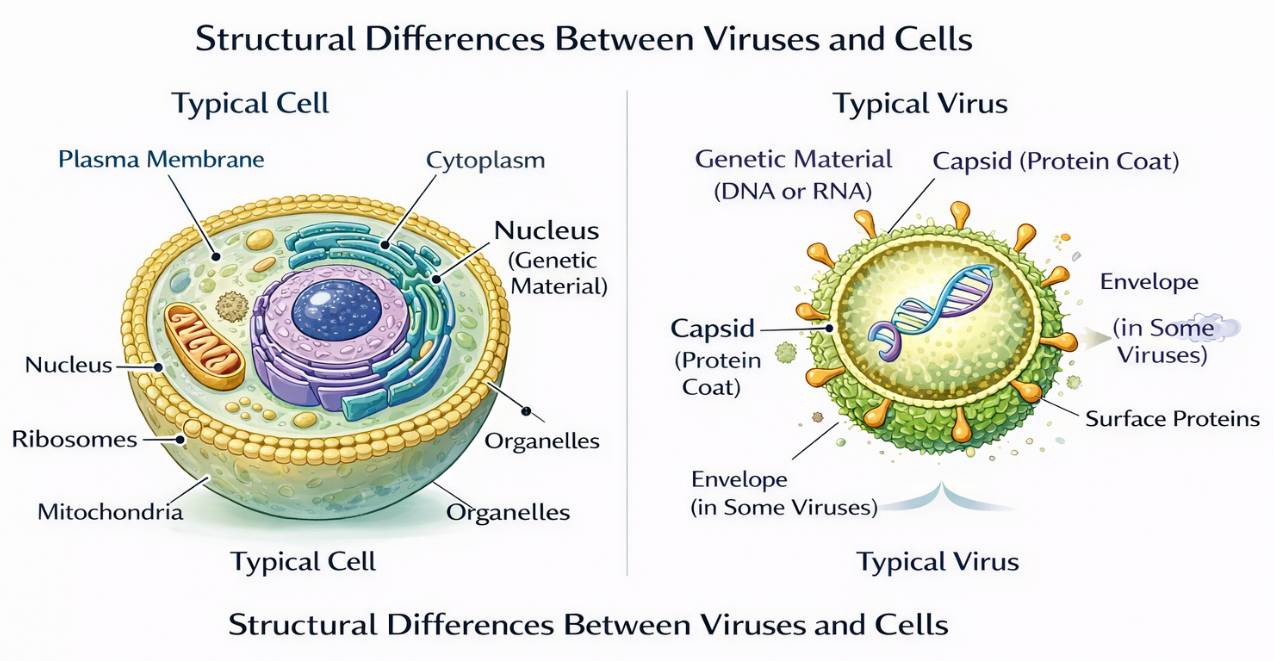
Structure of a Typical Cell
Cells share several fundamental structural components:
Plasma Membrane
- A phospholipid bilayer
- Regulates movement of substances
- Maintains internal homeostasis
Cytoplasm
- Semi-fluid internal environment
- Site of metabolic reactions
- Contains organelles
Ribosomes
- Responsible for protein synthesis
- Present in all cells
Genetic Material
- DNA organized into chromosomes
- Controls cell function
Organelles (in Eukaryotic Cells)
- Nucleus (stores DNA)
- Mitochondria (energy production)
- Endoplasmic reticulum (protein synthesis)
- Golgi apparatus (protein modification and transport)
📌 Cells are complex, self-sustaining systems.
Structure of a Virus
Viruses are structurally much simpler than cells.
A typical virus consists of:
Genetic Material
- Either DNA or RNA
- Not both
- Contains instructions for viral replication
Capsid
- Protein coat surrounding genetic material
- Protects viral genome
- Determines shape of virus
Envelope (in Some Viruses)
- Lipid layer derived from host cell membrane
- Contains surface proteins for attachment
📌 Viruses lack:
- Cytoplasm
- Ribosomes
- Organelles
- Metabolic enzymes for energy production
🧠 Key Structural Differences
1. Presence of Cellular Machinery
Cells
- Contain ribosomes for protein synthesis
- Possess enzymes for metabolism
- Can generate ATP
Viruses
- Lack ribosomes
- Cannot synthesize proteins independently
- Cannot produce energy
📌 Structural absence of machinery prevents independent survival.
2. Cellular Organization
Cells
- Surrounded by plasma membrane
- Maintain internal fluid environment
- Have organized internal compartments
Viruses
- Not considered true cells
- No cytoplasm
- No membrane-bound organelles
- Not compartmentalized
📌 Viruses are not organized cellular systems.
3. Genetic Material Arrangement
Cells
- DNA stored in nucleus (eukaryotes)
- DNA replicated before cell division
- Genetic material remains stable
Viruses
- May contain DNA or RNA
- Genetic material is packaged tightly
- Must enter host cell to replicate
📌 Viral genomes are inactive outside host cells.
4. Ability to Grow and Divide
Cells
- Grow in size
- Undergo mitosis or binary fission
- Divide independently
Viruses
- Do not grow
- Do not divide
- Are assembled inside host cells
📌 Viral replication depends entirely on host structure.
5. Size Comparison
- Cells are significantly larger
- Viruses are much smaller than even the smallest cells
📌 Small size reflects structural simplicity.
🧠 Why These Structural Differences Matter
Because viruses lack:
- Ribosomes
- Cytoplasm
- Energy-producing structures
- Complete cellular organization
They cannot:
- Perform metabolism
- Synthesize proteins
- Replicate independently
📌 Structural simplicity explains functional dependence.
📊 Summary Table: Structural Differences
| Feature | Cells | Viruses |
|---|---|---|
| Plasma membrane | Present | Sometimes envelope |
| Cytoplasm | Present | Absent |
| Ribosomes | Present | Absent |
| Organelles | Present (eukaryotes) | Absent |
| Genetic material | DNA | DNA or RNA |
| Metabolism | Independent | None |
| Reproduction | Independent division | Host-dependent assembly |
⚡ Quick Recap
Cells are complex, self-sustaining structures
Viruses are structurally simple and incomplete
Viruses lack ribosomes and cytoplasm
Viruses contain DNA or RNA inside a protein coat
Structural differences explain why viruses require host cells
How Viruses Affect Functions in Biological Systems
🌿 Introduction
Viruses are structurally simple and lack the cellular machinery required for independent life.
Because they do not possess ribosomes, cytoplasm, or metabolic systems, they cannot carry out energy-requiring reactions, including replication of their own genetic material.
To reproduce, viruses must infect host cells and hijack the host’s cellular machinery.
This hijacking disrupts normal cellular functions and can interfere with entire biological systems.
📌 Viral infection is not passive it actively redirects cellular processes.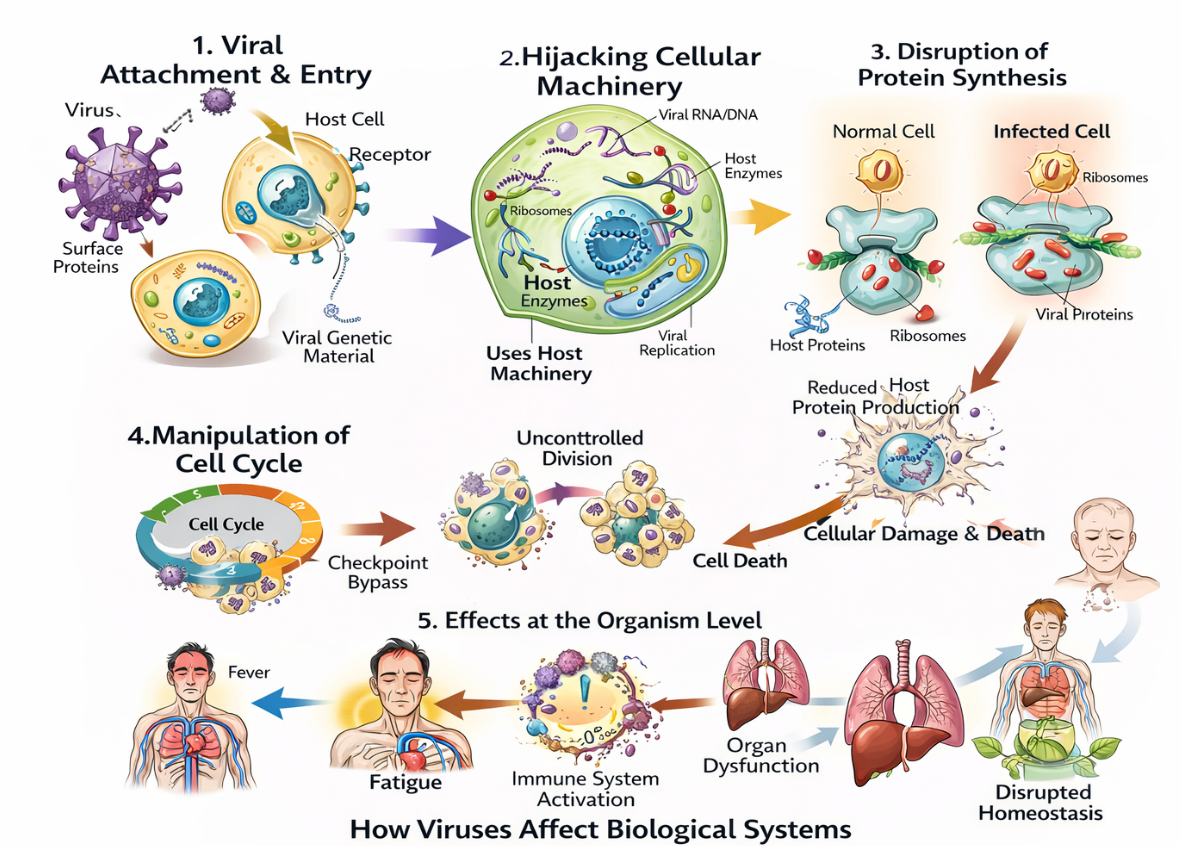
🧬 Step 1: Viral Attachment and Entry
The first effect of a virus on a biological system begins at the cellular level.
Binding to Host Cells
- Viruses have surface proteins that recognize specific receptors on host cell membranes.
- This binding determines which cells a virus can infect.
Only cells with matching receptors are susceptible.
Entry of Viral Genetic Material
After attachment:
- The virus releases its genetic material (DNA or RNA) into the host cell.
- The viral genome enters the cytoplasm or nucleus.
At this point:
- The host cell’s internal environment becomes altered.
- Viral genetic instructions begin influencing cell behavior.
🧬 Step 2: Hijacking Cellular Machinery
This is the most critical stage of viral impact.
Viruses lack:
- Ribosomes
- ATP-producing systems
- Enzymatic replication systems
Therefore, they must use the host’s:
- Ribosomes for protein synthesis
- Enzymes for genome replication
- Energy supply (ATP)
Disruption of Protein Synthesis
Normally:
- Ribosomes produce proteins necessary for cell survival.
During infection:
- Ribosomes are redirected to produce viral proteins instead.
- Host protein production decreases.
Consequence:
- Essential cellular proteins are not synthesized.
- Cell function begins to decline.
Replication of Viral Genetic Material
- Host enzymes replicate viral DNA or RNA.
- This diverts cellular resources.
- Reduces energy available for normal cell metabolism.
The infected cell becomes a viral production factory.
🧬 Step 3: Manipulation of the Cell Cycle
Some viruses interfere directly with cell cycle regulation.
They may:
- Override checkpoints
- Force cells into continuous division
- Prevent programmed cell death
Consequence of Cell Cycle Disruption
- If checkpoints are ignored:
- Cells divide uncontrollably
- DNA damage accumulates
- Tissue organization is disrupted
In some cases, this contributes to cancer development.
🧬 Step 4: Cellular Damage and Death
As viral replication continues:
- Cellular structures become damaged.
- Nutrient and energy stores are depleted.
- The cell may burst (lysis) or die.
Cell death results in:
- Loss of tissue function
- Inflammation
- Immune system activation
🧬 Effects at the Tissue Level
When many cells in a tissue are infected:
- Tissue structure is disrupted.
- Normal physiological function declines.
- Organ performance decreases.
For example:
- If respiratory cells are infected:
- Gas exchange efficiency decreases.
- If liver cells are infected:
- Detoxification is impaired.
Viral effects are amplified when multiple cells are affected.
🧬 Effects at the Organism Level
At the organism level, viral infection may lead to:
- Fever (immune response activation)
- Fatigue (energy depletion)
- Organ dysfunction
- Impaired homeostasis
Because organ systems are interconnected:
- Disruption in one tissue affects others.
- Circulatory, immune, and metabolic systems become stressed.
🧠 Summary of Biological Impact
Viruses affect biological systems by:
- Binding to host cells
- Releasing genetic material
- Hijacking ribosomes and enzymes
- Redirecting protein synthesis
- Disrupting cell cycle regulation
- Causing cell dysfunction or death
These effects cascade from molecular disruption to organism-level disease.
📊 Summary Table: Viral Impact on Biological Systems
| Level | Effect of Viral Infection |
|---|---|
| Molecular | Hijacked protein synthesis |
| Cellular | Reduced function, cell death |
| Tissue | Structural disruption |
| Organ | Decreased performance |
| Organism | Disease and homeostasis imbalance |
⚡ Quick Recap
Viruses bind to host cells and release genetic material
They use host ribosomes and enzymes to replicate
Normal cellular protein synthesis is disrupted
Some viruses alter cell cycle regulation
Infection can cause cell death and systemic disease