
Why the Products of Photosynthesis Are Ecologically Important
🌿 Introduction
Photosynthesis is the biological process through which photosynthetic organisms convert solar energy into chemical energy.
During this process, light energy is used to produce:
- Glucose (sugars)
- Oxygen (O₂)
Although photosynthesis occurs at the cellular level, its products are critical for the stability and survival of entire ecosystems.
📌 The ecological importance of photosynthesis lies in its role as the foundation of energy flow and atmospheric balance on Earth.
🧬 Primary Products of Photosynthesis
Photosynthesis produces two major outputs:
- Glucose (C₆H₁₂O₆)
- Oxygen (O₂)
Each product plays a distinct and essential ecological role.
🧪 Ecological Importance of Glucose (Chemical Energy Storage)
Glucose as an Energy Source
Glucose stores solar energy in the form of chemical bonds.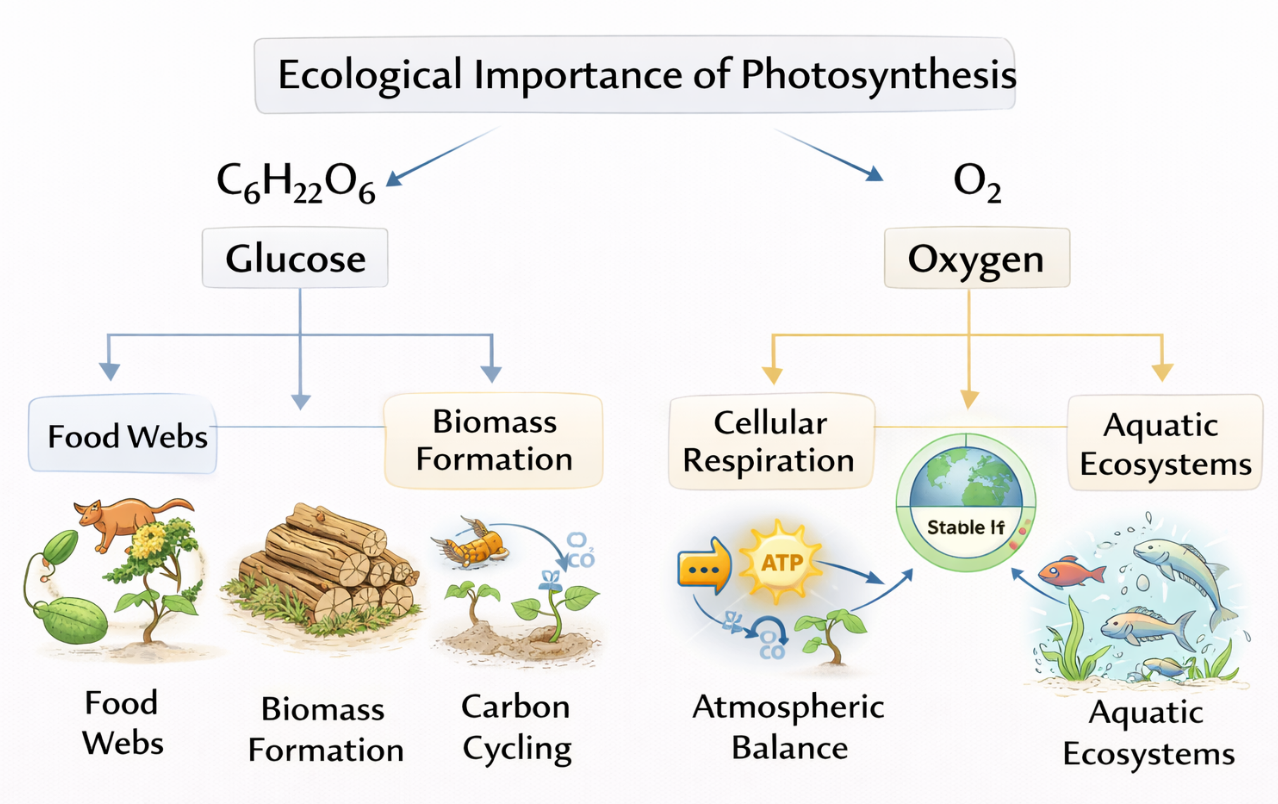
This chemical energy can later be released through cellular respiration.
Glucose is the primary energy currency for nearly all organisms.
Foundation of Food Webs
Photosynthetic organisms (plants, algae, some bacteria) are primary producers.
They:
- Convert inorganic molecules (CO₂ and H₂O)
- Into organic molecules (glucose)
This process introduces energy into ecosystems.
Consumers:
- Cannot capture solar energy directly
- Depend on producers for organic molecules
Without glucose production, food chains would collapse.
Biomass Formation
Glucose is not only used for energy – it is also used to build:
- Cellulose (plant cell walls)
- Starch (energy storage)
- Lipids
- Proteins (after nitrogen incorporation)
This contributes to:
- Plant growth
- Increase in biomass
- Carbon storage
Biomass supports herbivores, which support carnivores.
Carbon Cycling
Photosynthesis removes carbon dioxide from the atmosphere and incorporates it into organic molecules.
This:
- Reduces atmospheric CO₂ levels
- Maintains balance in the carbon cycle
- Prevents excessive greenhouse gas accumulation
Glucose production stabilizes global carbon dynamics.
🌬️ Ecological Importance of Oxygen
Oxygen and Cellular Respiration
Oxygen released during photosynthesis is essential for:
- Aerobic respiration
- ATP production in most organisms
Without oxygen:
- Energy production would be severely limited
- Complex multicellular life would not exist
📌 Oxygen enables high-efficiency energy release.
Maintenance of Atmospheric Composition
Photosynthesis continuously replenishes atmospheric oxygen.
This:
- Balances oxygen consumed by respiration
- Maintains breathable air
- Stabilizes atmospheric chemistry
📌 Oxygen concentration remains relatively stable due to ongoing photosynthesis.
Supports Aquatic Ecosystems
In aquatic environments:
- Dissolved oxygen is produced by photosynthetic organisms
- Aquatic animals depend on this oxygen for survival
If oxygen production declines:
- Fish and aquatic organisms suffocate
- Ecosystem collapse can occur
🧠 Ecosystem-Level Importance
The products of photosynthesis:
- Drive energy flow from sun → producers → consumers
- Maintain atmospheric gas balance
- Support carbon cycling
- Enable biomass accumulation
- Sustain aerobic life
Photosynthesis is the entry point of energy into nearly all ecosystems.
🔄 Energy Flow Perspective
Energy transformation follows this pathway:
Solar energy
→ Chemical energy (glucose)
→ ATP through respiration
→ Used for growth, movement, reproduction
Without photosynthetic glucose:
- Energy flow would stop
- Trophic levels would collapse
🌍 Long-Term Ecological Impact
Over geological time:
- Photosynthesis transformed Earth’s atmosphere
- Oxygen accumulation allowed evolution of complex organisms
- Carbon fixation shaped global climate patterns
Photosynthesis made complex ecosystems possible.
📊 Summary Table: Ecological Importance
| Product | Ecological Role |
|---|---|
| Glucose | Energy storage and biomass formation |
| Glucose | Foundation of food webs |
| Glucose | Carbon fixation and climate regulation |
| Oxygen | Required for aerobic respiration |
| Oxygen | Maintains atmospheric balance |
| Oxygen | Supports aquatic life |
⚡ Quick Recap
Photosynthesis produces glucose and oxygen
Glucose stores solar energy as chemical energy
Producers form the base of all food webs
Oxygen supports respiration in most organisms
Photosynthesis regulates carbon and atmospheric balance
Using Models to Explain How Solar Energy Is Converted into Chemical Energy Through Photosynthesis
🌿 Introduction
Photosynthesis is the process by which photosynthetic organisms convert solar energy into chemical energy stored in organic molecules.
This energy transformation does not occur randomly. It happens inside specialized cellular structures through a two-stage biochemical pathway.
To fully understand this conversion, we use models that represent:
- Cellular structures involved
- Movement of electrons and energy
- Transformation of light energy into ATP and NADPH
- Production of sugars
A correct model connects structure, energy flow, and chemical change.
🧬 Structural Model of Photosynthesis
Photosynthesis occurs in chloroplasts of photosynthetic eukaryotes.
A structural model of the chloroplast includes:
Outer and Inner Membranes
- Enclose the organelle
Thylakoid Membranes
- Internal folded membrane structures
- Contain chlorophyll and other pigments
- Site of light-dependent reactions
Stroma
- Fluid-filled space surrounding thylakoids
- Site of light-independent reactions
Structure determines where each stage occurs.
🌈 Model of Light Absorption (Photosynthetically Active Radiation)
Only specific wavelengths of visible light are absorbed effectively.
Pigments such as chlorophyll:
- Absorb light energy
- Excite electrons to higher energy states
📌 In a model:
Light energy → Pigment molecule → Excited electron
This is the starting point of energy conversion.
⚡ Stage 1: Light-Dependent Reactions (Energy Capture Stage)
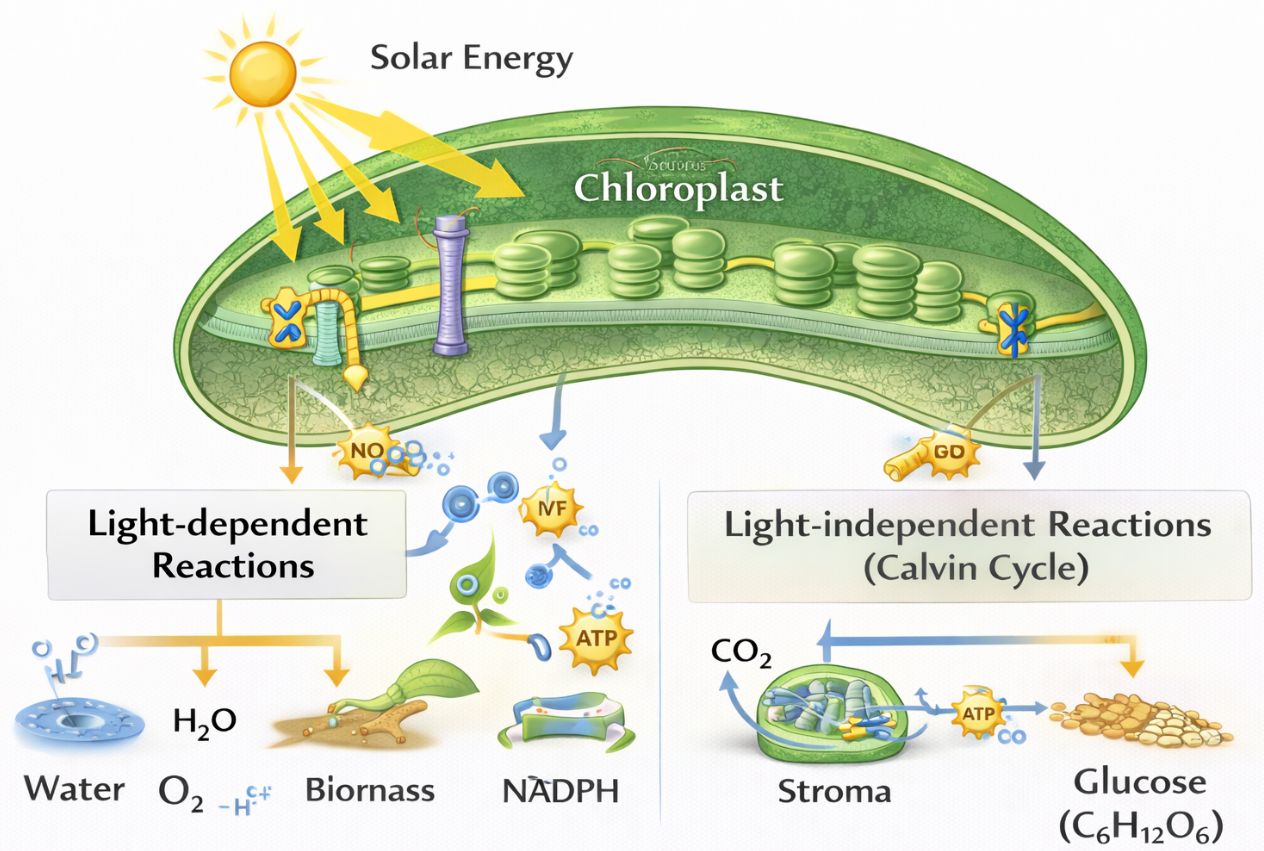
These reactions occur in the thylakoid membranes.
Step 1: Absorption of Solar Energy
- Chlorophyll absorbs photons.
- Electrons become energized.
- Energized electrons enter an electron transport system.
Model Representation:
Photon → Chlorophyll → High-energy electron
Step 2: Splitting of Water (Photolysis)
Water molecules are split into:
- Electrons
- Hydrogen ions
- Oxygen
Electrons replace those lost from chlorophyll.
Oxygen is released as a byproduct.
Model Representation:
H₂O → O₂ + electrons + hydrogen ions
This explains the ecological importance of oxygen production.
Step 3: ATP Formation
As energized electrons move through membrane proteins:
- Energy is released gradually.
- This energy is used to produce ATP.
ATP stores chemical energy temporarily.
Model Representation:
Electron flow → Energy release → ATP production
Step 4: NADPH Formation
High-energy electrons are transferred to NADP⁺ to form NADPH.
NADPH carries:
- High-energy electrons
- Reducing power for sugar production
🎯 Outcome of Light-Dependent Reactions
Products:
- ATP
- NADPH
- Oxygen (released)
📌 Solar energy is now stored in chemical forms (ATP and NADPH).
🌿 Stage 2: Light-Independent Reactions (Calvin Cycle)
These reactions occur in the stroma.
They do not require light directly but depend on ATP and NADPH.
Step 1: Carbon Dioxide Fixation
- CO₂ enters the cycle.
- It is incorporated into organic molecules.
Model Representation:
CO₂ + energy carriers → carbon compound
Step 2: Use of ATP and NADPH
ATP provides energy.
NADPH provides high-energy electrons.
These convert carbon molecules into:
- Glucose or other sugars
Chemical energy is now stored in carbon bonds.
🎯 Final Outcome
Solar energy
→ Converted to ATP and NADPH
→ Used to synthesize glucose
→ Stored in stable chemical bonds
This is true energy conversion: light energy becomes chemical energy.
🌊 Role of Water Properties in the Model
Water transport to leaves depends on:
- Cohesion
- Adhesion
- Surface tension
- Capillary action
Without water reaching chloroplasts:
- Photolysis cannot occur
- Electron supply fails
- Photosynthesis stops
Water movement supports energy conversion indirectly.
🔄 Complete Energy Flow Model
Sunlight
→ Pigment absorption
→ Excited electrons
→ ATP and NADPH
→ Carbon fixation
→ Glucose
Energy is not created. It is transformed.
📊 Summary Table: Model of Energy Conversion
| Stage | Location | Input | Output |
|---|---|---|---|
| Light-dependent | Thylakoid membrane | Light + H₂O | ATP + NADPH + O₂ |
| Light-independent | Stroma | CO₂ + ATP + NADPH | Glucose |
⚡ Quick Recap
Chloroplast structure supports photosynthesis
Light excites electrons in pigments
Water is split, releasing oxygen
ATP and NADPH store chemical energy
CO₂ is converted into glucose
Solar energy becomes chemical energy