
Why the Cellular Energy Processes in Producers and Consumers Are Dependent on One Another
🌿 Introduction
Energy is essential for all living organisms.
Cells require energy to:
- Synthesize molecules
- Maintain homeostasis
- Grow and repair
- Transport substances
- Reproduce
However, organisms do not all obtain energy in the same way.
Producers convert solar energy into chemical energy through photosynthesis.
Consumers obtain chemical energy by breaking down organic molecules through cellular respiration.
Although these processes appear opposite, they are biologically interdependent.
Together, they form a continuous cycle of energy transformation and matter exchange.
📌 The survival of both producers and consumers depends on this metabolic partnership.
🌞 Energy Capture by Producers
Photosynthesis as Energy Entry Point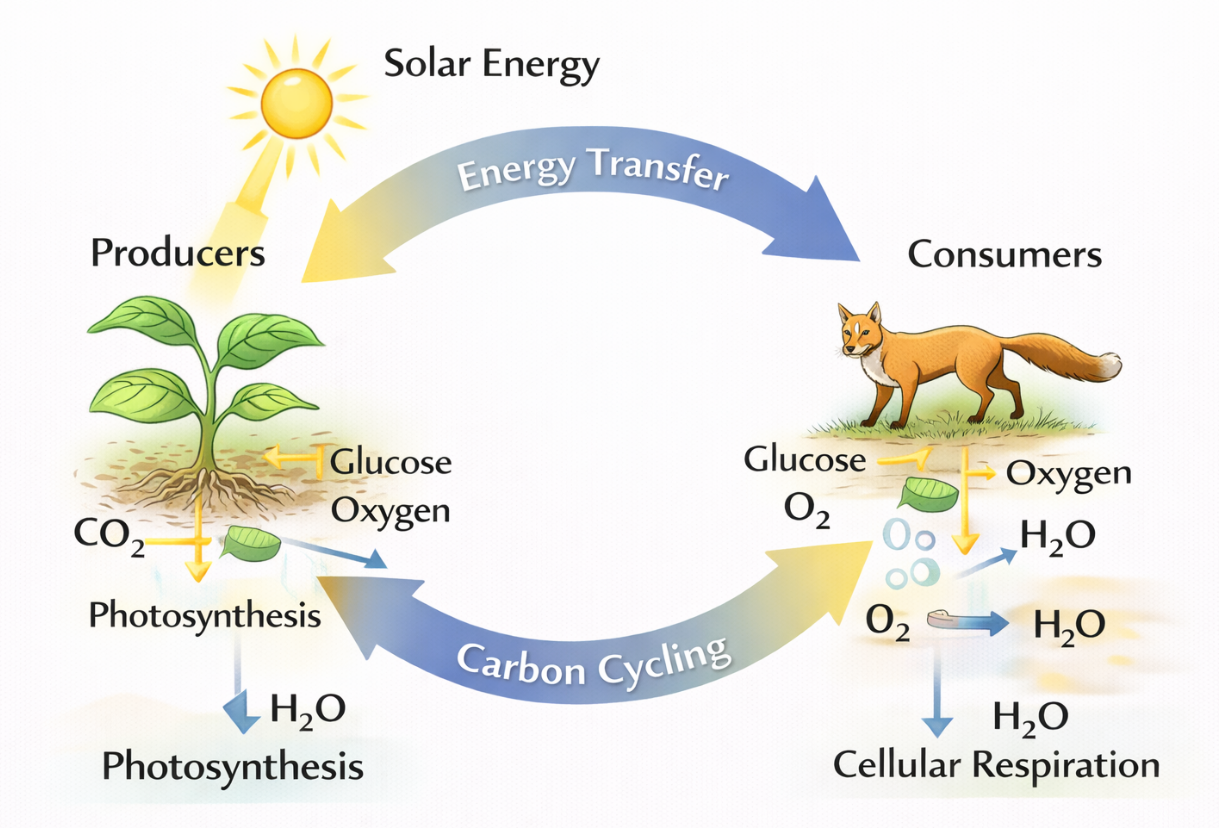
Producers, such as plants and algae:
- Capture solar energy
- Convert it into glucose
- Release oxygen as a byproduct
This process stores energy in the chemical bonds of glucose.
📌 Without photosynthesis, chemical energy would not enter biological systems.
Glucose as Energy Currency
Glucose serves as:
- A source of stored chemical energy
- A building block for larger biomolecules
- The foundation of food webs
Producers supply the organic molecules that all other organisms depend on.
🔥 Energy Release by Consumers
Cellular Respiration
Consumers cannot capture solar energy directly.
Instead, they:
- Obtain glucose from producers (directly or indirectly)
- Use cellular respiration to break down glucose
- Transfer energy to ATP
During respiration:
Glucose + Oxygen → Carbon dioxide + Water + ATP
Cellular respiration releases the energy originally stored during photosynthesis.
🔄 The Interdependence of Producers and Consumers
1. Oxygen-Carbon Dioxide Exchange
Photosynthesis:
- Uses carbon dioxide
- Produces oxygen
Cellular respiration:
- Uses oxygen
- Produces carbon dioxide
📌 The waste product of one process becomes the raw material of the other.
This maintains:
- Atmospheric balance
- Gas exchange stability
- Ecological equilibrium
2. Energy Transformation Cycle
Energy transformation follows this pathway:
Solar energy
→ Chemical energy in glucose (photosynthesis)
→ ATP production (cellular respiration)
→ Energy for cellular work
Consumers depend on producers for the initial energy conversion.
Producers depend on consumers to:
- Return carbon dioxide
- Maintain carbon cycling
3. Carbon Cycling Between Systems
Carbon atoms move between:
- Atmosphere (CO₂)
- Producers (glucose formation)
- Consumers (respiration)
- Back to atmosphere
Without consumers:
- Carbon dioxide levels would decrease excessively
- Photosynthesis would eventually slow
Without producers:
- No new glucose would form
- Consumers would lack energy sources
🧠 Ecosystem-Level Dependence
Producers:
- Form the base of food chains
- Provide energy to herbivores
Consumers:
- Transfer energy to higher trophic levels
- Maintain nutrient recycling
Energy flows through ecosystems, but matter cycles.
The balance between photosynthesis and respiration sustains life.
🌍 Why This Interdependence Maintains Homeostasis
At the ecosystem level:
- Oxygen levels remain stable
- Carbon dioxide levels remain regulated
- Energy remains available in usable form
At the organism level:
- Producers obtain CO₂ for photosynthesis
- Consumers obtain glucose and oxygen for respiration
Disruption of one process disrupts the other.
🔁 Summary of Metabolic Relationship
| Producers | Consumers |
|---|---|
| Capture solar energy | Break down glucose |
| Produce glucose | Use glucose |
| Release oxygen | Use oxygen |
| Use carbon dioxide | Release carbon dioxide |
These processes are complementary and cyclical.
⚡ Quick Recap
Producers convert solar energy into glucose
Consumers break down glucose to produce ATP
Photosynthesis produces oxygen used in respiration
Respiration produces carbon dioxide used in photosynthesis
Both processes are biologically interdependent
Using Models to Explain How Consumers Obtain Usable Energy from the Products of Photosynthesis
🌿 Introduction
Consumers cannot capture solar energy directly.
Instead, they obtain energy by consuming the organic molecules produced by photosynthesis, primarily glucose.
The chemical energy stored in glucose is not immediately usable.
Cells must convert this stored energy into ATP (adenosine triphosphate), the molecule that directly powers cellular work.
This conversion occurs through cellular respiration, a series of enzyme-controlled reactions.
📌 A correct model must show:
- Flow of carbon
- Flow of electrons
- Transfer of energy
- Production of ATP
🧬 Overall Energy Conversion Model
Energy flow in consumers follows this sequence:
Glucose (from producers)
→ Broken down through enzymatic pathways
→ High-energy electrons transferred
→ ATP produced
→ ATP powers cellular processes
Energy is transformed stepwise, not released all at once.
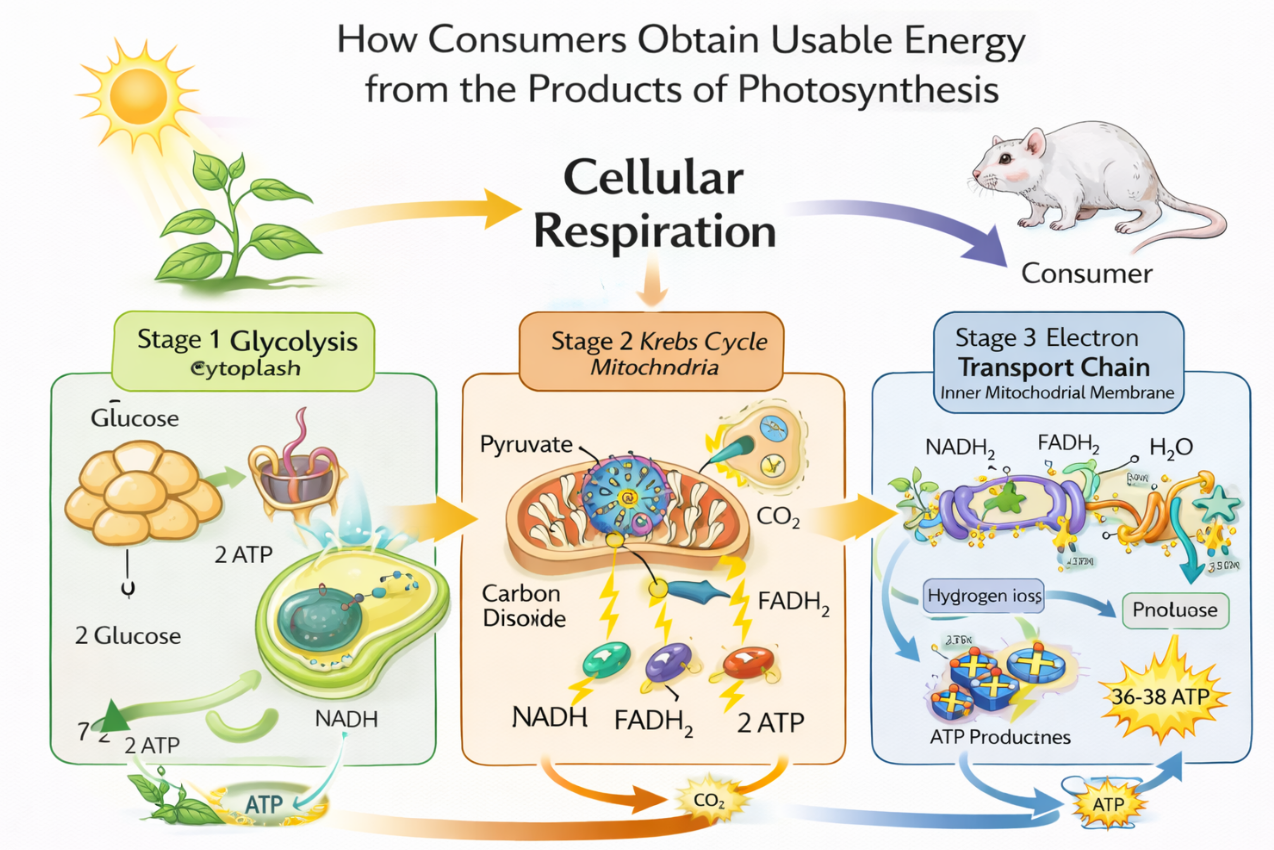
🔥 Stage 1: Glycolysis (Anaerobic – Cytoplasm)
Location
Occurs in the cytoplasm of the cell.
Model of Glycolysis
- One glucose molecule (6 carbons) enters.
- 2 ATP molecules are used to activate glucose.
- Glucose splits into two 3-carbon molecules (pyruvic acid).
- 4 ATP molecules are produced.
- 2 NADH molecules are produced.
Energy Outcome
- Net ATP gain = 2 ATP
- High-energy electrons stored in NADH
Glycolysis begins extracting energy but does not capture most of it yet.
🔥 Stage 2: Krebs Cycle (Aerobic – Mitochondria)
Location
Occurs in the mitochondrial matrix.
Model of Krebs Cycle
- Pyruvic acid enters mitochondria.
- Carbon atoms are gradually broken down.
- Carbon dioxide is released as waste.
- Energy is transferred to electron carriers:
- NADH
- FADH₂
- A small amount of ATP is produced.
Energy Outcome
- More NADH and FADH₂ accumulate.
- CO₂ is released.
- Small ATP yield compared to next stage.
Most usable energy is now stored in electron carriers.
🔋 Stage 3: Electron Transport Chain (ETC)
Location
Occurs in the inner mitochondrial membrane.
Model of Electron Transport
- NADH and FADH₂ donate high-energy electrons.
- Electrons move through a series of membrane proteins.
- Energy released is used to pump hydrogen ions (H⁺) across the membrane.
- A proton gradient builds up.
Chemiosmosis and ATP Production
- Hydrogen ions flow back through ATP synthase.
- ATP synthase produces large amounts of ATP.
- Final electron acceptor:
- Oxygen combines with electrons and hydrogen to form water.
Energy Outcome
- 36–38 ATP molecules produced per glucose.
- Water formed as byproduct.
This stage produces the majority of ATP.
🔄 Complete Energy Conversion Model
| Stage | Location | Main Output | Role in Energy Conversion |
|---|---|---|---|
| Glycolysis | Cytoplasm | 2 ATP + NADH | Begins glucose breakdown |
| Krebs Cycle | Mitochondria | NADH + FADH₂ + CO₂ | Transfers energy to carriers |
| Electron Transport Chain | Inner mitochondrial membrane | 36-38 ATP | Produces usable ATP |
🧠 Linking to Photosynthesis
Photosynthesis produces:
- Glucose
- Oxygen
Cellular respiration uses:
- Glucose as fuel
- Oxygen as final electron acceptor
Oxygen is essential for efficient ATP production.
Without oxygen:
- Electron transport stops.
- ATP production decreases dramatically.
⚙️ Why ATP Is the “Usable” Form of Energy
ATP contains:
- High-energy phosphate bonds
When ATP is broken down:
- Energy is released
Energy powers:
- Muscle contraction
- Active transport
- Protein synthesis
- Cell division
Glucose stores energy; ATP delivers it.
🌍 Ecosystem-Level Model
Producers:
- Convert sunlight → glucose
Consumers:
- Convert glucose → ATP
This creates a continuous energy transformation system.
Solar energy
→ Chemical energy (glucose)
→ ATP
→ Cellular work
⚡ Quick Recap
Consumers obtain glucose from producers
Glycolysis breaks glucose into pyruvate
Krebs cycle produces electron carriers
Electron transport chain generates most ATP
Oxygen enables efficient ATP production
ATP is the immediate usable energy form