
The Biological Importance of Fermentation
🌿 Introduction
Cellular respiration normally relies on oxygen to produce large amounts of ATP through the electron transport chain.
However, many cells experience conditions where oxygen is limited or completely absent.
Under these anaerobic conditions:
- The electron transport chain cannot function.
- NADH cannot transfer electrons to oxygen.
- NAD⁺ becomes depleted.
- Glycolysis would stop.
Fermentation is the biological process that prevents this shutdown.
Fermentation allows cells to continue producing ATP when oxygen is unavailable.
🧬 Why Fermentation Is Necessary
The Role of NAD⁺ in Glycolysis
During glycolysis:
- Glucose is broken down.
- 2 ATP molecules are produced.
- NAD⁺ is reduced to NADH.
For glycolysis to continue:
- NAD⁺ must be available.
If NAD⁺ runs out, ATP production stops.
Under aerobic conditions:
- NADH transfers electrons to oxygen.
- NAD⁺ is regenerated.
Under anaerobic conditions:
- Oxygen is absent.
- NADH cannot unload its electrons.
- NAD⁺ supply becomes limited.
Fermentation regenerates NAD⁺ without oxygen.
🔄 Core Biological Function of Fermentation
Fermentation:
- Transfers electrons from NADH to an organic molecule.
- Converts NADH back into NAD⁺.
- Allows glycolysis to continue.
- Maintains production of 2 ATP per glucose.
Without fermentation, cells would rapidly lose their ATP supply in anaerobic conditions.
🧪 Forms of Fermentation
🍷 1. Alcohol Fermentation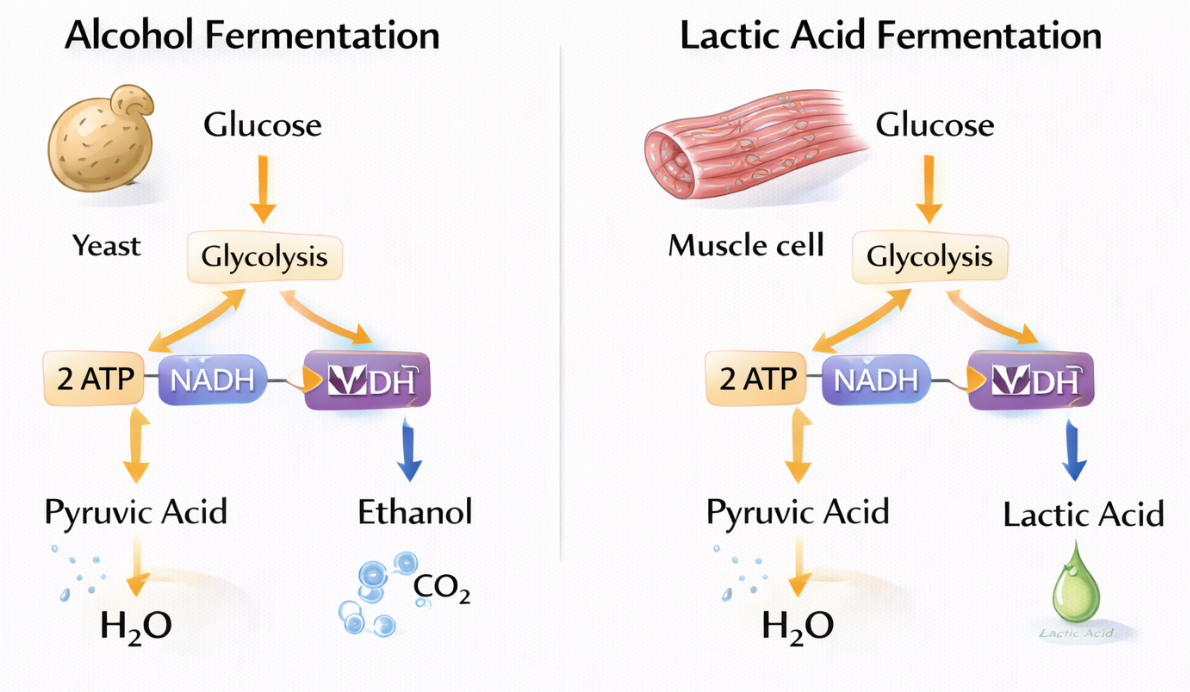
Occurs In:
- Yeast
- Some microorganisms
Process:
- Pyruvic acid is converted into ethanol.
- Carbon dioxide is released.
- NAD⁺ is regenerated.
Biological Importance:
- Enables yeast to survive without oxygen.
- Allows continued ATP production.
- Produces CO₂ that causes bread to rise.
Economically important in:
- Bread production
- Alcoholic beverages
🦠 2. Lactic Acid Fermentation
Occurs In:
- Muscle cells (when oxygen is low)
- Certain bacteria
Process:
- Pyruvic acid is converted into lactic acid.
- NAD⁺ is regenerated.
- No carbon dioxide released.
Biological Importance:
- Allows muscle cells to produce ATP during intense activity.
- Provides short-term survival under oxygen shortage.
Important in:
- Rapid muscle contraction
- Certain food fermentation processes
⚡ Energy Outcome of Fermentation
Compared to aerobic respiration:
- Aerobic respiration produces 36–38 ATP.
- Fermentation produces only 2 ATP (from glycolysis).
Fermentation is inefficient but essential for survival.
🌍 Ecological and Biological Significance
Fermentation is important because it:
- Allows survival in oxygen-poor environments.
- Enables microorganisms to inhabit diverse ecosystems.
- Supports anaerobic ecological niches.
- Contributes to nutrient cycling in certain habitats.
Some ecosystems rely heavily on anaerobic microbial processes.
🧠 Survival Perspective
Fermentation:
- Is a temporary solution for energy transfer.
- Prevents immediate energy collapse.
- Allows cells to survive until oxygen becomes available again.
In animals:
- Lactic acid buildup eventually slows muscle function.
- Oxygen must return for full recovery.
Fermentation supports short-term metabolic stability.
🔄 Metabolic Flow Summary
Glucose
→ Glycolysis
→ 2 ATP + NADH
→ Fermentation regenerates NAD⁺
→ Glycolysis continues
Fermentation does not produce extra ATP.
It maintains ATP production by recycling NAD⁺.
📊 Summary Table: Biological Importance of Fermentation
| Feature | Importance |
|---|---|
| NAD⁺ regeneration | Allows glycolysis to continue |
| ATP production | Maintains minimal energy supply |
| Survival | Enables life without oxygen |
| Alcohol fermentation | Economically important |
| Lactic acid fermentation | Supports muscle function |
⚡ Quick Recap
Fermentation occurs when oxygen is absent
It regenerates NAD⁺ from NADH
Glycolysis continues producing 2 ATP
Alcohol fermentation produces ethanol and CO₂
Lactic acid fermentation produces lactic acid
Fermentation is essential for anaerobic survival
Energy Transfer in Consumers Under Anaerobic Conditions
🌿 Introduction
Under normal conditions, consumers generate ATP primarily through aerobic cellular respiration, which requires oxygen as the final electron acceptor.
However, during conditions such as:
- Intense muscle activity
- Limited oxygen availability
- Temporary oxygen deprivation
Cells must continue producing ATP without oxygen.
Under these anaerobic conditions, energy transfer occurs through:
- Glycolysis
- Followed by lactic acid fermentation
📌 Anaerobic energy transfer is less efficient but essential for short-term survival.
🧬 What Stops When Oxygen Is Absent?
In aerobic respiration:
- NADH donates electrons to the electron transport chain.
- Oxygen accepts electrons.
- Large amounts of ATP are produced.
When oxygen is absent:
- Electron transport chain stops.
- NADH cannot unload electrons.
- NAD⁺ supply decreases.
- Glycolysis would stop if NAD⁺ is not regenerated.
Without NAD⁺, ATP production ceases.
🔥 Step 1: Glycolysis Continues (Anaerobic Phase)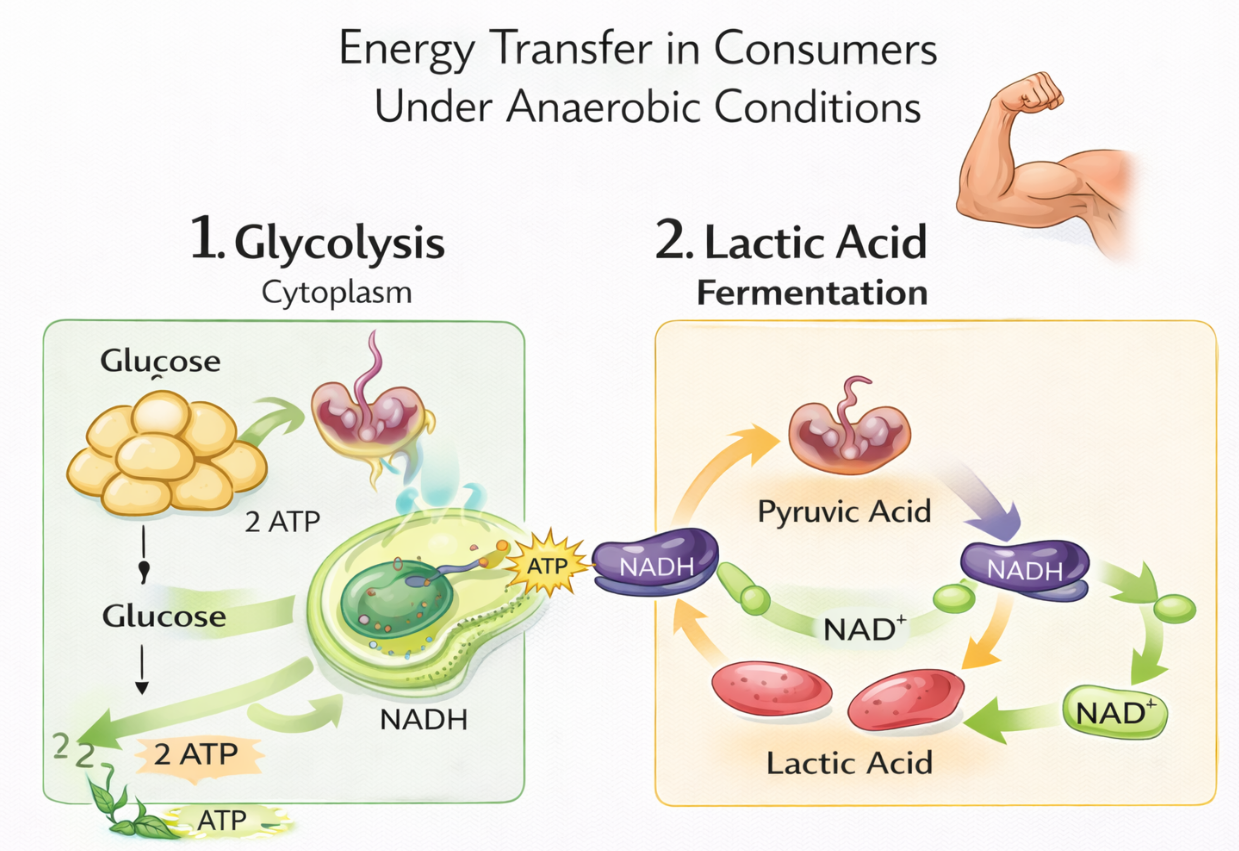
Location
Cytoplasm
What Happens in Glycolysis
- One glucose molecule enters.
- 2 ATP molecules are invested.
- Glucose splits into two pyruvic acid molecules.
- 4 ATP molecules are produced.
- Net gain: 2 ATP
- NAD⁺ is reduced to NADH.
Glycolysis does not require oxygen.
🔄 Step 2: Lactic Acid Fermentation Regenerates NAD⁺
Since oxygen is absent:
- NADH cannot transfer electrons to oxygen.
- NAD⁺ must be regenerated another way.
In consumer cells (animal muscle cells):
- Pyruvic acid accepts electrons from NADH.
- Pyruvic acid is converted into lactic acid.
- NADH becomes NAD⁺.
This allows glycolysis to continue producing ATP.
⚡ Energy Yield Under Anaerobic Conditions
Under anaerobic conditions:
- Only glycolysis produces ATP.
- Net ATP per glucose = 2 ATP
- No Krebs cycle.
- No electron transport chain.
Energy yield is much lower than aerobic respiration (36–38 ATP).
🧠 Why This Process Is Biologically Important
Anaerobic energy transfer allows:
- Muscle cells to continue contracting during intense exercise.
- Short bursts of activity when oxygen delivery is limited.
- Temporary survival under oxygen shortage.
Without fermentation:
- ATP levels would drop quickly.
- Cellular functions would stop.
- Muscle contraction would fail immediately.
🧪 Biological Consequence: Lactic Acid Accumulation
As lactic acid builds up:
- Muscle pH decreases.
- Enzyme activity slows.
- Muscle fatigue occurs.
When oxygen becomes available again:
- Lactic acid is transported to the liver.
- It can be converted back into glucose.
Anaerobic metabolism is temporary and self-limiting.
🔄 Energy Transfer Model Under Anaerobic Conditions
Glucose
→ Glycolysis
→ 2 ATP + NADH
→ Lactic acid fermentation
→ NAD⁺ regenerated
→ Glycolysis continues
ATP production continues, but at a reduced rate.
🌍 Comparison: Aerobic vs Anaerobic Energy Transfer
| Feature | Aerobic Respiration | Anaerobic (Fermentation) |
|---|---|---|
| Oxygen required | Yes | No |
| ATP yield | 36–38 ATP | 2 ATP |
| Electron acceptor | Oxygen | Pyruvic acid |
| Byproducts | CO₂ and H₂O | Lactic acid |
| Duration | Long-term | Short-term |
⚡ Quick Recap
Oxygen absence stops aerobic respiration
Glycolysis still produces 2 ATP
Lactic acid fermentation regenerates NAD⁺
ATP production continues but is limited
Lactic acid buildup causes fatigue