
Importance of the Cycling of Carbon for Biological Systems
🌱 Introduction
Carbon is one of the most important elements for life.
All living organisms are made of carbon-based molecules.
But carbon is limited on Earth.
So, it must be reused again and again through a process called the carbon cycle.
The cycling of carbon ensures that life on Earth continues without interruption.
🧬 Why Carbon is Important for Living Organisms
Carbon is the basic building block of macromolecules.
Carbon is found in:
- Carbohydrates
- Proteins
- Fats (lipids)
- Nucleic acids (DNA and RNA)
Without carbon:
- Cells cannot form
- Energy cannot be stored
- Growth and repair cannot occur
🔄 What is the Carbon Cycle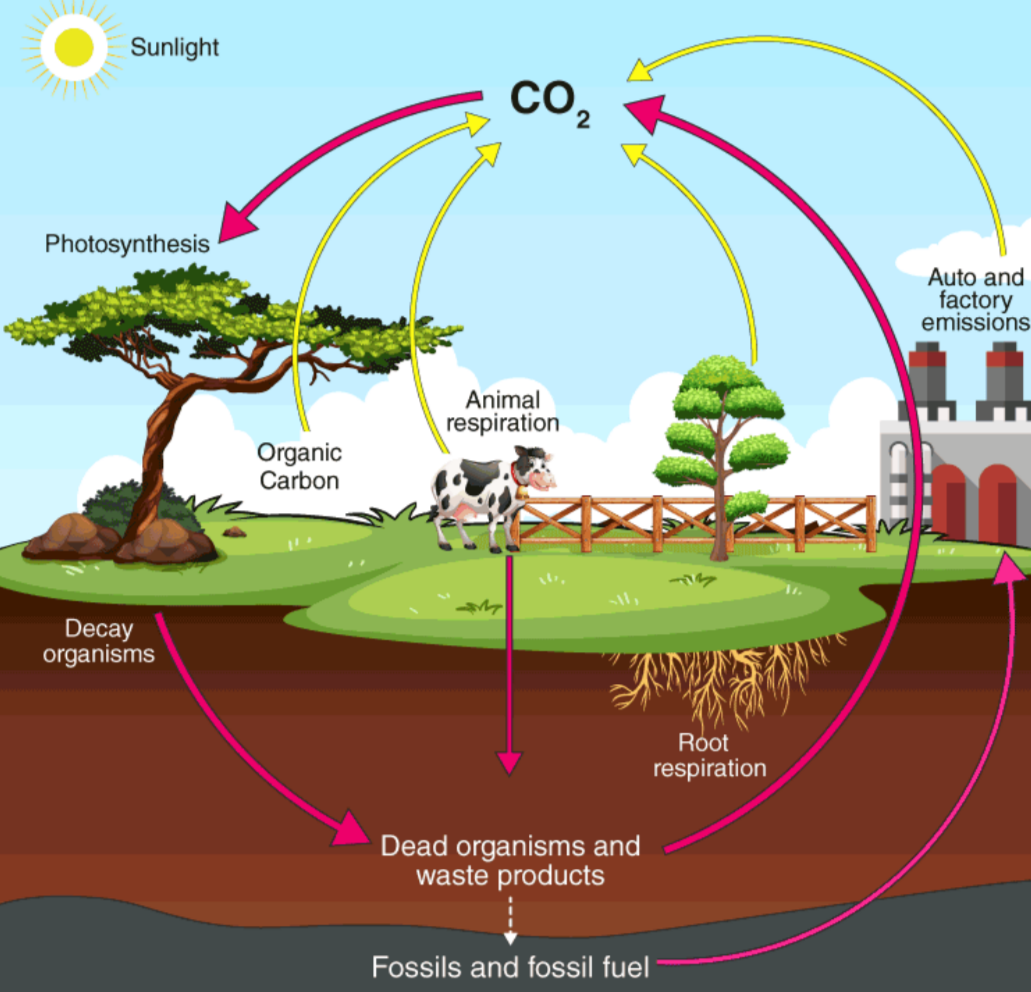
The carbon cycle is the movement of carbon between:
- atmosphere (air)
- living organisms (plants, animals)
- soil and water
- fossil fuels and rocks
Carbon keeps changing its form and location, but it is never lost.
🌿 Role of Photosynthesis in Carbon Cycling
Photosynthesis is the entry point of carbon into living systems.
- Plants take in carbon dioxide (CO₂) from the atmosphere.
- Using sunlight, plants convert CO₂ into carbohydrates.
- Carbon becomes part of plant body.
👉 This step stores carbon in food molecules.
Why it is important
- Provides food for plants
- Starts food chains
- Removes excess CO₂ from air
🐄 Transfer of Carbon Through Food Chains
Animals eat plants or other animals.
Carbon moves from one organism to another.
This transfers carbon through the ecosystem.
Example:
Grass → Deer → Lion
Carbon flows through all trophic levels.
🔥 Role of Cellular Respiration
Cellular respiration returns carbon to the atmosphere.
- Plants and animals break down food.
- Carbon-containing molecules are used for energy.
- Carbon dioxide is released as a waste product.
Importance
- Maintains balance of CO₂ in atmosphere
- Releases energy needed for life processes
🌱 Role of Decomposers
When plants and animals die:
- Decomposers break down dead bodies.
- Carbon returns to soil and atmosphere as CO₂.
Why this is important
- Prevents accumulation of dead matter
- Recycles carbon back into the system
🔥 Role of Fossil Fuels (Long-term Carbon Storage)
- Some carbon gets stored underground as coal, oil, and gas.
- Burning fossil fuels releases CO₂ back into atmosphere.
This shows carbon can be:
- stored for long periods
- released again into the cycle
📌 Importance of Carbon Cycling for Biological Systems
- Maintains Continuous Supply of Carbon
Living organisms always get carbon for growth and repair. - Supports Energy Flow
Carbon-based food molecules store energy.
Energy is released during respiration. - Maintains Atmospheric Balance
Controls CO₂ levels.
Helps regulate climate. - Connects Abiotic and Biotic Systems
Carbon moves between air, water, soil, and living organisms. - Prevents Carbon Shortage
Recycling ensures carbon is never exhausted.
📊 Summary Table
| Process | Role in Carbon Cycle |
|---|---|
| Photosynthesis | Fixes CO₂ into food |
| Food chains | Transfer carbon |
| Respiration | Releases CO₂ |
| Decomposition | Recycles carbon |
| Fossil fuels | Long-term storage |
📦 Quick Recap
Carbon is essential for life.
Carbon cycle recycles limited carbon.
Photosynthesis brings carbon into living systems.
Respiration and decomposition return carbon to atmosphere.
Carbon cycling supports energy flow and ecosystem balance.
How organisms capture and use energy to move carbon in ecosystems
🌱 Introduction
Carbon does not move on its own.
Its movement in nature depends on energy.
Living organisms capture energy and use energy, and during this process, carbon is continuously cycled through ecosystems.
To understand this, we use simple models that show:
- where energy comes from
- how organisms use energy
- how carbon moves because of energy use
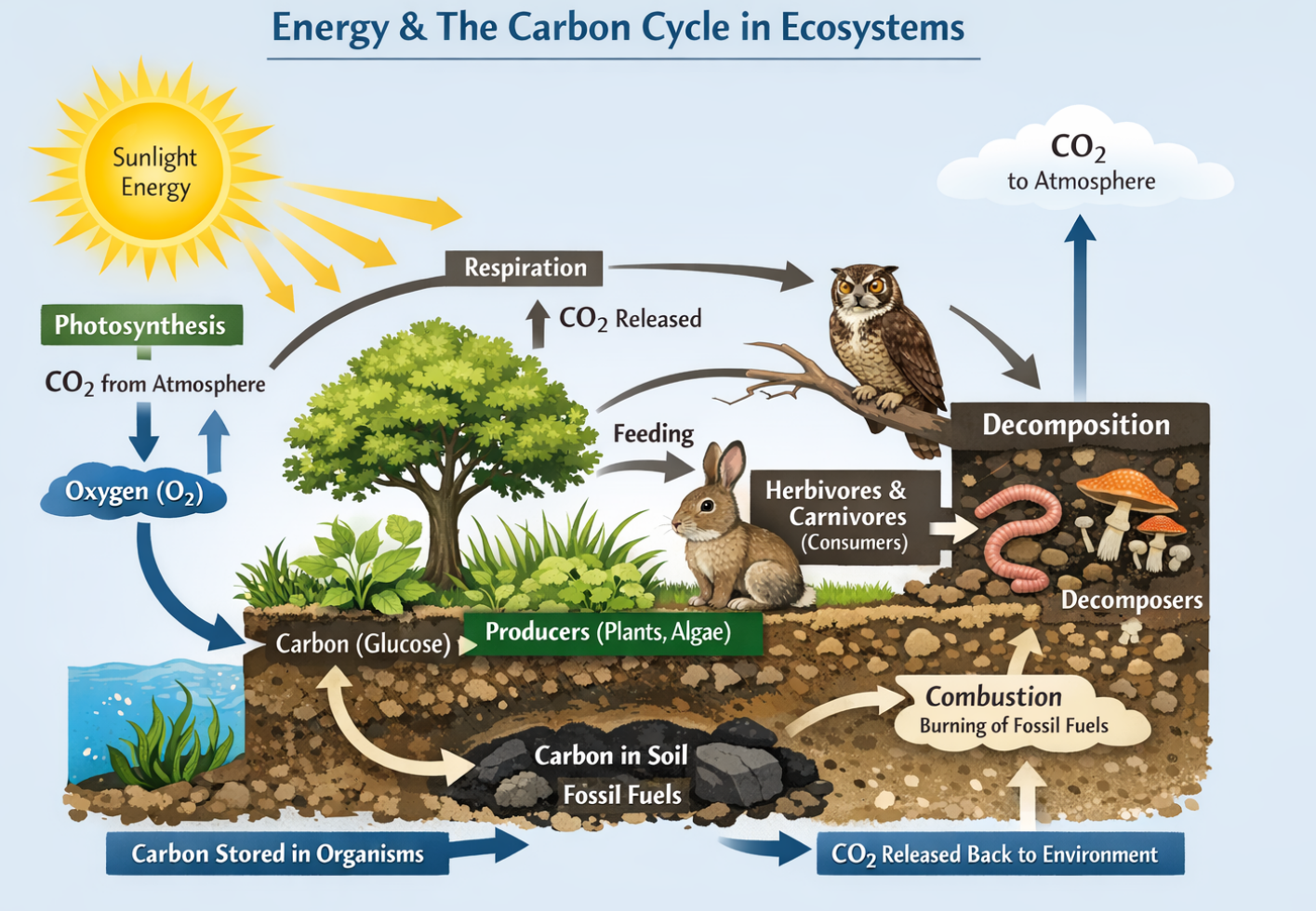
🧠 What is a Model
A model is a simplified diagram or explanation that helps us understand a process.
Here, a model helps explain:
- energy flow
- carbon movement
- connection between organisms and environment
☀️ Source of Energy in Ecosystems
The sun is the main source of energy for almost all ecosystems.
- Sunlight provides energy for photosynthesis
- This energy helps convert carbon dioxide into food
Without energy, carbon cannot enter living systems.
🌿 Step 1 Energy Capture by Producers (Photosynthesis Model)
Process
- Plants absorb sunlight.
- Plants take in carbon dioxide from air.
- Using light energy, CO₂ is converted into glucose.
Simple Model
Sunlight
↓
Plants (Photosynthesis)
↓
Glucose (Carbon + Stored Energy)
Importance
- Carbon enters living organisms.
- Energy is stored in carbon-based molecules.
- This is the starting point of the carbon cycle.
🐄 Step 2 Energy Transfer Through Food Chains
What happens
- Animals eat plants or other animals.
- Energy stored in food is transferred.
- Carbon moves along with energy.
Example Model
Plant → Herbivore → Carnivore
(Carbon + Energy move together)
Importance
- Carbon reaches all living organisms.
- Energy flows from one level to another.
🔥 Step 3 Use of Energy by Organisms (Respiration Model)
Process
- Organisms break down food molecules.
- Energy is released for life activities.
- Carbon dioxide is released as waste.
Simple Model
Glucose + Oxygen
↓
Energy + CO₂ + Water
Importance
- Energy supports growth, movement, repair.
- Carbon returns to the atmosphere.
- Cycle continues.
🌱 Step 4 Role of Decomposers in Energy Use
What decomposers do
- Break down dead plants and animals.
- Use stored energy in organic matter.
- Release carbon dioxide.
Model
Dead matter
↓
Decomposers
↓
CO₂ + Nutrients
Importance
- Prevents waste buildup.
- Recycles carbon and nutrients.
📌 Key Points Linking Energy and Carbon Cycling
- Energy capture allows carbon to enter ecosystems.
- Carbon stores energy in food molecules.
- Energy use releases carbon back into environment.
- Energy flow and carbon cycling are connected.
📊 Summary Table
| Stage | Energy Role | Carbon Movement |
|---|---|---|
| Photosynthesis | Energy captured | CO₂ → food |
| Food chain | Energy transferred | Carbon passed |
| Respiration | Energy released | CO₂ returned |
| Decomposition | Energy used | Carbon recycled |
📦 Quick Recap
Sun is the main energy source.
Plants capture energy during photosynthesis.
Energy is stored in carbon compounds.
Animals use energy and release CO₂.
Decomposers recycle carbon.
Energy flow drives the carbon cycle.
Importance of the Cycling of Nutrients for Biological Systems
🌱 Introduction
Living organisms require nutrients to survive, grow, repair their bodies, and reproduce.
These nutrients are chemical elements present in the environment.
However, nutrients are not unlimited.
If they were used only once, life on Earth would soon stop.
Therefore, nature follows a system where nutrients are reused again and again.
This process is known as nutrient cycling.
🧬 What are Nutrients
Nutrients are substances required by organisms to:
- build cells and tissues
- produce energy
- carry out life processes
Examples of essential nutrients
- Carbon
- Nitrogen
- Phosphorus
- Oxygen
- Sulfur
Each nutrient has a specific role in living systems.
🔄 What is Nutrient Cycling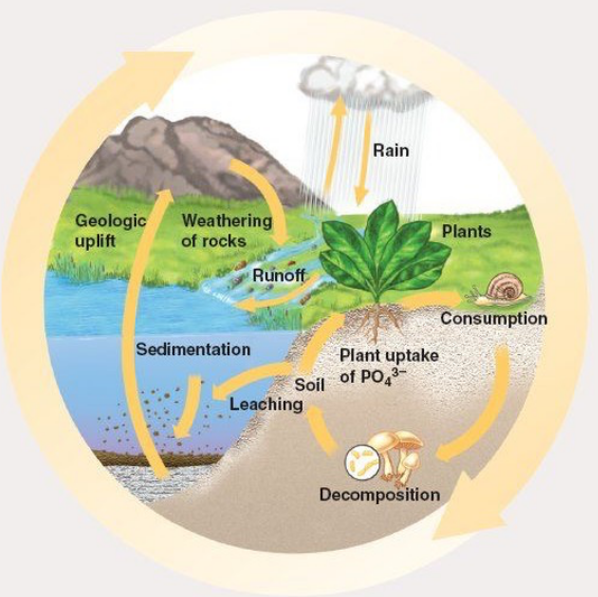
Nutrient cycling is the movement of nutrients between:
- Abiotic components (air, soil, water, rocks)
- Biotic components (plants, animals, microorganisms)
This movement occurs through biogeochemical cycles.
🌿 Importance of Nutrient Cycling for Biological Systems
1) Ensures Continuous Availability of Nutrients
- Nutrients are reused instead of being lost.
- Living organisms always get the materials they need.
- Supports life over long periods of time.
Example
Carbon used by one plant is later reused by another organism.
2) Helps in Formation of Biomolecules
Nutrients are needed to make macromolecules.
| Nutrient | Role |
|---|---|
| Carbon | Backbone of organic molecules |
| Nitrogen | Proteins and DNA |
| Phosphorus | ATP and DNA |
| Sulfur | Certain amino acids |
| Oxygen | Respiration |
Without nutrient cycling, these molecules cannot be formed continuously.
3) Supports Energy Flow in Ecosystems
- Nutrients help form energy-rich compounds.
- Energy stored in food depends on nutrients.
- Energy transfer in food chains requires nutrient recycling.
No nutrients = no energy flow.
4) Links Abiotic and Biotic Systems
- Plants absorb nutrients from soil, water, and air.
- Animals obtain nutrients by eating plants or animals.
- Decomposers return nutrients to environment.
This connection maintains ecosystem balance.
5) Maintains Soil Fertility
- Nutrients returned to soil improve soil quality.
- Healthy soil supports healthy plants.
- Prevents nutrient depletion of land.
Role of decomposers
- Break down dead organisms.
- Release nutrients back into soil.
6) Prevents Waste Accumulation
- Dead plants and animals are decomposed.
- Nutrients are recycled instead of piling up.
- Keeps environment clean and usable.
7) Supports Growth and Reproduction
- Nutrients help in cell division.
- Needed for tissue repair and reproduction.
- Lack of nutrients leads to poor growth.
🌾 Examples of Major Nutrient Cycles
Carbon Cycle
- Carbon is recycled through photosynthesis, respiration, and decomposition.
- Maintains balance of carbon in ecosystems.
Nitrogen Cycle
- Nitrogen is essential for proteins.
- Bacteria help convert nitrogen into usable forms.
- Nitrogen returns to soil and atmosphere.
Phosphorus Cycle
- Phosphorus is required for ATP and DNA.
- Cycles through rocks, soil, and water.
- Important for energy transfer.
📊 Summary Table
| Aspect | Importance |
|---|---|
| Continuous supply | Prevents nutrient exhaustion |
| Biomolecule formation | Builds cells and tissues |
| Energy flow | Supports food chains |
| Soil fertility | Supports plant growth |
| Ecosystem balance | Links living and non-living |
| Waste control | Prevents accumulation |
📦 Quick Recap
Nutrients are essential for life.
Nutrients are limited and must be recycled.
Nutrient cycling ensures continuous supply.
Supports energy flow and ecosystem balance.
Decomposers play a key role.
Without nutrient cycling, life cannot survive.
Cycling of Nitrogen Between Biotic and Abiotic Systems
🌱 Introduction
Nitrogen is an essential nutrient for all living organisms.
It is needed to make:
- proteins
- DNA
- enzymes
Although 78% of the atmosphere is nitrogen gas, most organisms cannot use nitrogen directly.
Therefore, nitrogen must be converted into usable forms and recycled continuously.
This process is called the nitrogen cycle.
🧬 What is the Nitrogen Cycle
The nitrogen cycle is the movement of nitrogen between:
- abiotic systems (atmosphere, soil, water)
- biotic systems (plants, animals, bacteria)
Nitrogen changes its form at different stages but keeps circulating.
🌬️ Major Reservoir of Nitrogen (Abiotic System)
The atmosphere is the largest reservoir of nitrogen.
- Nitrogen exists as nitrogen gas (N₂).
- This form is not usable by plants and animals.
So, nitrogen must first be fixed.
🔄 Steps of the Nitrogen Cycle
1. Nitrogen Fixation
Nitrogen fixation is the process of converting nitrogen gas into ammonia.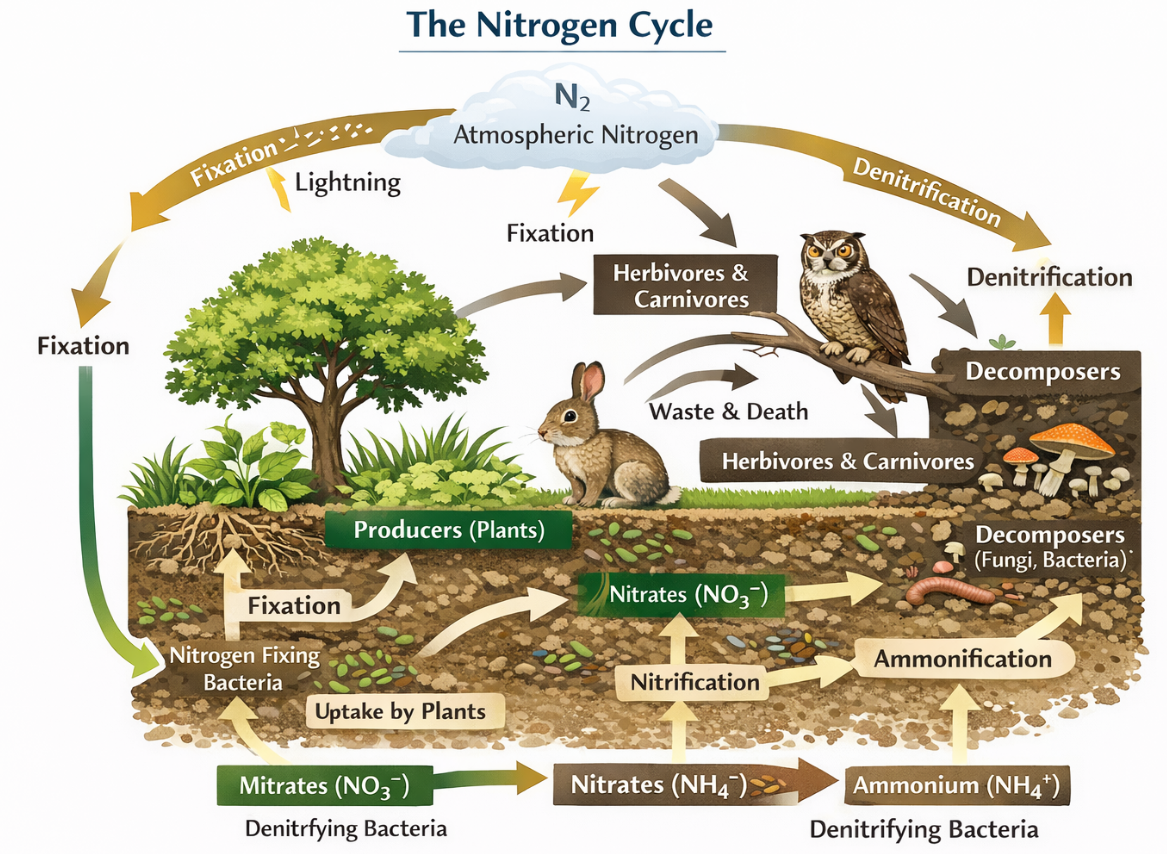
How it happens
- Certain bacteria convert N₂ into ammonia (NH₃).
- These bacteria live:
- freely in soil
- inside root nodules of legume plants
Importance
- Makes nitrogen usable for plants.
- First step of nitrogen entering living systems.
- Abiotic → Biotic link starts here
2. Nitrification
Nitrification is the process of converting ammonia into nitrates.
Steps
- Ammonia → Nitrites
- Nitrites → Nitrates
This conversion is done by nitrifying bacteria in soil.
Importance
- Nitrates are easily absorbed by plant roots.
3. Assimilation
Assimilation is the absorption of nitrates by plants.
What happens
- Plants absorb nitrates from soil.
- Nitrogen is used to make:
- proteins
- nucleic acids
Biotic role
- Plants become nitrogen-rich.
- Animals get nitrogen by eating plants.
4. Transfer Through Food Chain
- Herbivores eat plants.
- Carnivores eat herbivores.
- Nitrogen moves from one organism to another.
Nitrogen is now fully part of biotic systems.
5. Ammonification
Ammonification is the process of breaking down dead organisms and waste.
Who does this
- Decomposers like bacteria and fungi.
What happens
- Organic nitrogen → ammonia
Importance
- Returns nitrogen to soil.
- Prevents waste accumulation.
6. Denitrification
Denitrification is the process of converting nitrates back into nitrogen gas.
Who does this
- Denitrifying bacteria
What happens
- Nitrates → nitrogen gas (N₂)
Nitrogen returns to atmosphere.
Cycle is completed.
🌿 Biotic and Abiotic Roles
Abiotic Systems
- Atmosphere (N₂)
- Soil (ammonia, nitrates)
Biotic Systems
- Bacteria (fixation, nitrification, denitrification)
- Plants (assimilation)
- Animals (consumption)
📌 Importance of Nitrogen Cycle
- Provides nitrogen for proteins and DNA.
- Maintains soil fertility.
- Supports plant growth.
- Maintains balance of nitrogen in environment.
- Connects living and non living systems.
📊 Summary Table
| Step | Process | System Involved |
|---|---|---|
| Nitrogen fixation | N₂ → ammonia | Bacteria |
| Nitrification | Ammonia → nitrates | Soil bacteria |
| Assimilation | Uptake by plants | Plants |
| Food chain | Transfer | Animals |
| Ammonification | Decomposition | Decomposers |
| Denitrification | Nitrates → N₂ | Bacteria |
📦 Quick Recap
Nitrogen is essential but not directly usable.
Atmosphere is largest nitrogen store.
Bacteria play the most important role.
Nitrogen moves between abiotic and biotic systems.
Nitrogen cycle keeps soil fertile and life balanced.