
Role of Biological Diversity in Ecological Processes
🌱 Introduction
An ecosystem works smoothly only when many different organisms perform different roles.
This variety of living organisms in a community is called biological diversity.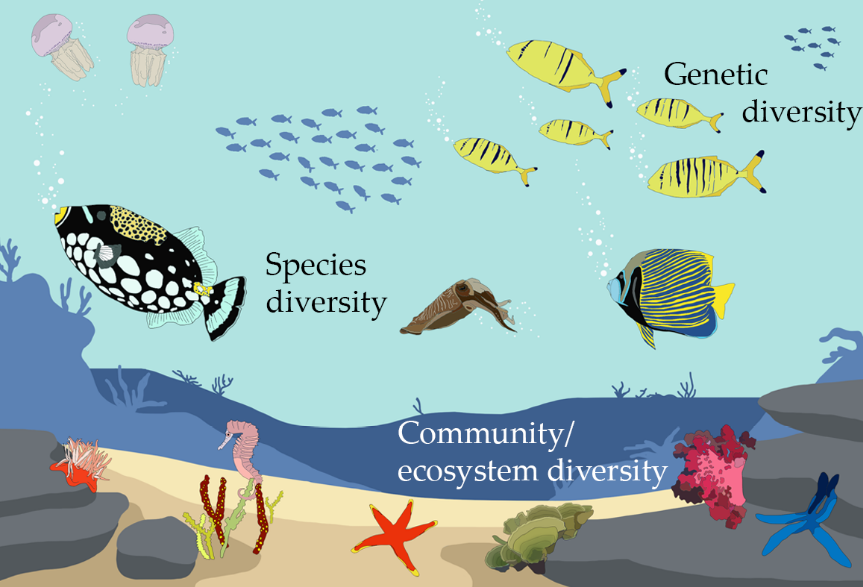 Ecological processes like nutrient cycling, energy flow, population regulation, and ecosystem stability depend directly on this diversity.
If biodiversity decreases, these processes become weak or unstable.
🌱 What is Biological Diversity in a Community?
Biological diversity refers to the variety of life forms present in an ecological community.
It includes:
- Different species of plants
- Different species of animals
- Microorganisms like bacteria and fungi
Each organism contributes in a unique way to ecosystem functioning.
🌱 Ecological Processes
Ecological processes are the natural activities that keep ecosystems functioning.
Major ecological processes include:
- Nutrient cycling
- Energy transfer through food webs
- Decomposition
- Population regulation
- Ecosystem recovery after disturbance
These processes cannot function properly without biodiversity.
🌱 Biodiversity and Nutrient Cycling
Nutrient cycling involves movement of elements like:
- Carbon
- Nitrogen
- Phosphorus
Role of biodiversity:
- Plants absorb nutrients from soil.
- Herbivores consume plants.
- Carnivores consume herbivores.
- Decomposers break down dead matter and return nutrients to soil.
More species = more efficient nutrient recycling.
If decomposers are lost:
- Nutrients remain locked in dead matter.
- Soil fertility decreases.
🌱 Biodiversity and Energy Transfer
Energy enters ecosystems through primary producers.
Energy flows through:
- Producers
- Consumers
- Decomposers
Role of biodiversity:
- Diverse producers capture energy more efficiently.
- Complex food webs provide multiple energy pathways.
- Energy flow remains stable even if one species declines.
High biodiversity prevents energy flow disruption.
🌱 Biodiversity and Food Web Stability
Food webs are made of many interconnected food chains.
Each species occupies a specific role.
Role of biodiversity:
- Multiple prey options reduce predator starvation.
- Multiple predators prevent prey overpopulation.
Loss of one species can disturb the entire food web.
🌱 Biodiversity and Population Regulation
- Predators control prey populations.
- Competitors regulate population size.
- Parasites and pathogens prevent dominance of a single species.
Role of biodiversity:
- Maintains population balance.
- Prevents overuse of resources.
Balanced populations keep ecosystems stable.
🌱 Biodiversity and Ecosystem Resilience
Resilience is the ability of an ecosystem to recover after disturbance.
Examples of disturbances:
- Drought
- Fire
- Disease outbreaks
Role of biodiversity:
- If one species fails, others can perform similar functions.
- Ecosystem continues functioning.
Diverse communities recover faster.
🌱 Effect of Biodiversity Loss on Ecological Processes
Reduction in biodiversity leads to:
- Slower nutrient cycling
- Disrupted energy flow
- Unstable food webs
- Reduced ecosystem productivity
Fewer species means fewer functional roles.
📊 Summary Table
| Ecological Process | Role of Biodiversity |
|---|---|
| Nutrient cycling | Efficient recycling of nutrients |
| Energy transfer | Stable energy flow |
| Food web stability | Multiple feeding pathways |
| Population regulation | Balanced population sizes |
| Resilience | Faster recovery |
📦 Quick Recap
Ecological processes depend on biodiversity.
Biodiversity supports nutrient cycling and energy flow.
It stabilises food webs and regulates populations.
High biodiversity increases ecosystem resilience.
Loss of biodiversity weakens ecosystem functioning
Ecological Services Provided by Biomes That Benefit Humans
🌱 Introduction
A biome is a large region with a specific climate, vegetation, and type of organisms.
Each biome performs essential ecological functions that support life on Earth.
These functions are called ecosystem services, and humans depend on them directly and indirectly.
Without healthy biomes, human survival, economy, and environmental stability would be seriously affected.
🌱 What Are Ecological (Ecosystem) Services?
Ecological services are the natural processes and benefits provided by ecosystems that support human life.
They exist because of high biodiversity and proper functioning of ecological processes.
Main categories:
- Regulating services
- Supporting services
- Provisioning services
🌱 Forest Biome
Key Characteristics
- High plant and animal diversity
- Dense tree cover
- High primary productivity
Ecological Services Provided
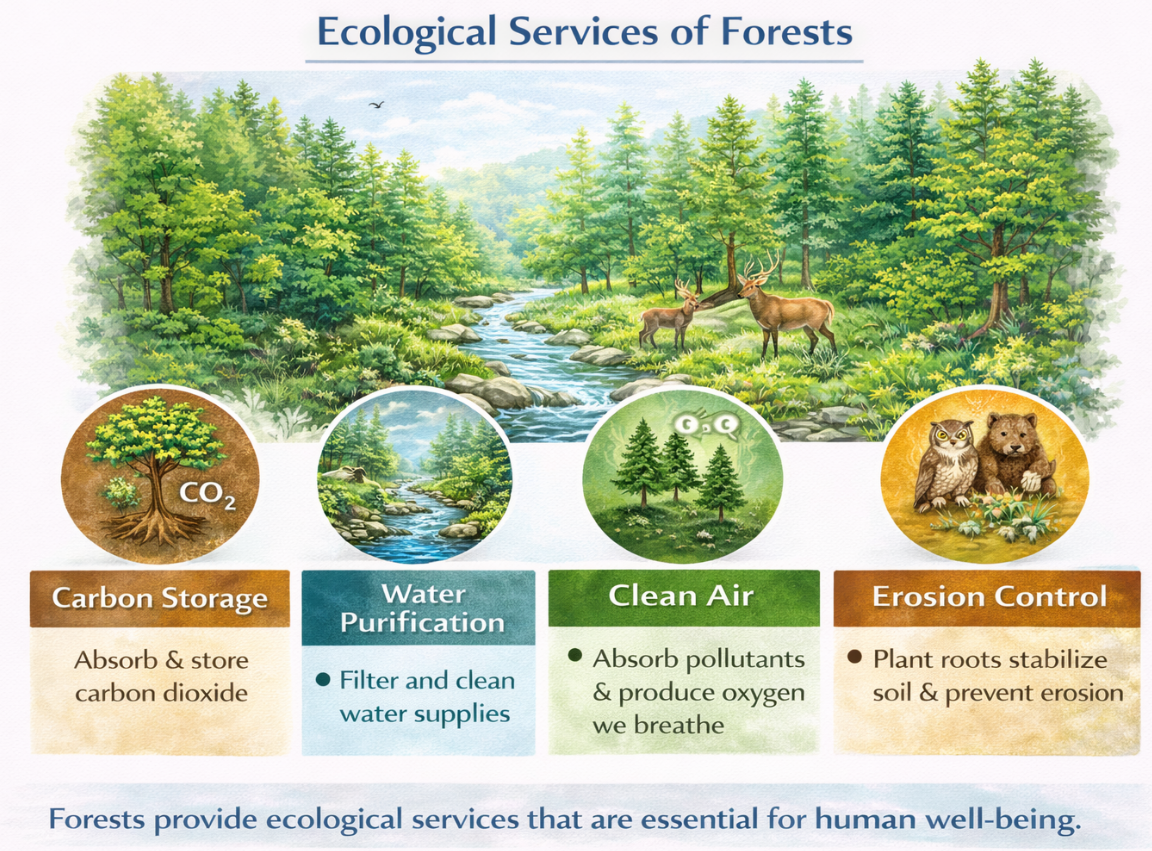
Climate Regulation
- Trees absorb carbon dioxide during photosynthesis.
- Carbon is stored in wood, leaves, and soil.
Carbon Storage
- Forests act as major carbon sinks.
- Reduce greenhouse gases.
Water Cycle Regulation
- Transpiration from leaves maintains rainfall patterns.
- Controls local and global climate.
Soil Protection
- Roots hold soil together.
- Prevent soil erosion and landslides.
Human Benefits
- Reduced global warming
- Stable climate and rainfall
- Fertile soil for agriculture
- Clean air and oxygen
🌱 Grassland Biome
Key Characteristics
- Dominated by grasses
- Seasonal rainfall
- Large grazing animals
Ecological Services Provided
Soil Fertility Maintenance
- Grasses have deep root systems.
- Add organic matter to soil.
Carbon Storage in Soil
- Carbon stored below ground.
- Reduces atmospheric CO₂.
Pollination Support
- Supports insects like bees and butterflies.
Human Benefits
- Supports crop production
- Provides grazing land for livestock
- Prevents desertification
- Maintains food security
🌱 Desert Biome
Key Characteristics
- Low rainfall
- Extreme temperatures
- Specialized organisms
Ecological Services Provided
Climate Regulation
- Influences global heat balance.
Mineral Cycling
- Soils rich in minerals.
Genetic Resources
- Organisms have special adaptations.
- Source of drought-resistant genes.
Human Benefits
- Medicinal plants
- Mineral resources
- Genetic material for crop improvement
🌱 Freshwater Biome (Rivers, Lakes, Streams)
Key Characteristics
- Flowing or standing freshwater
- High species interaction
Ecological Services Provided
Water Filtration
- Microorganisms remove pollutants.
- Sediments trap impurities.
Nutrient Cycling
- Supports aquatic food webs.
Flood Control
- Natural channels reduce flood intensity.
Human Benefits
- Clean drinking water
- Irrigation for agriculture
- Fisheries
- Reduced flood damage
🌱 Wetland Biome
Key Characteristics
- Water-saturated soil
- Very high biodiversity
Ecological Services Provided
Water Purification
- Wetland plants absorb toxins and excess nutrients.
Flood and Erosion Control
- Act as natural sponges.
- Slow down water flow.
Carbon Storage
- Store carbon in waterlogged soil.
Human Benefits
- Safe drinking water
- Protection from floods
- Climate regulation
- Biodiversity conservation
🌱 Marine Biome
Key Characteristics
- Largest biome on Earth
- Includes oceans and seas
Ecological Services Provided
Oxygen Production
- Phytoplankton produce large amounts of oxygen.
Carbon Sequestration
- Oceans absorb excess CO₂.
Climate Regulation
- Control global temperature and weather patterns.
Human Benefits
- Major food source
- Climate stability
- Livelihood for coastal populations
🌱 Why Biodiversity Is Essential for These Services
- Different species perform different functions.
- Loss of species weakens services.
- Less biodiversity leads to reduced ecosystem efficiency.
📊 Summary Table
| Biome | Major Ecological Services | Human Benefits |
|---|---|---|
| Forest | Carbon storage, climate control | Reduced warming |
| Grassland | Soil fertility, pollination | Agriculture |
| Desert | Genetic resources, mineral cycling | Medicine, crops |
| Freshwater | Water filtration, flood control | Drinking water |
| Wetlands | Water purification, erosion control | Flood protection |
| Marine | Oxygen production, carbon sink | Food, climate |
📦 Quick Recap
Biomes provide life-support services.
Forests regulate climate and store carbon.
Grasslands maintain fertile soil and pollination.
Wetlands provide clean water and flood control.
Freshwater systems supply drinking water and fisheries.
Marine biomes produce oxygen and stabilise climate.
Healthy biodiversity supports healthy human life