
How Competition Shapes Community Characteristics
🌱 Introduction
An ecological community consists of multiple species living together and interacting in the same environment.
One of the most powerful forces shaping these communities is competition for limited resources.
Competition does not simply affect individual organisms.
Over time, it determines which species persist, which decline, and how the entire community is structured.
🌱 What Is Competition in an Ecological Community?
Competition occurs when two or more species require the same limited resource, and the use of that resource by one species reduces its availability to others.
Key points:
- Competition arises because resources are finite
- It is strongest when species have overlapping ecological niches
- It operates continuously, not occasionally
Interspecific competition influences long-term community patterns, not just short-term interactions.
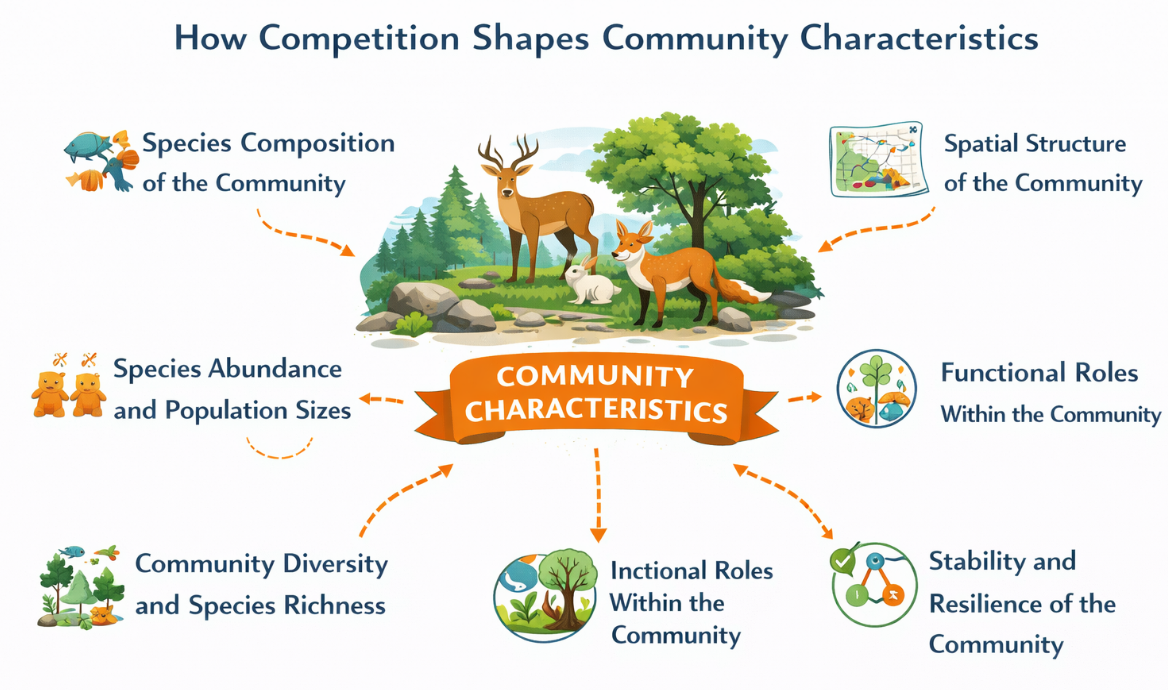
🌱 Community Characteristics Affected by Competition
Competition shapes multiple defining features of ecological communities.
1. Species Composition of the Community
Competition determines which species are present in a community.
- Species that are more efficient at resource use tend to survive and reproduce.
- Less competitive species may:
- Decline in number
- Be forced into marginal habitats
- Be eliminated locally
Result:
- Communities reflect the outcome of long-term competitive interactions.
Competition therefore acts as a filter, allowing only certain species to persist.
2. Species Abundance and Population Sizes
Competition directly affects population size within a community.
When competition is intense:
- Growth rates decrease
- Mortality increases
Dominant competitors often achieve:
- Higher population densities
- Greater access to resources
As a result:
- Communities often show uneven species abundances
- A few species may be numerically dominant, while others remain rare
This unevenness is a key characteristic shaped by competition.
3. Community Diversity and Species Richness
Competition influences how many species can coexist.
- When two species occupy the same niche, competition is intense.
Over time, this leads to:
- Competitive exclusion of one species
- Reduced species richness
However:
- When competition promotes resource differentiation, multiple species may coexist.
Thus, competition can:
- Reduce diversity through exclusion
- Maintain diversity through niche differentiation
Community diversity reflects the balance between exclusion and coexistence.
4. Spatial Structure of the Community
Competition affects where species live within a habitat.
Examples:
- Plants competing for light may grow at different heights.
- Animals competing for space may establish territories.
Effects:
- Species become spatially separated
- Communities show distinct spatial patterns
This spatial organization reduces direct competition and becomes a stable community characteristic.
5. Functional Roles Within the Community
Each species performs a functional role such as:
- Producer
- Herbivore
- Predator
- Decomposer
Competition shapes:
- Which species perform these roles
- How many species share similar functions
In communities with high competition:
- Functional redundancy may be reduced
- Loss of one species may strongly affect ecosystem processes
Thus, competition influences community functioning, not just composition.
6. Stability and Resilience of the Community
Competition contributes to community stability in two ways:
Short term
- Intense competition can destabilize populations.
Long term
- Stable competitive relationships lead to predictable community structure.
- Species adjust resource use over time.
Result:
- Communities develop dynamic equilibrium, where species persist without unlimited growth.
Competition therefore helps regulate community stability.
🌱 Competition as a Long-Term Shaping Force
Competition:
- Operates continuously
- Acts over generations
- Produces predictable outcomes
Community characteristics shaped by competition include:
- Species presence
- Species abundance
- Diversity
- Spatial arrangement
- Functional roles
These characteristics are not accidental.
They are the result of evolutionary and ecological pressures caused by competition.
📊 Summary Table
| Community Characteristic | Effect of Competition |
|---|---|
| Species composition | Selects dominant species |
| Species abundance | Creates uneven population sizes |
| Diversity | Can reduce or maintain diversity |
| Spatial structure | Promotes separation |
| Functional roles | Shapes ecosystem functioning |
| Stability | Regulates long-term balance |
📦 Quick Recap
Competition shapes community characteristics by controlling:
• Which species survive
• How abundant species become
• How many species coexist
• Where species are distributed
• How stable the community remains
Using Data to Analyze How Competition Influences Niche Partitioning in an Ecological Community
🌱 Introduction
In natural communities, many species live together while using similar resources.
If these species competed in exactly the same way, long-term coexistence would not be possible.
Instead, ecological data often show that competition drives species to divide resources, a process known as niche partitioning.
🌱 What Is Niche Partitioning?
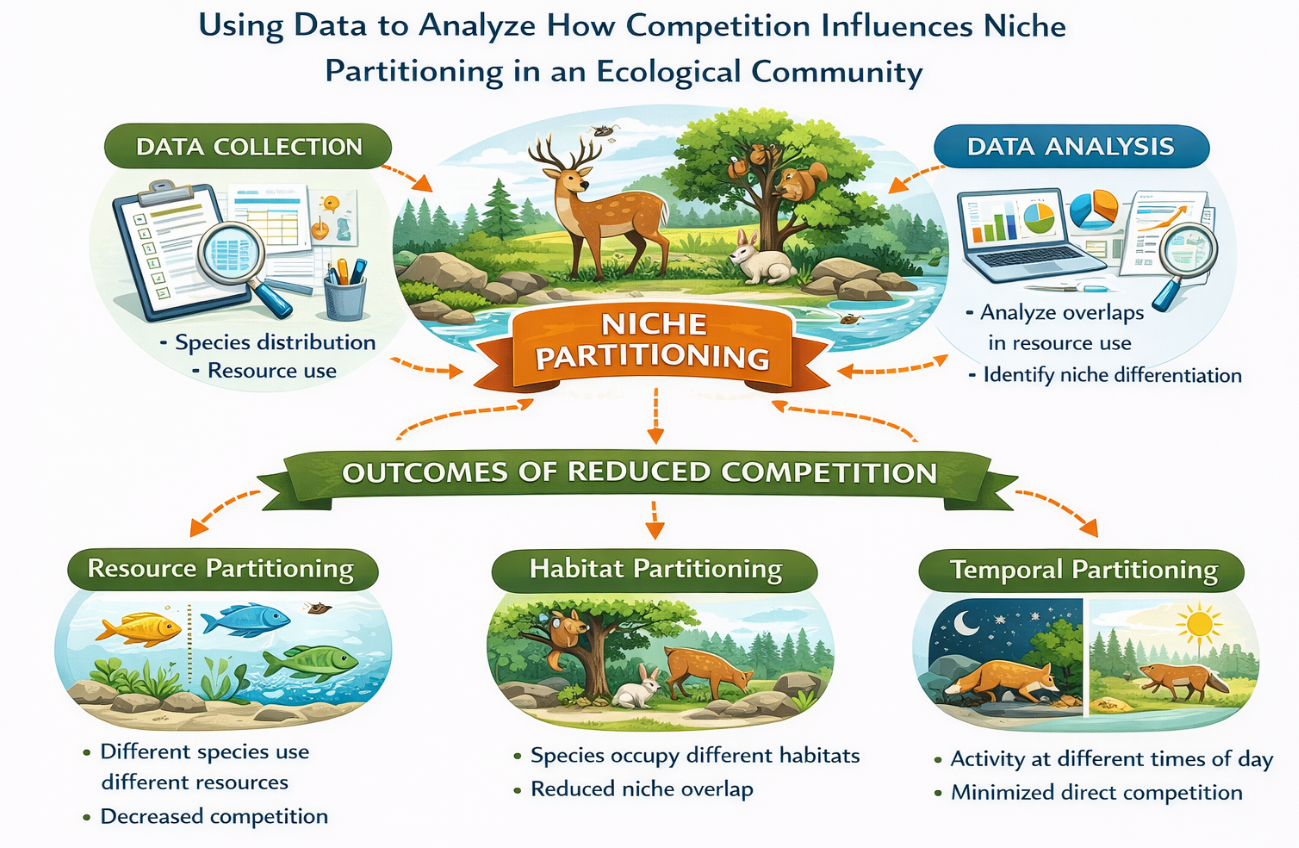
Niche partitioning is the process by which competing species use resources differently to reduce direct competition.
It may involve differences in:
- Space
- Time
- Type of resource
- Feeding behavior
As a result, species with overlapping niches are able to coexist within the same community.
🌱 Role of Competition in Driving Niche Partitioning
When two or more species compete for the same limited resource:
- Competition reduces growth and survival.
- Individuals that use slightly different resources experience less competition.
- Over time, natural selection favors these differences.
This leads to resource specialization, which becomes visible in population data.
🌱 Types of Data Used to Analyze Niche Partitioning
Ecologists rely on quantitative and observational data, including:
- Resource use measurements
- Population density across habitats
- Feeding frequency or diet composition
- Activity timing (day vs night)
- Spatial distribution data
Such data help reveal how species reduce overlap.
🌱 Spatial Resource Partitioning (Data Interpretation)
Concept
Species may occupy different physical areas within the same habitat.
Data Evidence
- Species A has high population density in shallow zones.
- Species B dominates deeper zones.
- Overlap is minimal where competition is strongest.
Interpretation
- Competition for space or food pushes species into different microhabitats.
- Data showing distinct spatial distributions indicate spatial niche partitioning.
🌱 Dietary Niche Partitioning (Data Interpretation)
Concept
Species consume different food types or sizes to avoid competition.
Data Evidence
- Analysis of stomach contents shows:
- Species A consumes small seeds.
- Species B consumes large seeds.
Resource overlap decreases when both species coexist.
Interpretation
- Competition drives specialization in diet.
- Reduced overlap in food use allows coexistence.
🌱 Temporal Niche Partitioning (Data Interpretation)
Concept
Species use the same resource at different times.
Data Evidence
- Activity data show:
- Species A feeds during daylight.
- Species B feeds at night.
Resource availability remains constant.
Interpretation
- Competition is reduced by time separation.
- Data indicate temporal niche partitioning.
🌱 Niche Overlap and Competition Data
Ecologists often calculate niche overlap indices.
- High overlap indicates strong competition.
- Low overlap indicates reduced competition.
Data trends commonly show:
- Overlap decreases when species coexist.
- Overlap increases when one species is removed.
This confirms that competition actively shapes resource use.
🌱 Classic Experimental Evidence (Conceptual)
When competition is experimentally removed:
- Species expand their niche.
- Resource use becomes broader.
When competitors are present:
- Species restrict resource use.
- Niche width becomes narrower.
This pattern, supported by data, demonstrates that:
- Niche partitioning is a response to competition, not coincidence.
🌱 Effects of Niche Partitioning on Community Structure
Data consistently show that niche partitioning:
- Increases species coexistence
- Reduces competitive exclusion
- Maintains community diversity
- Stabilizes resource use
Communities with strong niche partitioning are:
- More diverse
- More stable
- Less likely to collapse due to competition
📊 Summary Table
| Type of Data | Evidence of Niche Partitioning |
|---|---|
| Spatial distribution | Habitat separation |
| Diet composition | Different food resources |
| Activity timing | Temporal separation |
| Population density | Reduced overlap |
| Experimental removal | Niche expansion |
📦 Quick Recap
Competition increases niche overlap.
High overlap reduces survival.
Species respond by partitioning resources.
Using Models to Predict How Changes in Resource Availability Affect Interactions Between Species
🌱 Introduction
Species interactions in ecological communities are not fixed.
They change whenever the availability of resources changes.
Resources such as food, space, light, nutrients, and water determine:
- The intensity of competition
- The type of interaction between species
- Whether species coexist or exclude one another
🌱 What Is Meant by “Models” in Ecology?
In ecology, a model is a simplified representation used to explain or predict real-world interactions.
Common models used include:
- Conceptual models (flow diagrams)
- Resource-use overlap models
- Population growth graphs
- Food web models
- Carrying capacity models
Models help answer the question:
What will happen to species interactions if resource availability changes?
🌱 Resource Availability as a Driver of Species Interactions
Resource availability determines:
- Whether competition is weak or strong
- Whether niche partitioning occurs
- Whether competitive exclusion happens
Changes in resources can be:
- Increases
- Decreases
- Uneven redistribution
Each type of change produces predictable effects, which models help illustrate.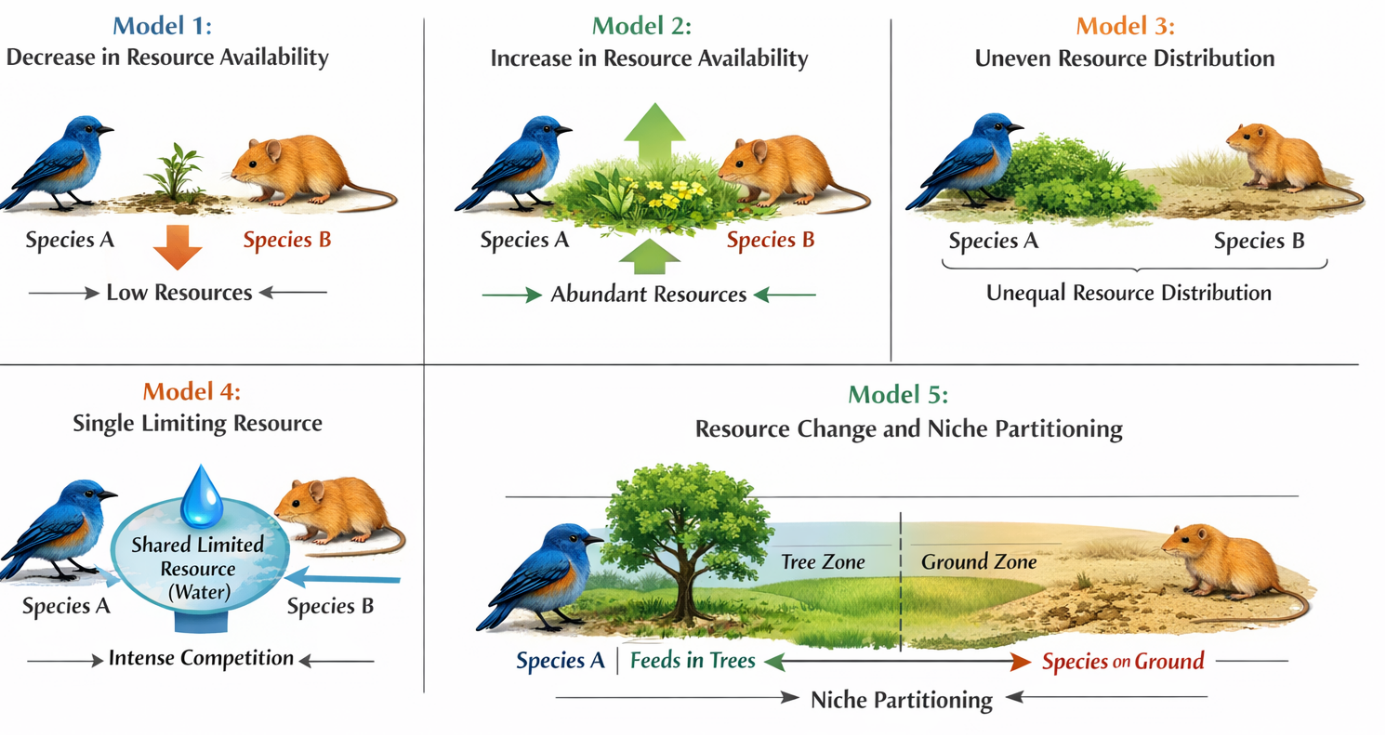
🌱 Model 1: Decrease in Resource Availability
Conceptual Model
Limited resources → Increased competition → Strong interaction outcomes
Prediction
- Competition intensity increases
- Species with overlapping niches are strongly affected
- One species may outcompete the other
Possible outcomes
- Competitive exclusion of the weaker species
- Reduction in population size of both species
- Increased stress and reduced growth rates
Community-level prediction
- Lower species diversity
- Simplified community structure
🌱 Model 2: Increase in Resource Availability
Conceptual Model
Abundant resources → Reduced competition → Increased coexistence
Prediction
- Competition pressure decreases
- Species can expand resource use
- Niche overlap becomes less harmful
Possible outcomes
- Coexistence of competing species
- Increase in population sizes
- Higher community diversity
Community-level prediction
- More stable community
- Reduced risk of competitive exclusion
🌱 Model 3: Uneven Resource Distribution
Conceptual Model
Patchy resources → Spatial niche partitioning
Prediction
- Species specialize in different patches
- Spatial separation increases
- Direct competition decreases
Possible outcomes
- Clear habitat partitioning
- Stable coexistence through reduced overlap
Community-level prediction
- Structured spatial community
- Reduced interaction intensity
🌱 Model 4: Single Limiting Resource
Conceptual Model
One limiting resource controls interaction outcomes
Prediction
- Species that use the resource more efficiently dominate
- Less efficient species decline or shift niche
Possible outcomes
- Strong competitive hierarchy
- Reduced niche breadth
Community-level prediction
- Dominance of one species
- Loss of functional redundancy
🌱 Model 5: Resource Change and Niche Partitioning
Conceptual Model
Competition → Resource differentiation → Coexistence
Prediction
- Species alter behavior, diet, or habitat use
- Niche partitioning develops
Possible outcomes
- Reduced niche overlap
- Long-term coexistence
Community-level prediction
- Maintained biodiversity
- Stable resource use
🌱 Using Graphical Models to Support Predictions
Population growth graphs show that:
- Resource decline lowers carrying capacity
- Resource increase raises carrying capacity
Food web models show that:
- Loss of a resource affects multiple species
- Changes propagate through the community
These models help predict indirect effects, not just direct competition.
🌱 Importance of Models in Ecological Prediction
Models allow ecologists to:
- Predict outcomes before changes occur
- Compare alternative scenarios
- Understand complex interactions logically
They are essential for:
- Conservation planning
- Ecosystem management
- Biodiversity protection
📊 Summary Table
| Resource Change | Predicted Interaction Outcome |
|---|---|
| Decrease | Strong competition, exclusion |
| Increase | Reduced competition, coexistence |
| Uneven distribution | Spatial partitioning |
| Single limiting resource | Species dominance |
| Moderate limitation | Niche partitioning |
📦 Quick Recap
Resource availability controls species interactions.
Resource decline increases competition.
Resource increase promotes coexistence.
Uneven resources cause niche partitioning.
Limiting resources drive exclusion or dominance.
Ecological models link resource change to community outcomes