
Types of Symbiotic Relationships Between Organisms
🌱 Introduction
In many ecosystems, species do not live independently.
Instead, they form close and long-term associations with other species.
Such relationships are called symbiotic relationships.
🌱 What Is a Symbiotic Relationship?
A symbiotic relationship is a close, persistent interaction between two different species in which at least one organism benefits.
Key characteristics:
- Long-term association
- Species live closely together
- Interaction affects survival, growth, or reproduction
Symbiotic relationships are classified based on the effect on each organism.
🌱 Basis for Classifying Symbiosis
To determine the type of symbiosis, ask three questions:
- Does organism A benefit?
- Does organism B benefit?
- Is either organism harmed?
Based on these outcomes, symbiosis is classified into three major types.
🌱 Mutualism (+ / +)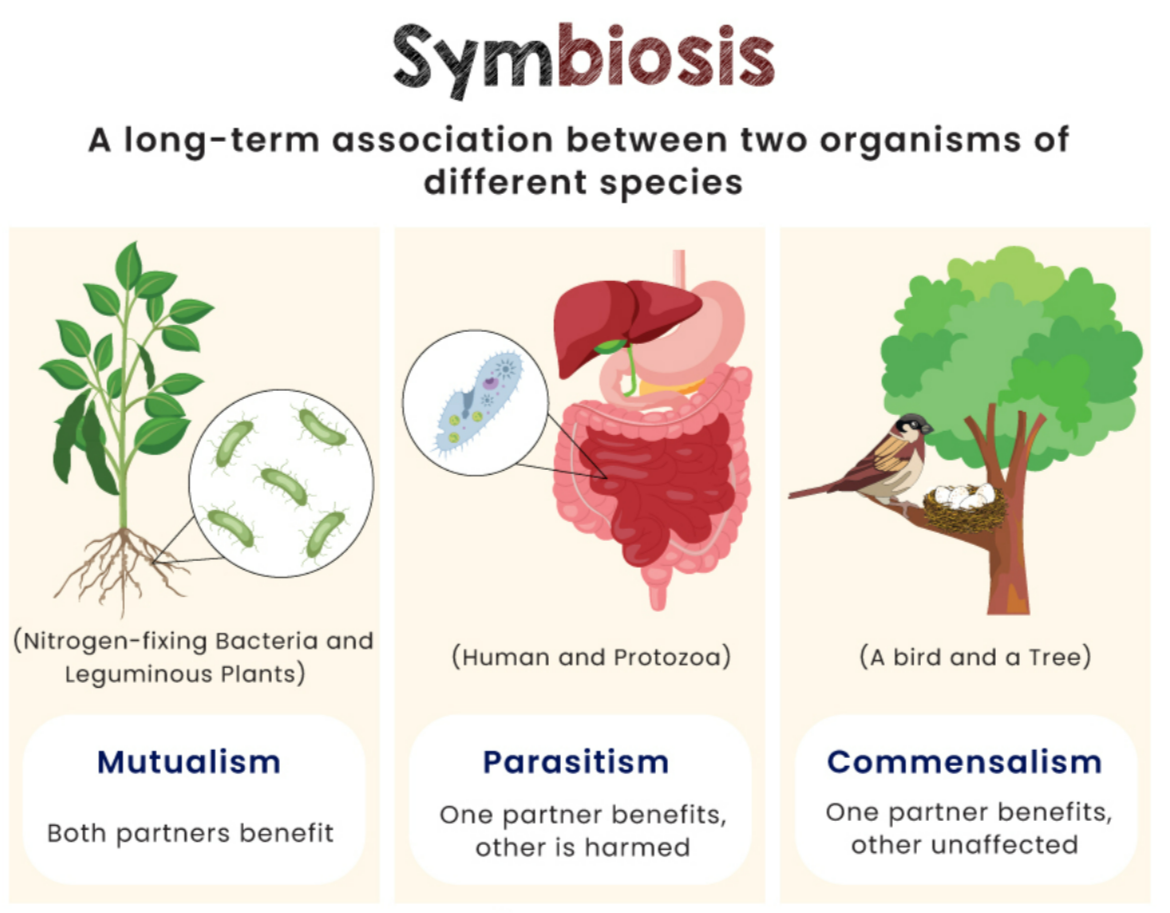
Definition
Mutualism is a symbiotic relationship in which both organisms benefit.
Characteristics
- Both species gain a survival or reproductive advantage
- Interaction may involve:
- Exchange of nutrients
- Protection
- Transportation
Mutualism can be:
- Obligate (essential for survival)
- Facultative (beneficial but not essential)
Examples
- Bees and flowering plants
Bee gets nectar
Plant gets pollinated - Lichen (algae + fungus)
Algae provides food
Fungus provides shelter and moisture
Ecological Significance
- Increases efficiency of resource use
- Enhances survival of both species
- Strengthens ecosystem stability
🌱 Parasitism (+ / −)
Definition
Parasitism is a symbiotic relationship in which one organism benefits while the other is harmed.
The benefiting organism is called the parasite, and the harmed organism is the host.
Characteristics
- Parasite gains:
- Food
- Shelter
Host experiences:
- Reduced health
- Lower reproductive success
Parasite usually does not kill the host immediately.
Examples
- Tapeworm in human intestine
Tapeworm gains nutrients
Human loses nutrients - Tick feeding on mammals
Tick gains blood
Host suffers blood loss and disease risk
Ecological Significance
- Regulates host population size
- Drives evolution of host defenses
- Influences community structure
🌱 Commensalism (+ / 0)
Definition
Commensalism is a symbiotic relationship in which one organism benefits, while the other is neither helped nor harmed.
Characteristics
- One species gains:
- Shelter
- Transport
- Access to food
The host remains unaffected.
Examples
- Barnacles attached to whales
Barnacles gain transport and food access
Whale is unaffected - Epiphytic plants growing on trees
Plant gains sunlight
Tree is unaffected
Ecological Significance
- Allows species to exploit resources efficiently
- Reduces competition
- Increases species coexistence
🌱 How to Identify the Type of Symbiosis
When given two organisms:
- Identify the benefit received by each organism
- Determine if there is harm, benefit, or no effect
- Match the interaction to the correct category
📊 Summary Table
| Type of Symbiosis | Effect on Organism A | Effect on Organism B |
|---|---|---|
| Mutualism | Benefit | Benefit |
| Parasitism | Benefit | Harm |
| Commensalism | Benefit | No effect |
📦 Quick Recap
Symbiosis is a close, long-term interaction.
Mutualism (+/+) means both benefit.
Parasitism (+/−) means parasite benefits, host is harmed.
Commensalism (+/0) means one benefits, the other is unaffected.
Classification depends on the effect on each organism
How Symbiotic Relationships Reduce Environmental Pressures and Provide Advantages
🌱 Introduction
Organisms in natural environments face constant environmental pressures such as limited food, predation, competition, and harsh physical conditions.
Survival depends on how effectively these pressures are reduced.
🌱 What Are Environmental Pressures?
Environmental pressures are factors that limit survival, growth, or reproduction.
Common pressures include:
- Limited food and nutrients
- High competition
- Predation
- Harsh abiotic conditions
- Disease and parasites
Symbiotic relationships evolve because they reduce one or more of these pressures, improving fitness.
🌱 How Symbiosis Provides Advantage
Symbiosis reduces environmental pressure by:
- Improving resource access
- Increasing protection
- Reducing energy expenditure
- Enhancing survival and reproduction
Each type of symbiosis reduces pressure in a different way.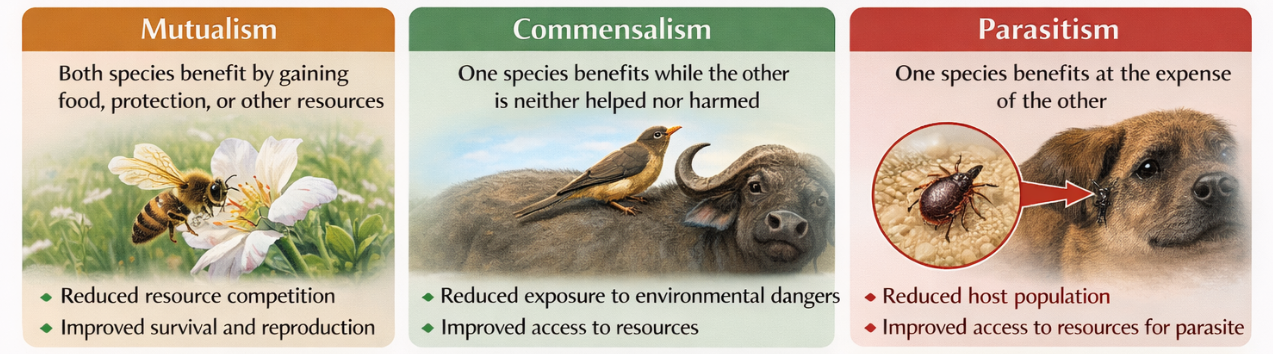
🌱 Mutualism and Reduction of Environmental Pressures
Reduction of Food Limitation
In mutualism, organisms often exchange resources.
Mechanism:
- One species provides food or nutrients.
- The other provides access, protection, or processing ability.
Effect:
- Reduced pressure from food scarcity.
- Increased growth and reproduction.
Example explanation:
- Plants receive nutrients or pollination.
- Animals receive food resources.
🌱 Reduction of Predation Pressure
Some mutualistic relationships provide protection.
Mechanism:
- One species offers shelter, defense, or warning signals.
- The other provides food or habitat.
Effect:
- Lower mortality due to predators.
- Increased survival rates.
This allows organisms to survive in environments where predation pressure would otherwise be too high.
🌱 Reduction of Competition
Mutualism can reduce competition by:
- Allowing access to resources that are otherwise unavailable.
- Improving efficiency of resource use.
Effect:
- Less overlap with competitors.
- Greater niche specialization.
🌱 Parasitism and Reduction of Environmental Pressures
Reduction of Energy Expenditure
For parasites, symbiosis reduces the pressure of:
- Finding food
- Surviving harsh external conditions
Mechanism:
- Parasite lives inside or on the host.
- Host provides nutrients and a stable environment.
Effect:
- Parasite invests less energy in survival.
- More energy available for reproduction.
Protection from External Threats
Living inside a host reduces exposure to:
- Predators
- Environmental extremes
This increases parasite survival even in unstable environments.
Cost to the Host
While parasitism benefits the parasite, it:
- Increases environmental stress for the host.
- Reduces host fitness.
Thus, parasitism shifts environmental pressure from the parasite to the host.
🌱 Commensalism and Reduction of Environmental Pressures
Reduction of Habitat and Shelter Limitation
In commensalism, one organism gains:
- Shelter
- Physical support
- Transport
Mechanism:
- Host organism provides a living surface or structure.
Effect:
- Reduced pressure to find habitat.
- Increased survival without harming the host.
Reduction of Food Search Pressure
Some commensals gain access to:
- Food scraps
- Concentrated resources
Effect:
- Lower energy spent searching for food.
- Increased feeding efficiency.
🌱 Symbiosis and Overall Fitness
Fitness refers to an organism’s ability to:
- Survive
- Reproduce
- Pass on genes
By reducing environmental pressures, symbiosis:
- Increases survival probability
- Improves reproductive success
- Enhances long-term population stability
Symbiotic relationships therefore represent evolutionary advantages shaped by natural selection.
🌱 Why Symbiosis Is Favored in Ecosystems
Symbiosis:
- Reduces vulnerability to environmental stress
- Allows organisms to exploit new niches
- Increases efficiency of resource use
- Promotes coexistence in crowded ecosystems
📊 Summary Table
| Type of Symbiosis | Environmental Pressure Reduced | Advantage Provided |
|---|---|---|
| Mutualism | Food limitation, predation | Shared benefits |
| Parasitism | Energy cost, harsh conditions | Stable resources |
| Commensalism | Shelter and habitat limitation | Safe living space |
📦 Quick Recap
Environmental pressures limit survival.
Symbiosis reduces pressure by improving access to food, providing protection, reducing energy costs, and increasing reproductive success.
Mutualism benefits both species.
Parasitism benefits one species.
Commensalism benefits one without harm.