
How Natural Changes in an Ecosystem Affect Ecosystem Dynamics
🌱 Introduction
Ecosystems are dynamic systems, not static structures.
They constantly change in response to natural environmental factors such as shifts in energy availability, nutrient cycles, climate patterns, and natural disturbances.
These changes influence:
- Species composition
- Population sizes
- Energy flow
- Nutrient cycling
Together, these responses are called ecosystem dynamics.
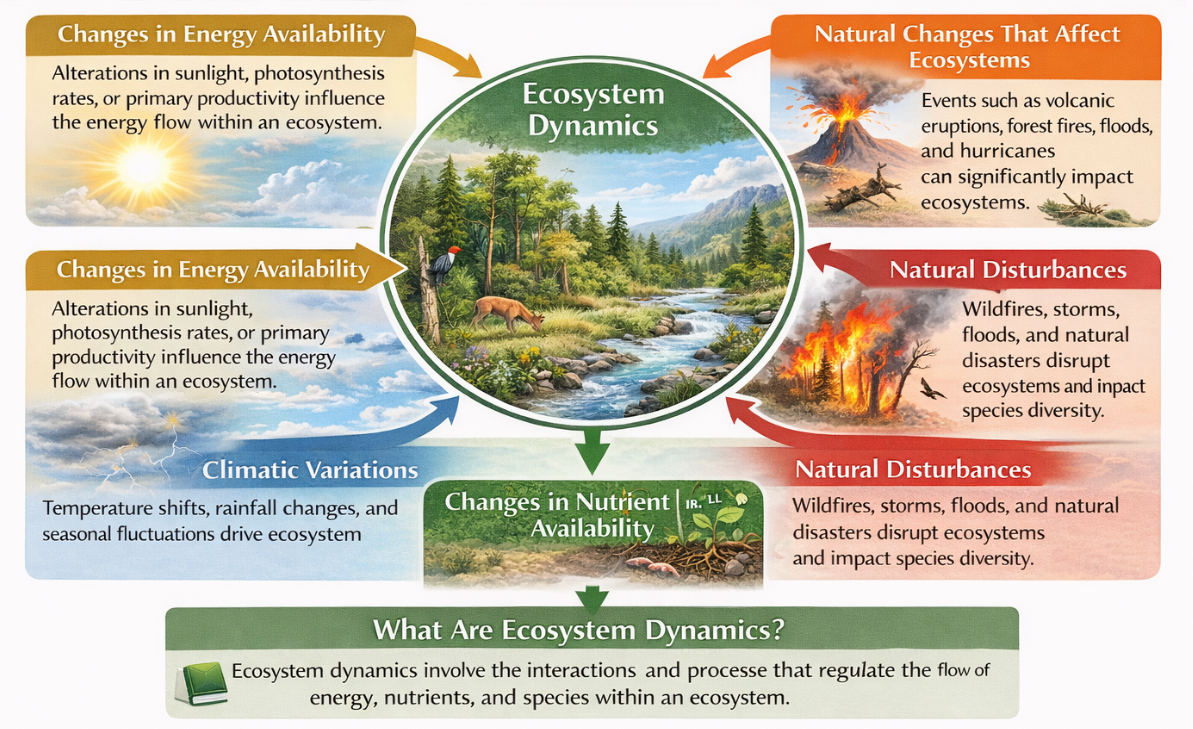
🌱 What Are Ecosystem Dynamics?
Ecosystem dynamics refer to the changes in structure and function of an ecosystem over time.
They include changes in:
- Species diversity
- Community interactions
- Trophic structure
- Physical environment
Ecosystem dynamics result from continuous interactions between biotic and abiotic components.
🌱 Natural Changes That Affect Ecosystems
Natural changes are non-human environmental variations that alter ecosystem conditions.
Major types include:
- Changes in energy availability
- Changes in nutrient availability
- Climatic fluctuations
- Natural disturbances
Each of these affects ecosystem dynamics in a specific way.
🌱 Changes in Energy Availability
Source of Energy
Most ecosystems depend on solar energy.
Energy enters through primary producers.
How Energy Changes Occur
- Seasonal changes in sunlight
- Cloud cover
- Climate-driven shifts in temperature
Effects on Ecosystem Dynamics
- Reduced energy lowers primary productivity.
- Less energy moves through food webs.
- Consumer populations decline.
- Trophic structure becomes simplified.
Energy availability controls ecosystem productivity and complexity.
🌱 Changes in Nutrient Availability
Role of Nutrients
Nutrients such as nitrogen and phosphorus are essential for growth.
Nutrients cycle through ecosystems via biogeochemical cycles.
Natural Causes of Nutrient Change
- Floods deposit nutrient-rich sediments.
- Volcanic eruptions release minerals.
- Decomposition rates vary with climate.
Effects on Ecosystem Dynamics
- Increased nutrients boost plant growth.
- Increased plant growth supports higher consumer populations.
- Nutrient limitation slows growth and reduces biodiversity.
Nutrient availability directly affects species abundance and diversity.
🌱 Climatic Variations
Types of Climatic Changes
- Temperature fluctuations
- Changes in precipitation
- Droughts and wet periods
Effects on Ecosystem Dynamics
- Species shift geographic ranges.
- Some species decline or disappear.
- Community composition changes.
- Timing of biological events shifts.
Climate affects which species can survive in an ecosystem.
🌱 Natural Disturbances
Natural disturbances are sudden events that disrupt ecosystem structure.
Examples:
- Forest fires
- Hurricanes
- Floods
- Volcanic eruptions
Immediate Effects
- Destruction of vegetation
- Reduction in population sizes
- Loss of habitat
Long-Term Effects
- Initiation of ecological succession
- Creation of new habitats
- Increase in species turnover
Disturbances reset ecosystems and drive long-term change.
🌱 Ecological Succession and Ecosystem Dynamics
After disturbance, ecosystems undergo succession.
- Early species colonize first.
- Later species replace them over time.
Types:
- Primary succession on bare surfaces
- Secondary succession after disturbance
Succession leads to:
- Gradual increase in biodiversity
- Stabilization of ecosystem processes
🌱 Role of Species Interactions in Dynamic Change
Natural changes alter:
- Competition intensity
- Predator–prey relationships
- Symbiotic interactions
These altered interactions:
- Restructure food webs
- Change population dynamics
- Influence biodiversity patterns
🌱 Ecosystem Resilience and Stability
Resilience
Ability to recover after disturbance.
Stability
Ability to maintain structure despite change.
Natural changes test both:
- High biodiversity increases resilience.
- Low biodiversity increases vulnerability.
🌱 Overall Impact on Ecosystem Dynamics
Natural changes cause ecosystems to:
- Shift in species composition
- Adjust energy flow pathways
- Reorganize trophic relationships
- Reach new dynamic equilibrium states
Ecosystems are therefore constantly adjusting systems, not fixed endpoints.
📊 Summary Table
| Natural Change | Effect on Ecosystem Dynamics |
|---|---|
| Energy variation | Alters productivity |
| Nutrient shifts | Changes biodiversity |
| Climate change | Shifts species ranges |
| Disturbances | Initiates succession |
| Species interaction changes | Restructures communities |
📦 Quick Recap
Ecosystems are dynamic systems.
Natural changes affect energy flow, nutrient cycling, species composition, and community interactions.
Disturbances initiate succession.
Ecosystems reorganize and reach new equilibrium.
Biodiversity increases resilience to change.
Using Models to Predict How Changes in Biodiversity Affect Local Ecosystems
🌱 Introduction
Local ecosystems respond to changes in biodiversity in predictable ways.
Because ecosystems are complex, ecologists rely on models to simplify reality and predict outcomes when biodiversity increases or decreases.
This objective focuses on:
- Using ecological models
- Linking biodiversity change to ecosystem structure and function
- Making evidence-based predictions about local ecosystems
🌱 What Are Ecological Models?
An ecological model is a simplified representation of an ecosystem used to:
- Explain interactions
- Predict responses to change
- Compare alternative scenarios
Common models used in this context:
- Conceptual flow models
- Food web models
- Trophic cascade models
- Diversity-stability models
- Population and carrying capacity models
Models allow scientists to ask:
What happens to a local ecosystem if biodiversity changes?
🌱 Biodiversity as a Driver of Ecosystem Function
Biodiversity influences:
- Energy flow through food webs
- Nutrient cycling efficiency
- Population regulation
- Ecosystem stability and resilience
Changes in biodiversity alter how ecosystems operate, not just which species are present.
🌱 Model 1: Biodiversity Increase Model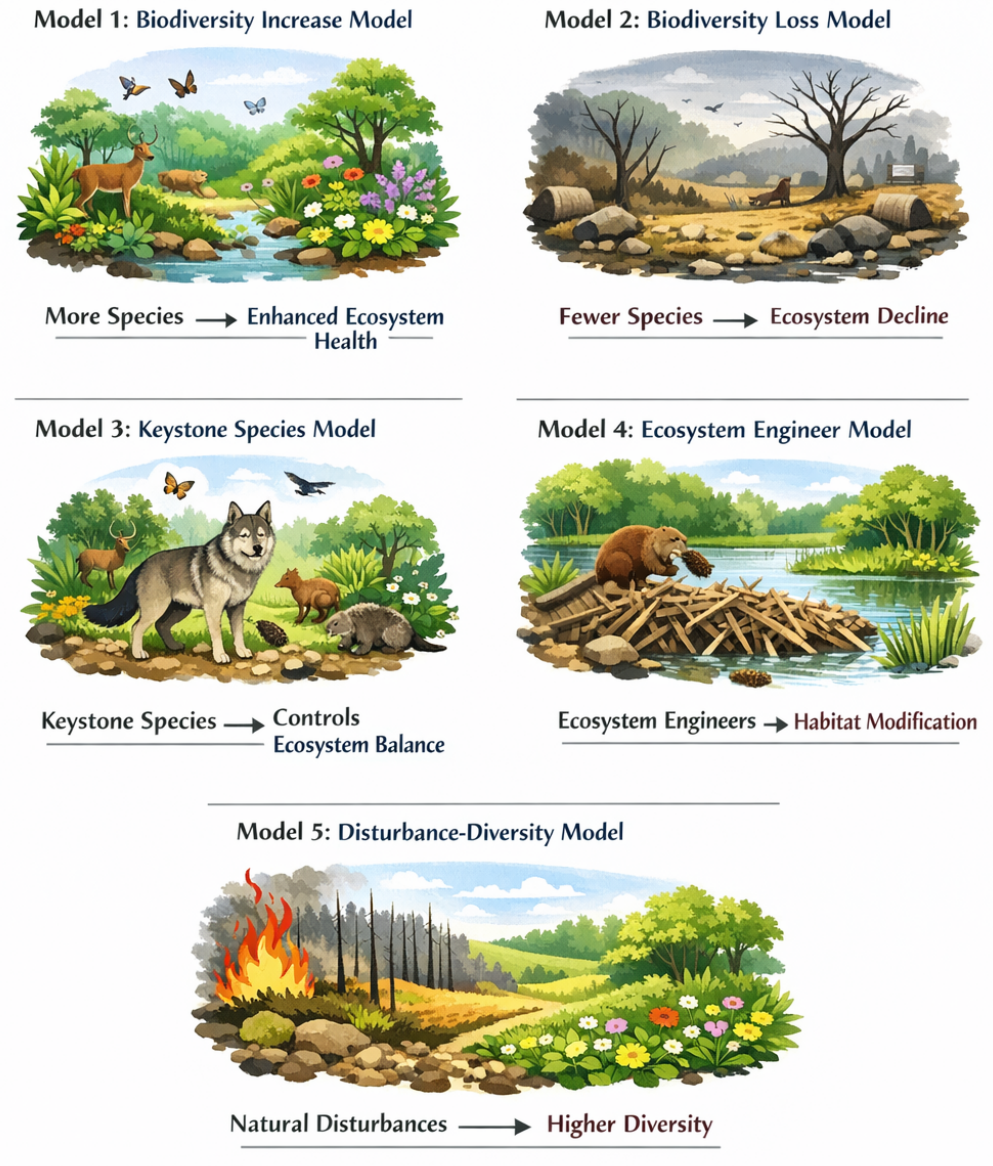
Model Description
High species diversity → complex food web → multiple interaction pathways
Prediction
- Food webs become more complex
- Energy flows through multiple pathways
- Loss of one species has less impact
Ecosystem Effects
- Increased ecosystem stability
- Higher productivity
- Greater resistance to disturbance
Local Ecosystem Outcome
- Stable populations
- Efficient nutrient cycling
- Faster recovery after disturbance
🌱 Model 2: Biodiversity Loss Model
Model Description
Low species diversity → simplified food web → limited interaction pathways
Prediction
- Food webs lose redundancy
- Energy flow becomes restricted
- Ecosystem becomes vulnerable to change
Ecosystem Effects
- Reduced productivity
- Disrupted nutrient cycling
- Increased population fluctuations
Local Ecosystem Outcome
- Higher risk of collapse
- Slower recovery after disturbance
- Loss of ecosystem services
🌱 Model 3: Keystone Species Model
Model Description
A single species has a disproportionately large effect on ecosystem structure.
Prediction
- Trophic interactions are disrupted
- Certain populations increase uncontrollably
- Others decline or disappear
Ecosystem Effects
- Trophic cascades
- Rapid biodiversity loss
- Altered habitat structure
Local Ecosystem Outcome
- Reduced species richness
- Long-term instability
🌱 Model 4: Ecosystem Engineer Model
Model Description
Ecosystem engineers modify the physical environment.
Examples:
- Beavers altering water flow
- Elephants modifying vegetation
Prediction
- Habitat simplification
- Reduced niche availability
Ecosystem Effects
- Decline in dependent species
- Reduced biodiversity
Local Ecosystem Outcome
- Homogeneous habitat
- Lower resilience
🌱 Model 5: Disturbance-Diversity Model
Model Description
Biodiversity influences how ecosystems respond to disturbances.
Prediction
- High biodiversity → rapid recovery
- Low biodiversity → prolonged disruption
Ecosystem Effects
- Species replacement occurs faster in diverse systems
- Ecosystem processes resume quickly
Local Ecosystem Outcome
- Stable ecosystem dynamics
- Sustained productivity
🌱 Using Models for Comparative Predictions
Models allow prediction of relative outcomes:
- Which ecosystem is more stable?
- Which will recover faster?
- Which will lose species after disturbance?
These comparisons are essential for conservation and management decisions.
🌱 Why Models Are Essential?
Models:
- Simplify complex systems
- Reveal cause-effect relationships
- Support predictions without direct experimentation
They are central tools in ecological forecasting.
📊 Summary Table
| Model Type | Biodiversity Change | Predicted Ecosystem Effect |
|---|---|---|
| Food web complexity | Increase | Greater stability |
| Simplified web | Decrease | Vulnerability |
| Keystone species | Loss | Trophic cascade |
| Ecosystem engineer | Loss | Habitat reduction |
| Disturbance response | High diversity | Rapid recovery |
📦 Quick Recap
Ecological models predict ecosystem responses.
High biodiversity leads to complex food webs, greater stability, and faster recovery.
Low biodiversity results in simplified interactions, ecosystem instability, and loss of services.
Models link biodiversity change to ecosystem dynamics.
Using Data to Predict the Effects of Biodiversity in Response to Environmental Changes
🌱 Introduction
Environmental conditions are constantly changing due to natural disturbances, climate variability, and shifts in resource availability.
Different ecosystems respond differently to these changes, and a key factor determining the response is biodiversity.
🌱 Role of Data in Understanding Biodiversity Responses
Ecologists cannot rely on assumptions alone.
They use long-term and short-term data to evaluate how biodiversity affects ecosystem response.
Common data sources include:
- Species richness counts
- Population trends over time
- Productivity measurements
- Recovery rates after disturbance
- Before-and-after disturbance comparisons
These data reveal cause-effect relationships between biodiversity and ecosystem performance.
🌱 Environmental Changes Considered in Data Analysis
Environmental changes that commonly appear in data sets include:
- Temperature fluctuations
- Droughts and floods
- Fires and storms
- Nutrient enrichment or depletion
- Habitat disturbance
Each change acts as a stress test for ecosystems.
🌱 Interpreting Species Richness Data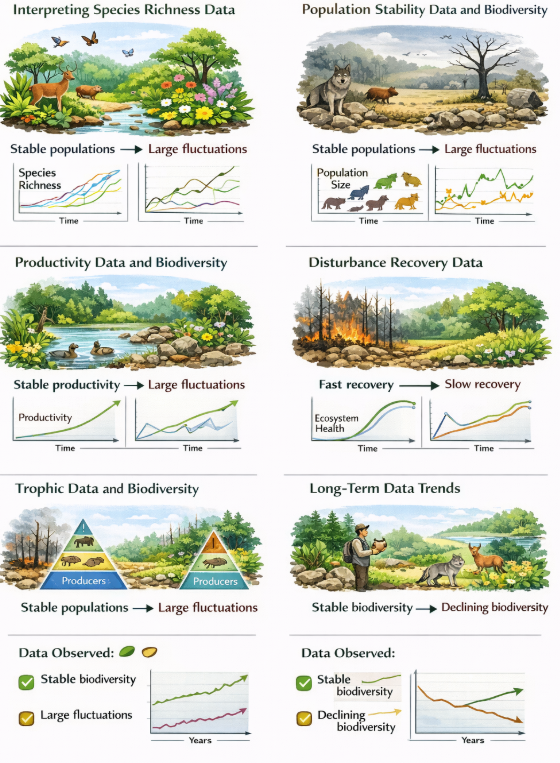
Data Pattern
- Ecosystem A has high species richness
- Ecosystem B has low species richness
After an environmental change:
- Ecosystem A shows minor population declines
- Ecosystem B shows major species loss
Prediction
Higher biodiversity buffers ecosystems against environmental change.
Reasoning:
- Multiple species perform similar ecological roles
- Loss of one species can be compensated by others
Data support the idea that species richness increases ecosystem resilience.
🌱 Population Stability Data and Biodiversity
Data Pattern
- Population graphs show smaller fluctuations in diverse ecosystems
- Larger fluctuations occur in species-poor ecosystems
Prediction
Ecosystems with higher biodiversity maintain more stable population dynamics.
Reasoning:
- Diverse food webs distribute energy across many pathways
- This prevents extreme population booms or crashes
🌱 Productivity Data and Biodiversity
Data Pattern
- Net primary productivity declines sharply in low-diversity systems after disturbance
- Productivity recovers quickly in high-diversity systems
Prediction
- Faster recovery of productivity
- More efficient energy and nutrient use
This indicates that biodiversity stabilizes ecosystem function, not just species numbers.
🌱 Disturbance Recovery Data
Data Pattern
After events like fire or flood:
- Diverse ecosystems recover species composition rapidly
- Less diverse ecosystems recover slowly or incompletely
Prediction
Biodiversity increases ecosystem resilience, defined as the ability to recover after disturbance.
Mechanism:
- Presence of pioneer and late-successional species
- Functional redundancy
🌱 Trophic Data and Biodiversity
Data Pattern
- Ecosystems with diverse predators and prey show stable food webs
- Simplified ecosystems show trophic imbalances after change
Prediction
Higher biodiversity stabilizes trophic interactions and reduces the risk of trophic cascades.
🌱 Long-Term Data Trends
Observed Patterns
Ecosystems with declining biodiversity show:
- Reduced ecosystem services
- Increased sensitivity to climate variability
Prediction
Long-term biodiversity loss reduces ecosystem adaptability and increases vulnerability to future changes.
🌱 Using Data to Compare Ecosystem Responses
When analyzing data, ecologists compare:
- Before vs after environmental change
- High vs low biodiversity ecosystems
- Short-term vs long-term effects
These comparisons allow predictive conclusions rather than descriptive statements.
🌱 Why Data-Based Predictions Matter
Data analysis allows scientists to:
- Forecast ecosystem collapse or recovery
- Identify ecosystems at risk
- Design conservation strategies
Without data, predictions about biodiversity effects would lack scientific validity.
📊 Summary Table
| Data Observed | Biodiversity Level | Predicted Ecosystem Response |
|---|---|---|
| Stable populations | High | High resilience |
| Large fluctuations | Low | Instability |
| Fast recovery | High | Functional stability |
| Slow recovery | Low | Vulnerability |
| Stable productivity | High | Sustained ecosystem services |
📦 Quick Recap
Environmental changes test ecosystems.
Data show that high biodiversity leads to stability and resilience, while low biodiversity leads to vulnerability and disruption.
Species richness, population trends, and recovery rates are key data used to predict ecosystem responses.
Biodiversity buffers ecosystems against environmental change.