Home / AP® Exam / Pre AP Biology / Pre AP Biology

ECO 5.2 Human-Induced Changes in Biodiversity- Pre AP Biology Study Notes - New Syllabus.

ECO 5.2 Human-Induced Changes in Biodiversity- Pre AP Biology Study Notes

ECO 5.2 Human-Induced Changes in Biodiversity- Pre AP Biology Study Notes – New Syllabus.

LEARNING OBJECTIVE

ECO 5.2(a) Use evidence to support the claim that changes in ecosystems have resulted from human activities.
ECO 5.2(b) Given a human activity, predict the potential biological consequences for an ecosystem’s biodiversity.
ECO 5.2(c) Create and/or use models to design solutions that mitigate the adverse effects of a human-induced environmental change on the biodiversity of an ecosystem.

Key Concepts: 

  • ECO 5.2.1 Human activities (e.g., urbanization, farming, tree harvesting) also alter availability of nutrients, food, and niches for species and therefore affect population and community dynamics.
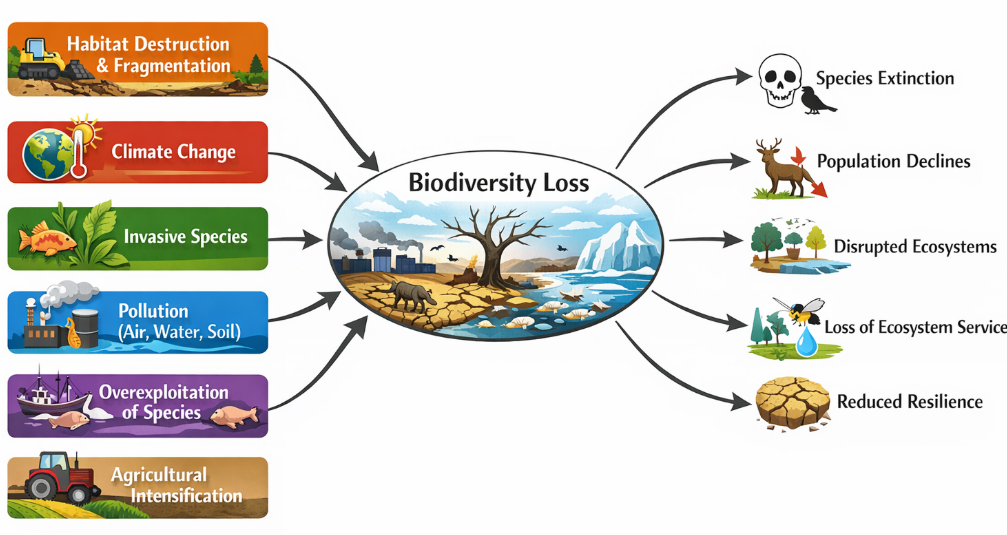
    a. Human activities include anthropogenic climate change, the introduction of invasive species, habitat destruction, and air/water pollution.
    b. The effects of human-induced environmental changes and their impact on species are the subject of a significant amount of current scientific research.

Pre AP Biology-Concise Summary Notes- All Topics

Evidence That Human Activities Have Caused Changes in Ecosystems

🌱 Introduction

Ecosystems change naturally over time, but many recent and rapid changes cannot be explained by natural processes alone.
Scientific evidence collected over decades clearly shows that human activities are major drivers of ecosystem alteration at local, regional, and global scales.

🌱 What Counts as Evidence in Ecology?

In ecology, evidence includes:

  • Long-term observational data
  • Experimental studies
  • Before-and-after comparisons
  • Correlations supported by mechanisms
  • Global and regional trend analyses

To support a claim scientifically, evidence must show:

  • A human activity
  • A measurable ecosystem change
  • A clear causal link

🌱 Evidence from Habitat Destruction and Land-Use Change

Human Activity

  • Deforestation
  • Urbanization
  • Conversion of land for agriculture

Observed Ecosystem Changes

  • Loss of native plant species
  • Decline in animal populations
  • Habitat fragmentation
  • Reduced species richness

Scientific Evidence

  • Satellite data show large-scale forest loss linked to logging and farming.
  • Biodiversity surveys show lower species diversity in urban and agricultural areas compared to natural habitats.
  • Fragmented habitats show increased local extinctions due to isolation.

Conclusion: Habitat destruction caused by humans directly alters ecosystem structure and biodiversity.

🌱 Evidence from Anthropogenic Climate Change

Human Activity

  • Burning fossil fuels
  • Industrial emissions
  • Deforestation reducing carbon sinks

Observed Ecosystem Changes

  • Shifts in species geographic ranges
  • Changes in migration timing
  • Coral bleaching events
  • Altered ecosystem productivity

Scientific Evidence

  • Temperature records show rapid global warming correlated with increased greenhouse gas concentrations.
  • Species distribution data show poleward and altitudinal shifts consistent with warming trends.
  • Coral reef data show bleaching events following temperature spikes caused by climate change.

Conclusion: Climate-driven ecosystem changes align closely with human-caused greenhouse gas emissions.

🌱 Evidence from Pollution (Air, Water, Soil)

Human Activity

  • Industrial waste discharge
  • Agricultural runoff
  • Plastic and chemical pollution

Observed Ecosystem Changes

  • Decline in aquatic biodiversity
  • Bioaccumulation in food webs
  • Reduced reproductive success in wildlife

Scientific Evidence

  • Water quality data link nutrient runoff to eutrophication and dead zones.
  • Fish and bird populations show toxin accumulation traced to industrial chemicals.
  • Reduced oxygen levels in polluted waters correspond with species loss.

Conclusion: Pollution caused by human activity disrupts ecosystem processes and species survival.

🌱 Evidence from Introduction of Invasive Species

Human Activity

  • Global trade and transport
  • Intentional or accidental species introductions

Observed Ecosystem Changes

  • Decline of native species
  • Altered food webs
  • Reduced ecosystem stability

Scientific Evidence

  • Invasive species often lack natural predators and outcompete native species.
  • Population data show rapid invasive species spread following human introduction.
  • Native species decline is strongly correlated with invasive species presence.

Conclusion: Human-mediated species introductions cause significant ecosystem restructuring.

🌱 Evidence from Overexploitation of Species

Human Activity

  • Overfishing
  • Overhunting
  • Unsustainable harvesting

Observed Ecosystem Changes

  • Population collapses
  • Trophic imbalances
  • Loss of keystone species

Scientific Evidence

  • Fisheries data show dramatic population declines following increased harvesting.
  • Removal of top predators leads to trophic cascades affecting entire ecosystems.
  • Recovery occurs only after human pressure is reduced.

Conclusion: Overexploitation by humans alters population and community dynamics.

🌱 Evidence from Nutrient Cycle Alteration

Human Activity

  • Fertilizer use
  • Wastewater release

Observed Ecosystem Changes

  • Excess nutrient loading
  • Algal blooms
  • Hypoxic conditions

Scientific Evidence

  • Nutrient input data correlate with increased algal growth.
  • Oxygen depletion follows nutrient enrichment.
  • Biodiversity decreases as sensitive species disappear.

Conclusion: Human modification of nutrient cycles causes ecosystem imbalance.

🌱 Strength of the Evidence

The evidence is strong because:

  • Patterns are consistent across ecosystems.
  • Changes occur rapidly following human activities.
  • Similar ecosystems show different outcomes depending on human impact.
  • Removal or reduction of human pressure often leads to partial recovery.

This supports a causal relationship, not coincidence.

📊 Summary Table

Human ActivityEvidence of Ecosystem Change
DeforestationHabitat loss, species decline
Climate changeRange shifts, coral bleaching
PollutionDead zones, bioaccumulation
Invasive speciesNative species loss
OverexploitationPopulation collapse
Nutrient alterationEutrophication

📦 Quick Recap 
Human activities cause measurable ecosystem changes.
Evidence includes habitat loss and fragmentation, climate-driven species shifts, pollution-related biodiversity decline, invasive species impacts, and overexploitation effects.
Scientific data strongly support the claim that humans are major drivers of ecosystem change.

Predicting the Biological Consequences of Human Activities on Ecosystem Biodiversity

🌱 Introduction

Human activities modify ecosystems by altering habitats, resource availability, and species interactions.
These changes do not affect biodiversity randomly. Instead, they produce predictable biological consequences that can be explained using ecological principles.

🌱 General Framework for Prediction

To predict biodiversity consequences, ecologists follow this logic:

Human activity → Environmental change → Species response → Biodiversity outcome

Environmental changes may include:

  • Habitat loss
  • Altered nutrient cycles
  • Climate shifts
  • New species interactions

Species respond through:

  • Population decline or growth
  • Migration
  • Extinction or invasion

🌱 Human Activity 1: Habitat Destruction and Fragmentation

Description of Activity

  • Deforestation
  • Urban expansion
  • Agricultural land conversion

Environmental Change

  • Reduction in available habitat
  • Isolation of populations
  • Loss of nesting and feeding sites

Predicted Biological Consequences

  • Decline in species richness
  • Local extinction of habitat-specialist species
  • Reduced genetic diversity due to isolation
  • Increased dominance of generalist species

Biodiversity Outcome

  • Simplified communities
  • Lower ecosystem resilience
  • Reduced ecosystem services

🌱 Human Activity 2: Anthropogenic Climate Change

Description of Activity

  • Greenhouse gas emissions
  • Fossil fuel combustion
  • Deforestation reducing carbon sinks

Environmental Change

  • Rising temperatures
  • Altered precipitation patterns
  • Increased frequency of extreme events

Predicted Biological Consequences

  • Shifts in species geographic ranges
  • Mismatch in timing of biological events
  • Increased extinction risk for temperature-sensitive species
  • Coral bleaching and reef degradation

Biodiversity Outcome

  • Loss of endemic species
  • Changes in community composition
  • Decline in global biodiversity

🌱 Human Activity 3: Introduction of Invasive Species

Description of Activity

  • Global trade and transport
  • Accidental or intentional species release

Environmental Change

  • Novel species interactions
  • Lack of natural predators or controls

Predicted Biological Consequences

  • Competitive exclusion of native species
  • Altered food webs
  • Reduced population sizes of native organisms

Biodiversity Outcome

  • Homogenization of ecosystems
  • Reduced native species diversity
  • Long-term ecosystem instability

🌱 Human Activity 4: Pollution (Air, Water, Soil)

Description of Activity

  • Industrial waste release
  • Agricultural runoff
  • Chemical and plastic pollution

Environmental Change

  • Toxic environments
  • Altered nutrient levels
  • Reduced oxygen availability

Predicted Biological Consequences

  • Decline in sensitive species
  • Bioaccumulation of toxins in food webs
  • Reduced reproductive success
  • Increased mortality

Biodiversity Outcome

  • Lower species diversity
  • Disrupted trophic interactions
  • Loss of ecosystem function

🌱 Human Activity 5: Overexploitation of Species

Description of Activity

  • Overfishing
  • Overhunting
  • Unsustainable harvesting

Environmental Change

  • Removal of key species
  • Altered population balance

Predicted Biological Consequences

  • Population collapse
  • Trophic cascades
  • Overpopulation of prey species
  • Habitat degradation

Biodiversity Outcome

  • Loss of keystone species
  • Reduced ecosystem complexity
  • Long-term biodiversity decline

🌱 Human Activity 6: Agricultural Intensification

Description of Activity

  • Monoculture farming
  • Heavy fertilizer and pesticide use

Environmental Change

  • Reduced habitat heterogeneity
  • Altered nutrient cycles

Predicted Biological Consequences

  • Decline in pollinators
  • Loss of soil biodiversity
  • Increased pest outbreaks

Biodiversity Outcome

  • Low species richness
  • Increased vulnerability to disturbance

🌱 Why These Predictions Are Reliable

These predictions are supported by:

  • Long-term ecological studies
  • Experimental manipulation
  • Global biodiversity assessments

Similar human activities consistently produce similar biological outcomes across ecosystems.

📊 Summary Table

Human ActivityPredicted Biodiversity Consequence
Habitat destructionSpecies loss, fragmentation
Climate changeRange shifts, extinctions
Invasive speciesNative species decline
PollutionReduced survival and reproduction
OverexploitationPopulation collapse
Intensive agricultureBiodiversity simplification

📦Quick Recap 
Human activities alter ecosystems.
These changes modify habitats and resources, disrupt species interactions, reduce species richness, and lower ecosystem resilience.
Given a human activity, predictable biological consequences for biodiversity can be explained using ecological principles.

 Using Models to Design Solutions That Reduce Human Impacts on Biodiversity

🌱 Introduction

Human activities change ecosystems by altering habitats, resources, and species interactions, which often leads to biodiversity loss.
To reduce these negative effects, ecologists use models to understand the problem clearly and to design mitigation solutions that can restore or protect biodiversity.

🌱 What “Models” Mean Here

A model is a tool that helps explain or predict ecological outcomes. Common models include:

  • Cause-effect (conceptual) models
  • Food web and trophic cascade models
  • Habitat fragmentation and connectivity models
  • Population viability models
  • Nutrient loading and eutrophication models
  • Restoration models

Models help answer:
What is changing, why is it harmful, and what intervention will reduce damage?

🌱 Stepwise Framework

A strong solution follows this chain:

Human activity → Environmental change → Biodiversity impact → Model-based solution → Predicted improvement

Your solution must target the cause or the mechanism of biodiversity loss, not just the symptoms.

🌱 Model 1: Habitat Destruction and Fragmentation

Human-induced change

  • Urbanization
  • Deforestation
  • Roads and farmland expansion

Model used

  • Habitat connectivity model
  • Fragmentation isolates populations
  • Isolation reduces gene flow
  • Small populations face higher extinction risk

Predicted biodiversity impacts

  • Loss of habitat specialists
  • Reduced genetic diversity
  • Increased local extinctions

Solutions designed using the model

  • Create wildlife corridors
  • Establish protected areas and buffer zones
  • Reforestation and habitat restoration
  • Wildlife crossings on roads

Predicted outcome

  • Improved movement and gene flow
  • Higher survival of small populations
  • Long-term biodiversity stability

🌱 Model 2: Nutrient Pollution and Eutrophication

Human-induced change

  • Fertilizer runoff
  • Sewage discharge
  • Industrial waste

Model used

  • Nutrient loading model
  • Excess nutrients cause algal blooms
  • Oxygen depletion follows decomposition

Predicted biodiversity impacts

  • Loss of oxygen-sensitive species
  • Reduced species richness
  • Simplified aquatic food webs

Solutions designed using the model

  • Precision farming to reduce fertilizer use
  • Vegetated buffer strips near waterways
  • Improved wastewater treatment
  • Wetland restoration

Predicted outcome

  • Lower nutrient input
  • Reduced algal blooms
  • Recovery of aquatic biodiversity

🌱 Model 3: Invasive Species Introduction

Human-induced change

  • Global trade and transport
  • Intentional or accidental species release

Model used

  • Competition and food web disruption model
  • Invasives outcompete natives
  • Lack natural predators

Predicted biodiversity impacts

  • Native species decline
  • Reduced community diversity
  • Ecosystem homogenization

Solutions designed using the model

  • Quarantine and biosecurity measures
  • Early detection and rapid response
  • Targeted removal and control
  • Native habitat restoration

Predicted outcome

  • Reduced invasive spread
  • Recovery of native populations
  • Stabilized food webs

🌱 Model 4: Climate Change Impacts on Biodiversity

Human-induced change

  • Greenhouse gas emissions
  • Land-use change

Model used

  • Species range shift and resilience model
  • Species track suitable climates
  • Barriers limit migration

Predicted biodiversity impacts

  • Range shifts
  • Local extinctions
  • Disrupted species interactions

Solutions designed using the model

  • Protect climate refuges
  • Create migration corridors
  • Increase ecosystem resilience
  • Reduce emissions and increase carbon sinks

Predicted outcome

  • Lower extinction risk
  • Improved species persistence
  • Greater ecosystem stability

🌱 Model 5: Overexploitation and Trophic Cascades

Human-induced change

  • Overfishing
  • Overhunting
  • Unsustainable harvesting

Model used

  • Trophic cascade model
  • Removal of key species disrupts food webs

Predicted biodiversity impacts

  • Loss of keystone species
  • Community imbalance
  • Reduced ecosystem complexity

Solutions designed using the model

  • Harvest limits and seasonal bans
  • Protected areas and reserves
  • Sustainable harvesting practices
  • Reintroduction of keystone species

Predicted outcome

  • Recovery of populations
  • Balanced food webs
  • Restored biodiversity

📊 Summary Table

Human-Induced ChangeModel UsedMitigation SolutionExpected Biodiversity Outcome
Habitat fragmentationConnectivity modelCorridors, protected areasGene flow, reduced extinction
Nutrient pollutionEutrophication modelBuffers, wastewater treatmentHigher oxygen, more species
Invasive speciesCompetition modelBiosecurity, controlNative recovery
Climate changeRange shift modelRefuges, corridorsLower extinction risk
OverexploitationTrophic cascadeSustainable limitsFood web balance


Scroll to Top