
Using Scientific Evidence to Justify an Evolutionary Relationship Between Species
🌱 Introduction
Evolutionary relationships are not guesses.
Scientists use multiple, independent lines of evidence to show that different species are related through common ancestry.
The stronger the evidence overlap, the stronger the evolutionary claim.
🔬 What Does “Scientific Evidence” Mean?
Scientific evidence in evolution refers to observable, measurable data that supports the idea that species share ancestors.
To justify a claim, scientists:
- Compare organisms
- Analyze patterns
- Look for consistency across evidence types
🧬 Major Types of Evidence Used 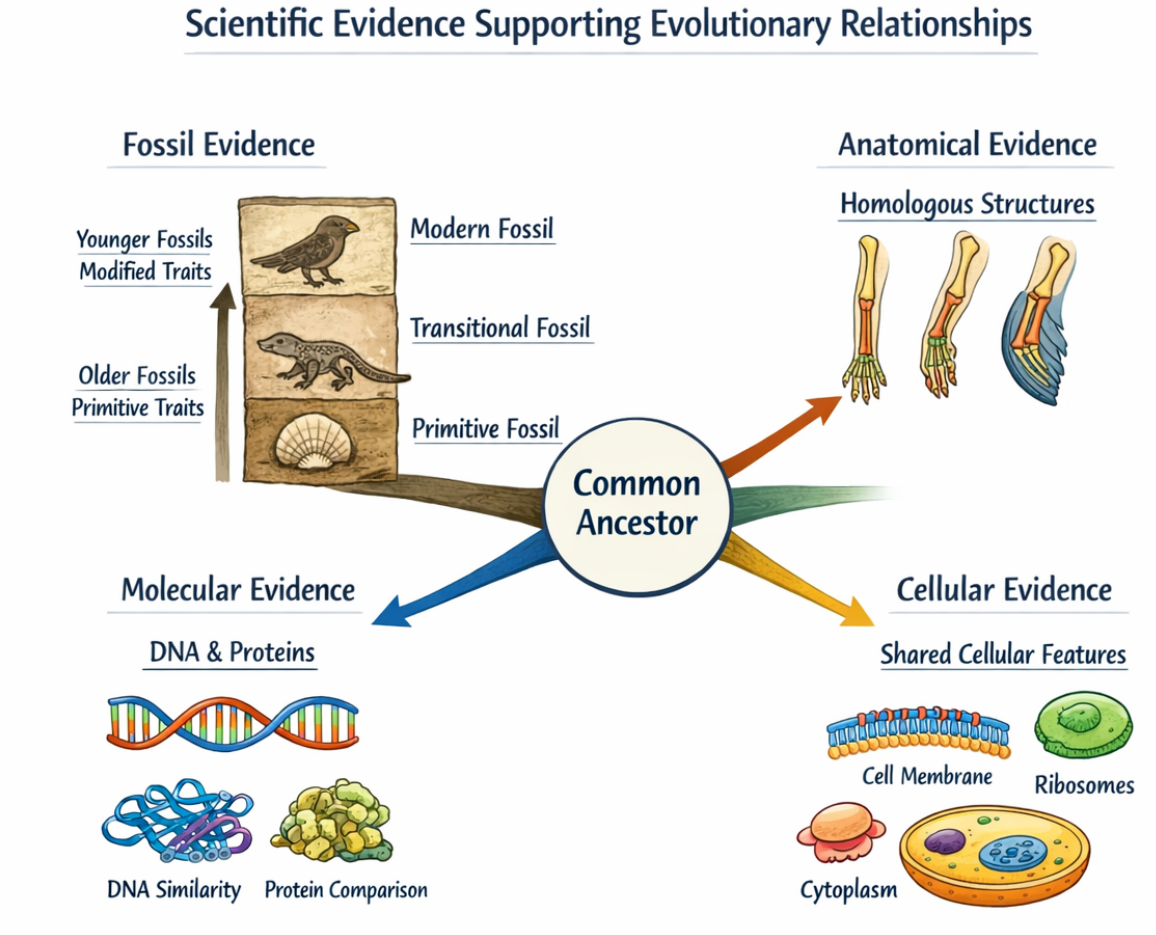
1. Fossil Evidence
Fossils are preserved remains or traces of ancient organisms.
How fossils support evolutionary relationships:
- Show sequence of life forms over time
- Reveal transitional forms between groups
- Show gradual change in structures
Fossils found in older rock layers are more primitive.
Fossils in younger layers are more complex or modified.
Dating Fossils
- Relative dating: older vs younger rock layers
- Radiometric dating: calculates actual age using radioactive decay
If two species appear in nearby time periods with similar traits, it supports a shared ancestry.
2. Anatomical Evidence (Comparative Anatomy)
Homologous Structures
Structures with:
- Same basic internal structure
- Different functions
- Found in different species
Example idea:
Forelimbs of mammals have similar bone arrangement.
Functions differ but structure remains same.
This similarity indicates descent from a common ancestor, not coincidence.
3. Molecular Evidence (DNA & Proteins)
This is the strongest modern evidence.
DNA Comparisons
- All living organisms use DNA as genetic material
- Same genetic code across life
- Differences accumulate over time
More similar DNA sequences = closer evolutionary relationship
Protein Comparisons
- Proteins like cytochrome care compared
- Fewer amino acid differences = closer relation
4. Cellular Evidence
All living organisms show:
- Cell membrane
- Ribosomes
- Cytoplasm
- Similar metabolic pathways
These shared cellular features support the idea of a single origin of life.
🧠 How Scientists Justify a Claim
To justify an evolutionary relationship, scientists:
- Identify similarities
- Decide if similarities are homologous
- Check fossil timeline
- Compare molecular data
- Combine all evidence
One type alone is weak
Multiple matching evidence = strong claim
📊 Summary Table
| Evidence Type | What is Compared | What It Shows |
|---|---|---|
| Fossils | Past organisms | Change over time |
| Relative dating | Rock layers | Order of evolution |
| Radiometric dating | Isotopes | Actual age |
| Homologous structures | Body parts | Common ancestry |
| DNA & proteins | Sequences | Degree of relatedness |
| Cellular features | Cell structures | Universal ancestry |
📦 Quick Recap
✔ Evolutionary relationships are proven using evidence
✔ Fossils show historical sequence of life
✔ Homologous structures indicate shared ancestry
✔ DNA similarity = closer relationship
✔ All life shares basic cellular features
✔ Strongest claims use multiple evidences together
Shared Characteristics (Homologies) as Evidence for Common Ancestry
🌱 Introduction
Organisms may look different on the outside, but many share deep internal similarities.
These shared characteristics are called homologies, and they provide strong evidence that organisms evolved from a common ancestor.
Homologies focus on origin, not function.
🔑 What Are Homologies?
Homologies are similarities between organisms that exist because they were inherited from a common ancestor.
Key idea:
- Same origin
- Modified over time
- Different functions possible
Homologies explain why life shows unity with diversity.
🧬 Types of Homologies
1. Anatomical Homology (Structural Homology)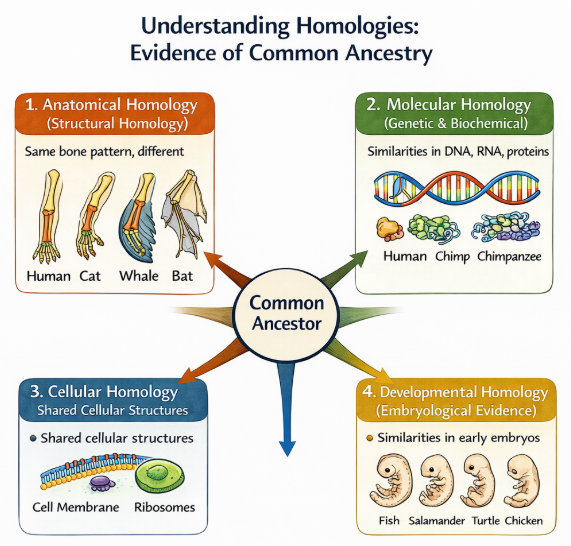
Definition
Anatomical homologies are body structures that have:
- The same basic internal structure
- Developed from the same ancestral structure
- May perform different functions
Key Features
- Bone arrangement or organ layout is similar
- Function may differ due to adaptation
- Indicates divergent evolution
Example idea:
- Vertebrate forelimbs follow the same bone pattern
- Used for flying, swimming, walking, or grasping
This similarity cannot be explained by chance
Best explanation = common ancestry
Homology vs Analogy
| Feature | Homologous | Analogous |
|---|---|---|
| Origin | Same ancestor | Different ancestors |
| Structure | Similar | Different |
| Function | May differ | Same |
| Evidence for evolution | Yes | No |
Analogous structures result from convergent evolution, not common ancestry.
2. Molecular Homology (Genetic & Biochemical)
Definition
Molecular homology refers to similarities in:
- DNA sequences
- RNA sequences
- Amino acid sequences of proteins
DNA as Universal Homology
- All living organisms use DNA as genetic material
- Same genetic code (codons)
- Same molecular structure
This shows all life forms share a single evolutionary origin
Comparing DNA & Proteins
- Closely related species have more similar DNA
- Distant species show more differences
- Mutations accumulate slowly over time
Fewer differences = recent common ancestor
This is one of the strongest pieces of evidence in modern biology.
3. Cellular Homology
Definition
Cellular homologies are similarities in basic cell structure and function across all living organisms.
Shared Cellular Features
All cells show:
- Plasma (cell) membrane
- Ribosomes
- Cytoplasm
- Similar metabolic pathways
Even prokaryotes and eukaryotes share these features
This supports the idea that all life descended from a common ancestral cell.
4. Developmental Homology (Embryological Evidence)
Definition
Developmental homology refers to similarities seen during early embryonic stages.
Key Points
- Embryos of different species appear very similar early on
- Structures develop differently later
- Early similarity reflects shared ancestry
Differences appear due to evolutionary modification, not separate origins.
🔗 How Homologies Support Common Ancestry
Scientists reason that:
- Complex similarities are unlikely to evolve independently
- Shared structures + genes + cells = inherited traits
- Best explanation is descent with modification
Multiple homologies together = strong evolutionary evidence
📊 Summary Table
| Type of Homology | What Is Compared | Evidence Provided |
|---|---|---|
| Anatomical | Body structures | Common ancestor |
| Molecular | DNA / proteins | Degree of relatedness |
| Cellular | Cell components | Universal ancestry |
| Developmental | Embryo stages | Shared origin |
📦 Quick Recap
✔ Homologies are similarities due to common ancestry
✔ Anatomical homology shows same structure, different function
✔ Molecular homology compares DNA and proteins
✔ Cellular homology shows unity of life
✔ Developmental homology appears in embryos
✔ Homology ≠ analogy
✔ Multiple homologies strengthen evolutionary claims