
Mechanisms of Speciation
🌱 Introduction
Speciation is the process by which one species splits into two or more new species.
Geographic separation does not directly create new species, but it creates the conditions that allow speciation to occur.
When populations are physically separated, gene flow is reduced or completely stopped, and over time this can lead to genetic divergence and reproductive isolation.
📌 Meaning of Geographic Separation
Geographic separation occurs when a physical barrier divides a single population into two or more isolated populations, preventing individuals from moving between them and mating.
Key features:
- Physical barrier present
- Populations are isolated from each other
- Interbreeding becomes impossible
- Gene flow between populations is reduced or stopped
Remember: “Geographic separation reduces gene flow between populations of the same species.”
🧱 Types of Geographic Barriers
| Geographic Barrier | How It Causes Separation |
|---|---|
| Rivers | Populations live on opposite banks and cannot cross |
| Mountains | Prevent movement and mating |
| Glaciers | Push populations apart during ice ages |
| Oceans | Isolate populations on islands |
| Continental drift | Separates populations over long geological time |
🧠 Important note:
The barrier can be sudden (flood, earthquake) or gradual (mountain formation, continental drift).
🧬 Step-by-Step: From Separation to Speciation
1. Original Single Population
- All individuals belong to the same species
- Individuals can interbreed freely
- Gene flow is continuous
- Population shares a common gene pool
2. Formation of a Geographic Barrier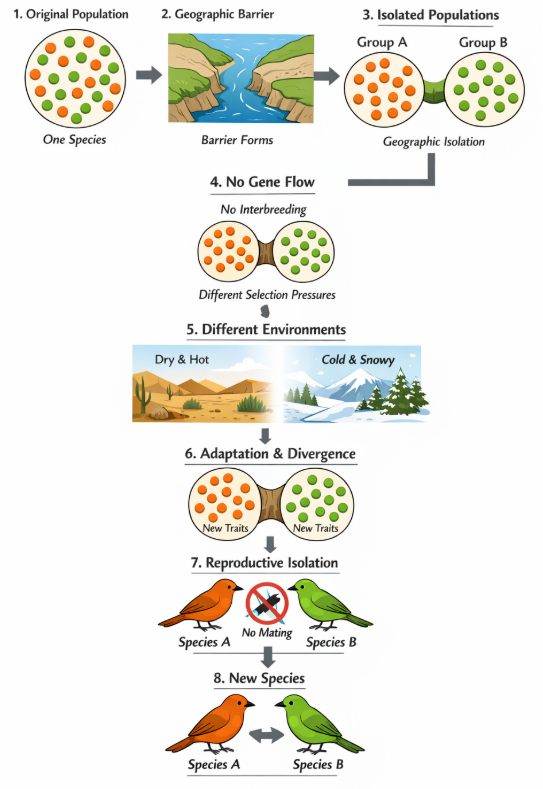
- A physical barrier forms between members of the population
Examples:
- A river changes its course
- A glacier advances
- Land splits due to continental drift
Result: Population splits into isolated groups.
3. Isolation of Populations
- Individuals cannot meet or mate across the barrier
- No movement between populations
This is called geographic isolation.
4. Reduction or Cessation of Gene Flow
- Alleles are no longer exchanged
- Each population evolves independently
“Geographic isolation reduces gene flow, allowing populations to become genetically distinct.”
5. Different Environmental Conditions Act
Each isolated population experiences different selective pressures:
- Temperature
- Rainfall
- Food availability
- Predators
- Competition
6. Natural Selection Favors Different Traits
- Different traits increase survival in different environments
- Allele frequencies change differently
7. Accumulation of Genetic Differences
- Due to natural selection
- Mutations
- Genetic drift
Populations become genetically divergent over time.
8. Development of Reproductive Isolation
- Mating no longer occurs
- Fertilization may fail
- Offspring may be weak or sterile
Speciation is complete.
9. Even If the Barrier Is Removed
- Populations may still not interbreed
- Genetic differences are permanent
🧪 Type of Speciation
Allopatric Speciation
- Caused by geographic isolation
- Most common form of speciation
📊 Summary Table
| Stage | What Happens |
|---|---|
| Initial population | One species, free interbreeding |
| Barrier forms | Population splits |
| Isolation | No mating between groups |
| Gene flow | Reduced or stopped |
| Selection | Different traits favored |
| Divergence | Genetic differences accumulate |
| Reproductive isolation | New species formed |
📦 Quick Recap
Geographic separation splits a population
Physical barriers prevent mating
Gene flow is reduced or stopped
Different environments cause different adaptations
Genetic differences accumulate over generations
Reproductive isolation develops
New species form (allopatric speciation)
Mechanisms of Speciation
🌱 Introduction
Even when populations live near each other, speciation can still occur.
This happens when reproductive separation (reproductive isolation) prevents individuals from mating successfully.
Any mechanism that prevents mating or successful offspring production reduces gene flow and can lead to speciation.
Reproductive separation can occur before fertilization or after fertilization.
📌 What Is Reproductive Separation?
Reproductive separation means that members of the same original species can no longer reproduce successfully.
Key points:
- Prevents gene flow
- Populations evolve independently
- Leads to formation of new species over time
“Reproductive isolation reduces or prevents gene flow between populations.”
🧬 Types of Reproductive Isolation
| Category | When Isolation Occurs |
|---|---|
| Prezygotic barriers | Before fertilization |
| Postzygotic barriers | After fertilization |
🔒 PREZYGOTIC MECHANISMS
(Prevent mating or fertilization)
1. Habitat (Ecological) Isolation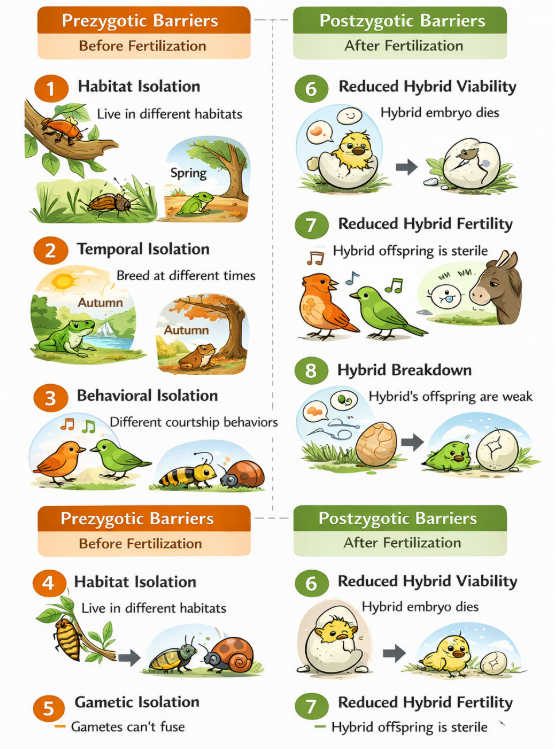
- Populations live in different habitats or niches
- Same geographic area, different microhabitats
- No opportunity to mate
Example idea:
- One insect species lives on trees
- Another lives on grass in the same area
Result: Mating does not occur → gene flow reduced
2. Temporal Isolation
- Populations breed at different times
- Differences may be in time of day, season, or year
Example idea:
- One population mates in spring
- Another mates in autumn
Important point:
No overlap in breeding time = no reproduction
3. Behavioral Isolation
- Differences in courtship behavior or mating signals
- Different mating calls, dances, or pheromones
Example idea:
- Birds with different songs
- Insects responding to specific chemical signals
Behavioral differences prevent recognition of suitable mates.
4. Mechanical Isolation
- Structural differences prevent successful mating
- Reproductive organs are incompatible
Example idea:
- Insects with incompatible body structures
- Flowers adapted to different pollinators
Result: Mating attempt occurs, but fertilization fails
5. Gametic Isolation
- Mating occurs, but gametes cannot fuse
- Sperm cannot survive or penetrate egg
- Egg does not recognize sperm
Important:
Common in aquatic species that release gametes into water
🚫 POSTZYGOTIC MECHANISMS
(Fertilization occurs, but offspring is unsuccessful)
6. Reduced Hybrid Viability
- Embryo fails to develop properly
- Offspring is weak or dies early
Result: Genes are not passed to the next generation
7. Reduced Hybrid Fertility
- Hybrid offspring survives but is sterile
Example idea:
- Mule (offspring of horse and donkey)
Key point:
Sterile offspring = no gene flow
8. Hybrid Breakdown
- Hybrid offspring is viable and fertile
- Next generation is weak
- Later generations fail to survive or reproduce
Important:
Critical for long-term speciation
📊 Summary Table: Reproductive Isolation Mechanisms
| Mechanism | Type | How It Prevents Speciation |
|---|---|---|
| Habitat isolation | Prezygotic | Populations do not meet |
| Temporal isolation | Prezygotic | Different breeding times |
| Behavioral isolation | Prezygotic | Different mating behaviors |
| Mechanical isolation | Prezygotic | Incompatible structures |
| Gametic isolation | Prezygotic | Gametes cannot fuse |
| Reduced hybrid viability | Postzygotic | Offspring fails to develop |
| Reduced hybrid fertility | Postzygotic | Offspring is sterile |
| Hybrid breakdown | Postzygotic | Weak future generations |
🧠 Why Reproductive Separation Leads to Speciation
- Prevents gene flow
- Allows genetic differences to accumulate
- Reinforces divergence over generations
- Results in formation of new species
📌 Important note:
Reproductive isolation can evolve gradually due to natural selection.
📦 Quick Recap
Reproductive separation prevents successful mating
Gene flow between populations is reduced
Isolation can occur before or after fertilization
Prezygotic barriers prevent mating or fertilization
Postzygotic barriers reduce hybrid success
Genetic divergence increases
Speciation occurs over time
Reproductive separation occurs through prezygotic and postzygotic mechanisms that reduce gene flow, allowing populations to diverge genetically and form new species.