
Rates of Speciation
🌍 Introduction
The rate of speciation refers to how quickly new species are formed over time.
Speciation does not occur at a constant speed. Some lineages evolve very slowly, while others diversify rapidly.
The rate of speciation depends on environmental conditions, population characteristics, and evolutionary pressures acting on a population.
📌 What Do We Mean by “Rate of Speciation”?
- It is the speed at which populations split and form new species
- Measured over evolutionary time
- Influenced by how quickly genetic differences and reproductive isolation develop
🧬 Factors That Affect the Rate of Speciation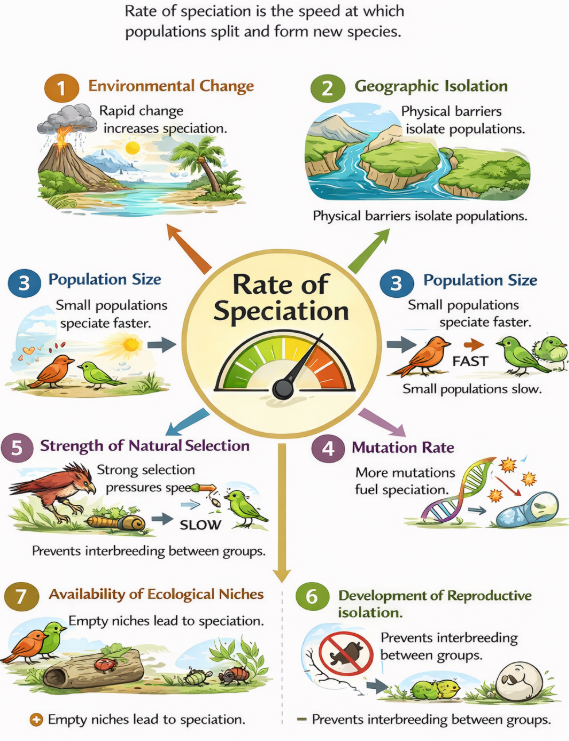
1. Environmental Change
Environmental change is one of the strongest factors influencing speciation rates.
How it affects speciation:
- Alters selective pressures
- Forces populations to adapt to new conditions
- Can split populations into different habitats
Examples of environmental change:
- Climate change (temperature, rainfall)
- Glacial advances or retreats
- Volcanic eruptions
- Sea-level changes
📌 Important point:
Rapid environmental change often increases the rate of speciation because populations must adapt quickly or diverge.
2. Geographic Isolation
Geographic isolation occurs when populations are physically separated.
Effects on speciation rate:
- Gene flow is reduced or stopped
- Populations evolve independently
- Different mutations and adaptations accumulate
Examples of isolating barriers:
- Mountains
- Rivers
- Oceans
- Continental drift
Populations that become geographically isolated tend to speciate faster than populations that remain connected.
3. Population Size
Population size strongly influences how quickly genetic changes spread.
Small populations:
- Experience stronger genetic drift
- Allele frequencies change rapidly
- Reproductive isolation can develop faster
Large populations:
- More genetic stability
- Slower accumulation of differences
- Lower speciation rates
Speciation often occurs more rapidly in small, isolated populations.
4. Mutation Rate
Mutations introduce new genetic variation into populations.
Role in speciation:
- Provide raw material for evolution
- Increase genetic diversity
- Allow populations to respond to selection
📌 Important clarification:
- Mutations do not directly cause speciation
- They support speciation by increasing variation
Higher mutation rates can increase the rate of speciation when combined with isolation and selection.
5. Strength of Natural Selection
Natural selection determines which traits are favored in an environment.
Strong selective pressures:
- Rapid changes in allele frequencies
- Faster divergence between populations
- Quicker development of adaptations
Examples of strong selection:
- New predators
- Limited food resources
- Extreme environmental conditions
📌 Key idea:
Stronger selection pressures increase the rate of speciation.
6. Development of Reproductive Isolation
Speciation is complete only when reproductive isolation evolves.
Faster reproductive isolation means:
- Faster reduction in gene flow
- Quicker genetic divergence
- Higher speciation rate
Mechanisms include:
- Behavioral differences
- Mechanical incompatibility
- Temporal differences in breeding
The faster reproductive isolation forms, the faster speciation occurs.
7. Availability of Ecological Niches
Ecological niches are the roles organisms play in an ecosystem.
When many niches are available:
- Populations adapt to different resources
- Competition is reduced
- Speciation rates increase
📌 Important situation:
After environmental change or extinction events, empty niches promote rapid speciation.
📊 Summary Table: Factors Affecting Rate of Speciation
| Factor | Effect on Speciation Rate |
|---|---|
| Environmental change | Increases speciation |
| Geographic isolation | Reduces gene flow |
| Small population size | Faster divergence |
| High mutation rate | More variation |
| Strong natural selection | Rapid adaptation |
| Reproductive isolation | Completes speciation |
| Available niches | Promotes diversification |
🧠 Memory Trick
E-G-P-M-S-R-N
- Environmental change
- Geographic isolation
- Population size
- Mutation rate
- Selection strength
- Reproductive isolation
- Niche availability
📦 Quick Recap
Speciation rates vary over time
Environmental change accelerates divergence
Geographic isolation reduces gene flow
Small populations speciate faster
Mutations increase genetic variation
Strong natural selection speeds adaptation
Faster reproductive isolation increases speciation rate
Rates of Speciation
🌱 Introduction
Speciation has not occurred at a constant rate throughout Earth’s history.
At some times, new species formed very slowly, while at other times, many new species appeared rapidly.
Central claim:
Rates of speciation have varied throughout Earth’s history due to environmental stability, rapid environmental change, and extinction events.
This claim is supported by multiple lines of scientific evidence, especially the fossil record.
📌 What Does “Variation in Speciation Rate” Mean?
- The number of new species formed per unit time changes
- Speciation can be slow and gradual or rapid and sudden
- These changes are linked to environmental conditions
🧪 Evidence Supporting Variable Rates of Speciation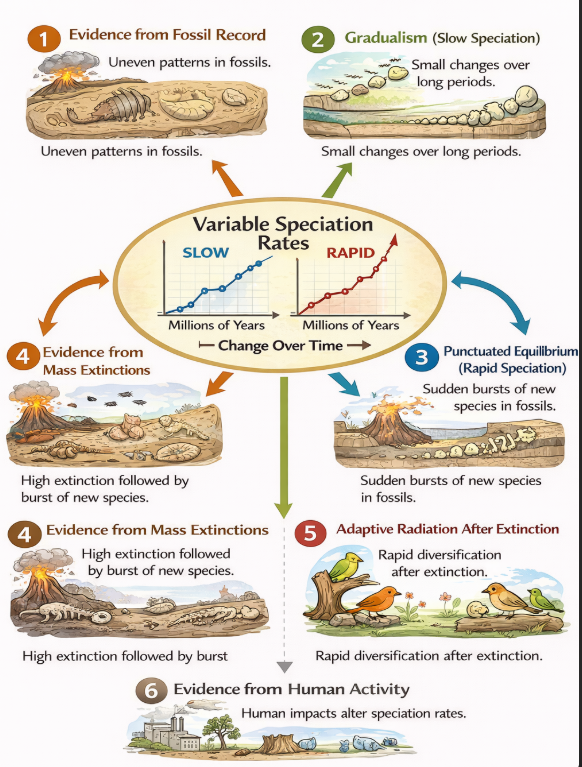
1. Evidence from the Fossil Record
The fossil record provides a timeline of life on Earth.
What fossils show:
- Long periods with little change in species
- Sudden appearances of new species
- Periods with high extinction rates
📌 Key conclusion:
If speciation occurred at a constant rate, fossils would show steady change.
Instead, fossils show uneven patterns, supporting variable rates of speciation.
2. Gradualism as Evidence of Slow Speciation
Definition
Gradualism is a model of evolution in which small genetic changes accumulate slowly over long periods of time, leading to speciation.
Evidence supporting gradualism:
- Transitional fossils showing small changes
- Species showing slight modifications over millions of years
- Long periods of environmental stability
Interpretation:
During stable conditions, speciation occurs slowly.
3. Punctuated Equilibrium as Evidence of Rapid Speciation
Definition
Punctuated equilibrium states that species experience:
- Long periods of little evolutionary change
- Short bursts of rapid speciation
Evidence supporting punctuated equilibrium:
- Sudden appearance of new species in fossil layers
- Little change in species before and after these events
- Rapid speciation following environmental disturbance
Interpretation:
Environmental change can trigger rapid increases in speciation rates.
📊 Comparison: Gradualism vs Punctuated Equilibrium
| Feature | Gradualism | Punctuated Equilibrium |
|---|---|---|
| Rate of speciation | Slow | Rapid bursts |
| Environmental conditions | Stable | Rapidly changing |
| Fossil record pattern | Continuous transitions | Sudden appearances |
| Speciation timing | Constant | Uneven |
Both models are supported by fossil evidence and show that speciation rates vary.
4. Evidence from Mass Extinction Events
Definition
A mass extinction is a period when many species go extinct in a short geological time.
Evidence:
- Sharp drops in biodiversity in fossil layers
- Sudden disappearance of many species
- Followed by rapid diversification of surviving species
📌 Important point:
After mass extinctions, speciation rates increase rapidly as organisms fill empty ecological niches.
5. Adaptive Radiation After Extinction
Adaptive radiation occurs when:
- A small number of species rapidly diversify
- Many new species evolve from a common ancestor
- New ecological niches are filled
Fossil evidence:
- Rapid appearance of multiple related species
- Increased biodiversity after extinction events
This supports the idea that speciation rates increase during certain periods.
6. Evidence from Human-Induced Changes
Modern evidence shows that human activity has altered natural speciation and extinction rates.
Examples:
- Overharvesting
- Habitat destruction
- Climate change
Species such as the great auk and passenger pigeon went extinct rapidly due to human influence.
📌 Conclusion:
Human activity has caused unnatural changes in evolutionary rates, further proving that speciation rates are not constant.
🧠 How All This Evidence Supports the Claim
- Speciation rates change over time
- Stable environments favor slow speciation
- Rapid environmental change favors rapid speciation
- Extinction events reset ecosystems and increase diversification
📦 Quick Recap
Fossil record shows uneven patterns of change
Gradualism supports slow speciation
Punctuated equilibrium supports rapid bursts
Mass extinctions reduce biodiversity
Adaptive radiation increases speciation afterward
Human activity has altered evolutionary rates