
Race to Discover DNA
🌿 Introduction
DNA structure was not discovered suddenly.
It was a scientific race. Different scientists collected different pieces of evidence.
When all pieces were combined, the final model of DNA was formed.
📌 Important idea: Scientific models change when new evidence is discovered.
This topic is about how the DNA model improved over time.
🧠 Step 1 – What Is a Scientific Model?
Before jumping into the scientists, understand this clearly:
A scientific model:
- Explains a structure or process
- Is based on evidence
- Can change when new data appears
- Must match experimental results
DNA structure is a perfect example of model improvement.
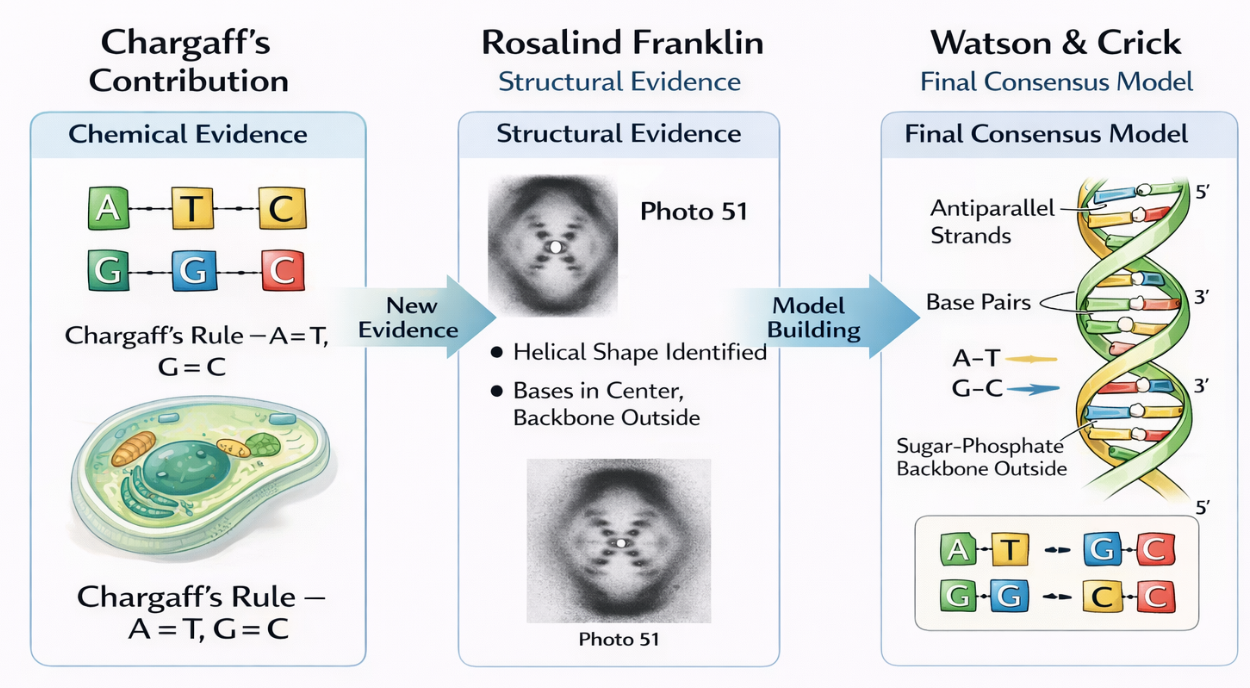
🧪 Step 2 – Chargaff’s Observations (Chemical Evidence)
Scientist: Erwin Chargaff
He studied the chemical composition of DNA from different organisms.
What He Found
- Amount of Adenine (A) = Amount of Thymine (T)
- Amount of Guanine (G) = Amount of Cytosine (C)
This is called:
Chargaff’s Rule
A = T
G = C
Why This Was Important
- DNA bases follow a pattern
- Bases are paired in some specific way
- DNA is not randomly arranged
But at this stage:
- Shape of DNA was unknown
- 3D structure was not discovered
So only chemical ratios were known, not structure.
📸 Step 3 – Franklin’s Structural Evidence
Scientist: Rosalind Franklin
She used X-ray diffraction to study DNA.
This technique helps scientists understand molecular shape.
Her famous image was called Photo 51.
What Her Work Showed
- DNA has a helical shape
- It has a uniform width
- Nitrogenous bases are located near the center
- Sugar-phosphate backbone is on the outside
Why This Was a Big Step
- First strong evidence that DNA is a helix
- Confirmed DNA has repeating structure
- Gave clues about internal arrangement
But:
- Exact base pairing pattern was still not fully explained
Now scientists knew the shape, but not the complete model.
🧠 Step 4 – Watson and Crick’s Final Model
Scientists: James Watson and Francis Crick
They combined:
- Chargaff’s base ratio data
- Franklin’s X-ray diffraction evidence
- Model building approach
They physically built a 3D model to see if all evidence fits together.
Final Consensus Model (Double Helix)
Their model explained everything clearly.
Main Features:
1. DNA is a double helix
Two strands twisted around each other
2. Strands are antiparallel
They run in opposite directions
3. Sugar-phosphate backbone is on the outside
4. Nitrogen bases are inside
5. Base pairing follows Chargaff’s rule
A pairs with T
G pairs with C
This pairing is called complementary base pairing.
🔄 How the Model Changed Over Time
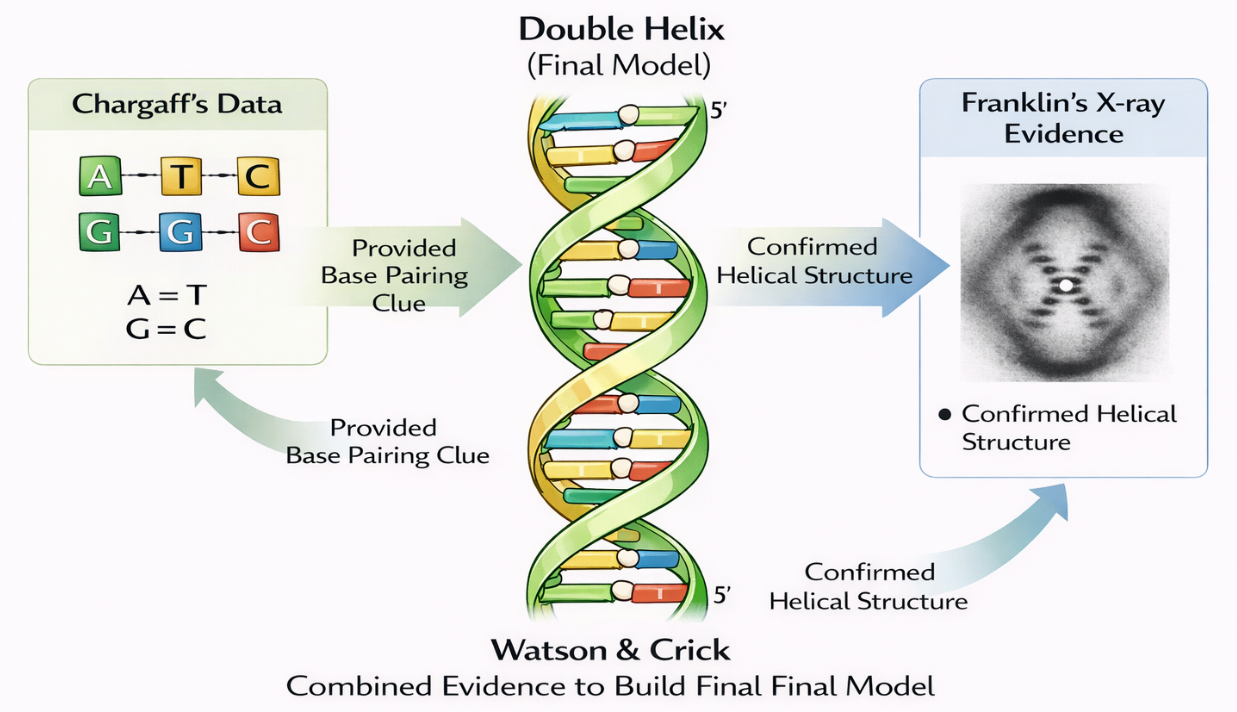
| Stage | What Was Known | What Was Missing |
|---|---|---|
| Chargaff | Base ratios (A=T, G=C) | Shape of DNA |
| Franklin | Helical shape | Exact pairing model |
| Watson & Crick | Double helix with base pairing | Became final accepted model |
Each step solved a different puzzle piece.
Consensus means:
The scientific community accepted it because it explained all evidence.
🧠 Simple Memory Trick
Think in order:
C → F → W
Chargaff → Franklin → Watson & Crick
First numbers
Then shape
Then final structure
📦 Quick Recap
DNA model improved step by step.
Chargaff discovered base ratios A=T and G=C.
Franklin proved DNA is a helix with bases inside.
Watson and Crick built the double helix model.
Scientific models change when new evidence emerges.