
DNA Organization in Prokaryotes vs Eukaryotes
🌿 Introduction
DNA is the genetic material found in all living organisms.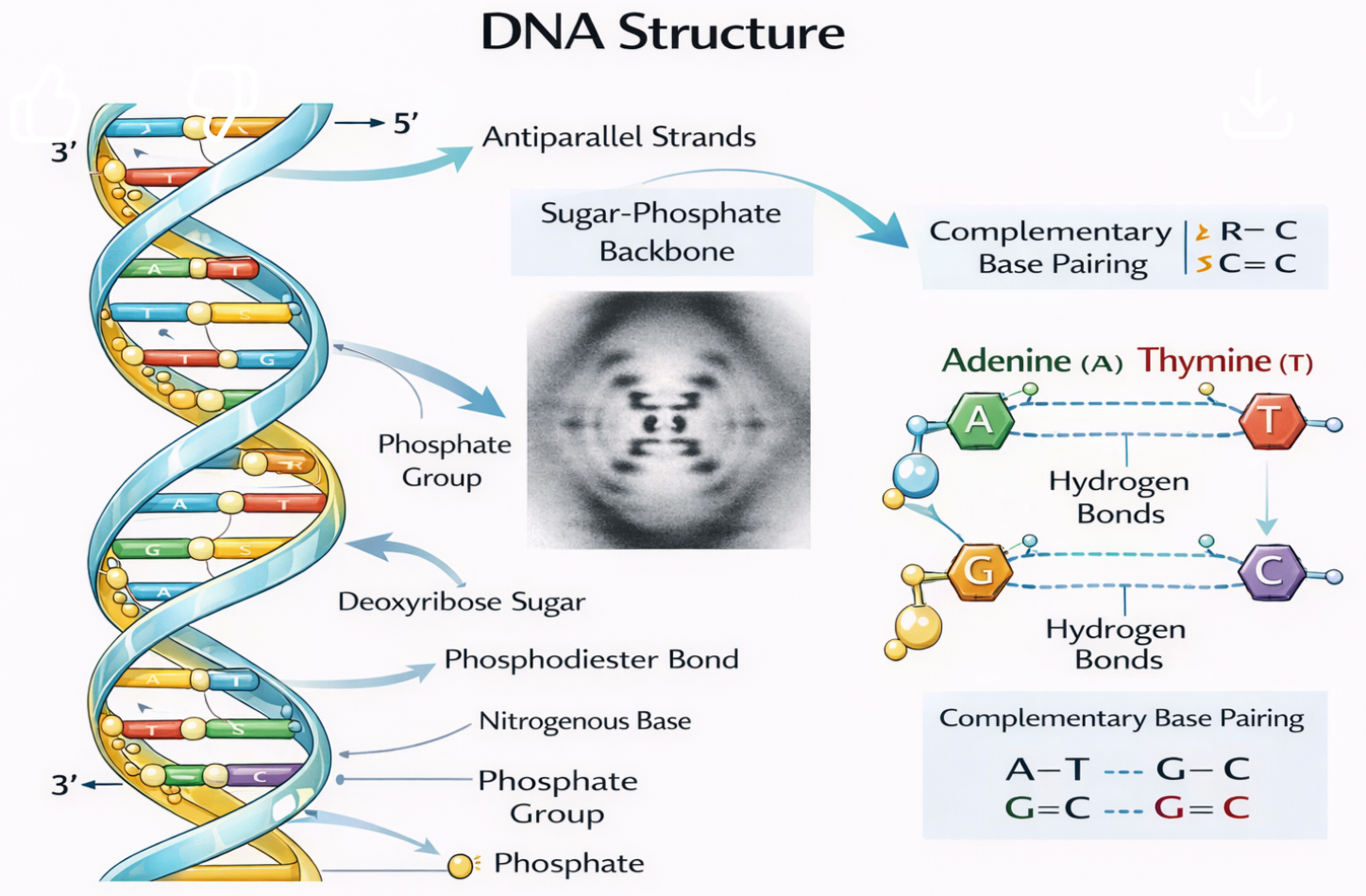 But the way DNA is arranged inside cells is not the same in all organisms.
The organization of DNA depends on whether the cell is:
- Prokaryotic
- Eukaryotic
Understanding this difference is very important because it affects:
- Gene expression
- Cell division
- Complexity of the organism
🦠 DNA Organization in Prokaryotes
Basic Identity
Prokaryotes include:
- Bacteria
- Archaea
They are simpler cells and do not have a nucleus.
Location of DNA
- DNA is found in the cytoplasm
- Specifically in a region called the nucleoid
- It is not surrounded by a membrane
Key idea: No nucleus = DNA is free in cytoplasm.
Structure of Genomic DNA
- Usually one single chromosome
- Chromosome is circular
- Double-stranded DNA
- Compact and supercoiled
Think of it like: A closed loop.
📌 Additional DNA (Plasmids)
Many prokaryotes also have:
- Small circular DNA molecules called plasmids
- Carry extra genes (like antibiotic resistance)
- Separate from main chromosome
But remember:
The main genomic DNA = single circular chromosome.
Why Circular DNA?
Circular DNA:
- Has no free ends
- Is stable
- Replicates quickly
This suits prokaryotes because they divide rapidly.
🧫 DNA Organization in Eukaryotes
Basic Identity
Eukaryotes include:
- Plants
- Animals
- Fungi
- Protists
These cells are more complex and have a true nucleus.
Location of DNA
- DNA is enclosed inside the nucleus
- Surrounded by a nuclear membrane
Key idea: DNA is separated from cytoplasm.
Structure of Genomic DNA
- Multiple chromosomes
- Each chromosome is linear
- Double-stranded DNA
- Much longer than prokaryotic DNA
Instead of one loop,
There are many long strands.
📌 DNA Packaging
Because eukaryotic DNA is very long, it must be tightly organized.
It wraps around proteins called histones.
This forms:
- Nucleosomes
- Chromatin
- Chromosomes (during cell division)
This packaging allows large amounts of DNA to fit inside the nucleus.
🔬 Clear Comparison Table
| Feature | Prokaryotes | Eukaryotes |
|---|---|---|
| Nucleus | Absent | Present |
| DNA Location | Cytoplasm (nucleoid) | Inside nucleus |
| Number of Chromosomes | One | Multiple |
| Shape of DNA | Circular | Linear |
| DNA Packaging | Supercoiled | Wrapped around histones |
| Complexity | Simple organization | Highly organized |
🧠 Core Concept Flow
All living organisms have DNA.
But:
Prokaryotes → Single circular chromosome → No nucleus
Eukaryotes → Multiple linear chromosomes → Inside nucleus
The difference reflects:
- Cell complexity
- Level of organization
- Evolutionary advancement
📦 Quick Recap
DNA is genetic material in all living organisms.
Prokaryotes have one circular chromosome in the cytoplasm.
Eukaryotes have multiple linear chromosomes inside a nucleus.
Eukaryotic DNA is wrapped around histone proteins.
DNA organization increases in complexity from prokaryotes to eukaryotes.
Monomers Necessary for Cells to Build DNA
🌿 Introduction
DNA is a macromolecule.
It is not a single unit. It is a polymer, meaning it is built by joining many repeating small units.
Those small repeating units are called monomers.
🧬 DNA Is a Polymer
- DNA stands for Deoxyribonucleic Acid
- It is a nucleic acid
- It is made of repeating units
- Those repeating units are called nucleotides
So:
Polymer = DNA
Monomer = DNA nucleotide
🧠 What Exactly Is a DNA Nucleotide?
A DNA nucleotide is the building block used by cells to construct DNA strands.
Each DNA nucleotide contains three specific components:
- A phosphate group
- A 5-carbon sugar called deoxyribose
- A nitrogenous base
If even one of these is missing, DNA cannot form properly.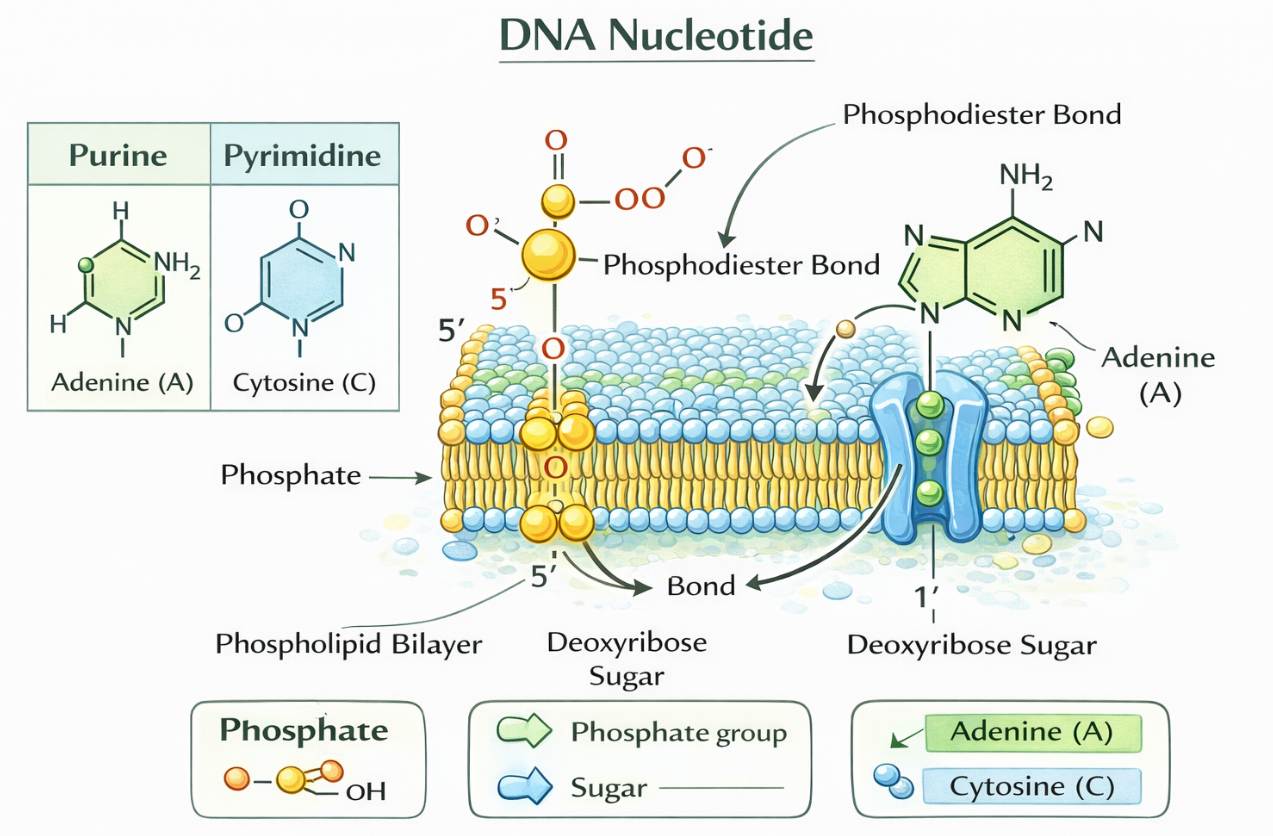
🧪 Component 1: Phosphate Group
Structure:
- Contains phosphorus atom bonded to oxygen atoms
- Negatively charged
Role:
- Links one nucleotide to the next
- Forms part of the sugar-phosphate backbone
- Provides structural stability
Bond formed:
- Phosphodiester bond
- Connects 5′ phosphate of one nucleotide to 3′ OH group of another
This bond is strong and gives DNA its stable structure.
🧬 Component 2: Deoxyribose Sugar
This is the sugar specific to DNA.
Important features:
- It is a 5-carbon sugar
- Carbon atoms are numbered 1′ to 5′
- Base attaches at 1′ carbon
- Phosphate attaches at 5′ carbon
- 3′ carbon has an OH group for bonding
Why is it called “deoxy”?
- It has one less oxygen than ribose (RNA sugar)
- This makes DNA more stable and less reactive
Stability is important because DNA stores long-term genetic information.
🧪 Component 3: Nitrogenous Bases
| Base | Symbol | Type |
|---|---|---|
| Adenine | A | Purine |
| Guanine | G | Purine |
| Thymine | T | Pyrimidine |
| Cytosine | C | Pyrimidine |
Purines vs Pyrimidines
Purines:
- Double-ring structure
- Larger molecules
- Adenine and Guanine
Pyrimidines:
- Single-ring structure
- Smaller molecules
- Thymine and Cytosine
One purine always pairs with one pyrimidine. This keeps DNA width uniform.
🧠 How Nucleotides Join to Build DNA
Cells build DNA by linking nucleotides in a specific way.
Step-wise process:
- Phosphate of one nucleotide bonds to sugar of next nucleotide
- Forms sugar-phosphate backbone
- Bases extend inward
- Complementary bases hydrogen bond
Base pairing rules:
A pairs with T
G pairs with C
Hydrogen bonds hold these bases together.
- A-T pair forms 2 hydrogen bonds
- G-C pair forms 3 hydrogen bonds
G-C pairing is slightly stronger due to extra hydrogen bond.
🧬 Directionality of DNA Strand
When nucleotides join:
- One end is called 5′ end
- Other end is called 3′ end
DNA strands grow in 5′ → 3′ direction.
This directionality is important for:
- DNA replication
- Enzyme function
🧪 What Monomers Do Cells Actually Use?
Cells do not just use plain nucleotides.
They use:
Deoxyribonucleotide triphosphates (dATP, dTTP, dGTP, dCTP)
Each contains:
- Deoxyribose
- Nitrogen base
- Three phosphate groups
Extra phosphates provide energy for bonding.
When DNA forms:
- Two phosphates are released
- Energy drives phosphodiester bond formation
This makes DNA synthesis energetically favorable.
🧠 Why These Monomers Are Essential
Without DNA nucleotides:
- DNA cannot be replicated
- Cells cannot divide
- Genetic information cannot be passed on
- No inheritance
- No growth
DNA nucleotides are fundamental to life.
📊 Summary Table
| Monomer of DNA | DNA nucleotide |
| Components | Phosphate + Deoxyribose + Base |
| Sugar | Deoxyribose (5-carbon) |
| Bases | A, T, G, C |
| Base pairing | A–T, G–C |
| Bond type (backbone) | Phosphodiester bond |
| Bond type (bases) | Hydrogen bonds |
| Building form used by cell | dNTPs |
📦 Quick Recap
DNA monomer = nucleotide
3 parts → phosphate + deoxyribose + base
Bases → A, T, G, C
Purines → A, G
Pyrimidines → T, C
Backbone → phosphodiester bonds
Base pairing → hydrogen bonds
Cells use dNTPs to build DNA