
Importance of DNA Synthesis
🌿 Introduction
DNA carries the genetic instructions of a cell.
Before a cell divides, it must copy its DNA so that each new cell receives the same information.
This copying process is called:
DNA synthesis
Also called DNA replication
Without DNA synthesis, life cannot continue.
🧠 Why DNA Synthesis Is Necessary
All living cells must divide at some point.
Cells divide for:
- Growth
- Repair
- Replacement of damaged cells
- Reproduction (in some organisms)
Before division occurs:
- The cell must duplicate its DNA.
If DNA is not copied:
- New cells would not receive genetic information
- Cells would not function properly
- Traits could not be inherited
DNA synthesis ensures continuity of life.
🧬 Role in Passing Genetic Information
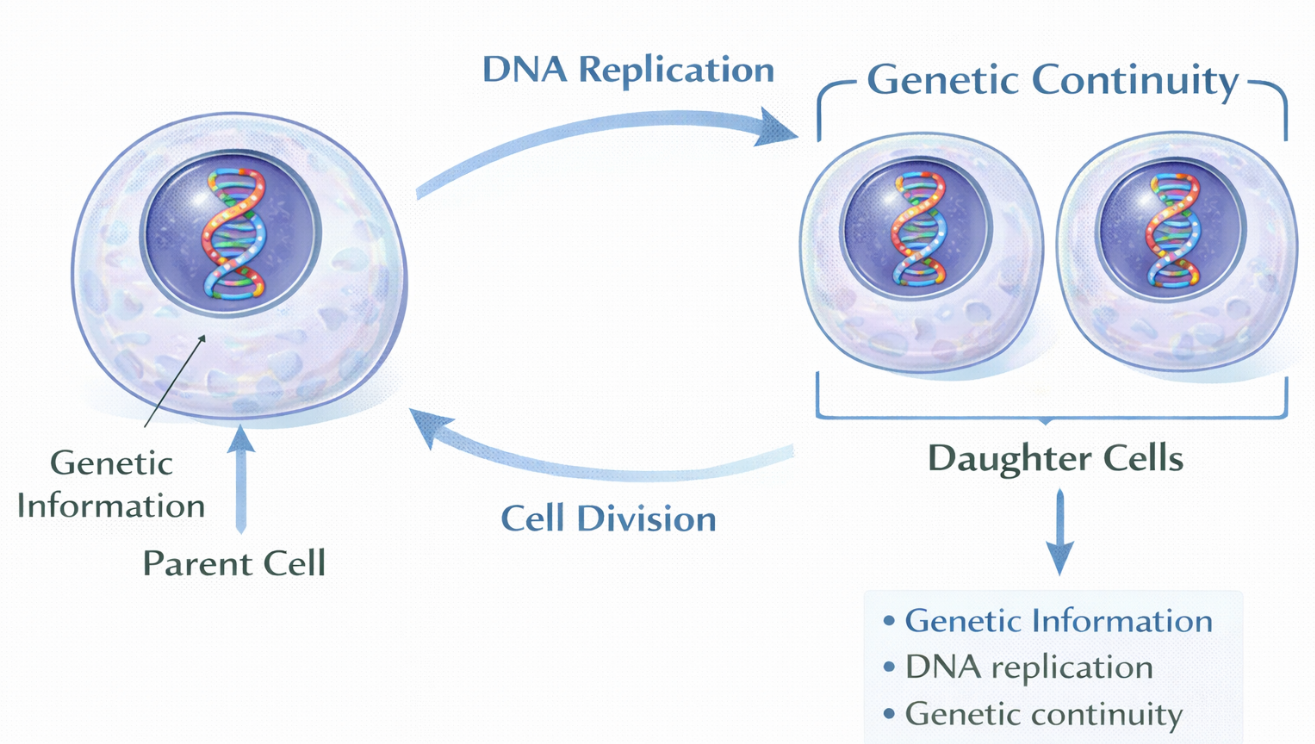
DNA stores hereditary information.
When replication occurs:
- Each new cell receives a complete copy of DNA
- The genetic code is preserved
- Traits are passed accurately
This is important because:
- Body cells must function the same way
- Organisms must maintain identity
- Genetic instructions must remain stable
Replication allows genetic stability across generations of cells.
🧪 DNA Synthesis and Cell Division
DNA synthesis occurs before:
- Mitosis (growth and repair)
- Meiosis (gamete formation)
In both cases:
- DNA must be copied first
- Division happens after replication
If replication fails:
- Cell division cannot proceed normally
- Mutations may occur
- Cells may die
DNA synthesis is required before every cell division cycle.
🧬 Semiconservative Nature of DNA Synthesis
One of the most important concepts:
DNA replication is semiconservative.
This means:
- Each new DNA molecule contains
- One original strand
- One newly synthesized strand
So after replication:
Original DNA → Two identical DNA molecules
Each molecule has:
- One old strand
- One new strand
This mechanism ensures accuracy and preservation of genetic information.
🧠 Importance for Growth and Development
In multicellular organisms:
- Growth requires increase in cell number
- More cells require more DNA copies
For example:
- A fertilized egg divides repeatedly
- Each new cell must contain identical DNA
If DNA synthesis does not occur:
- Organisms cannot grow
- Development would stop
🧪 Importance in Repair and Maintenance
Cells constantly experience:
- Damage
- Wear and tear
- Cell death
To replace damaged cells:
- Cells divide
- DNA must replicate first
For example:
- Skin cells
- Blood cells
- Intestinal lining cells
DNA synthesis allows tissues to repair and renew.
🧬 Importance in Reproduction
In reproduction:
- Genetic information must be passed to offspring
- Gametes contain DNA
- Fertilization combines genetic material
If replication does not occur:
- Genetic continuity between generations would stop
DNA synthesis ensures inheritance.
📊 Summary Table
| Function | Why DNA Synthesis Is Important |
|---|---|
| Growth | Increases number of cells |
| Repair | Replaces damaged cells |
| Maintenance | Maintains tissue function |
| Reproduction | Passes genes to offspring |
| Genetic Stability | Preserves DNA information |
| Cell Division | Required before mitosis/meiosis |
📦 Quick Recap
DNA synthesis = DNA replication
Occurs before cell division
Ensures each new cell gets identical DNA
Semiconservative → one old + one new strand
Needed for growth, repair, reproduction
Essential for genetic continuity
Using Models to Explain How DNA Synthesis Occurs
🌿 Introduction
DNA synthesis is the process by which a cell makes an identical copy of its DNA.
Because DNA is very long and complex, scientists use models to understand and explain this process.
A model helps us visualize:
- How DNA strands separate
- How new strands are formed
- Why replication is accurate
The model of DNA replication explains how genetic information is copied before cell division.
🧠 What Does a Replication Model Show?
A DNA replication model must show:
- The original double helix
- Separation of the two strands
- Each strand acting as a template
- Complementary base pairing
- Formation of two identical DNA molecules
The model should clearly demonstrate:
Replication is semiconservative
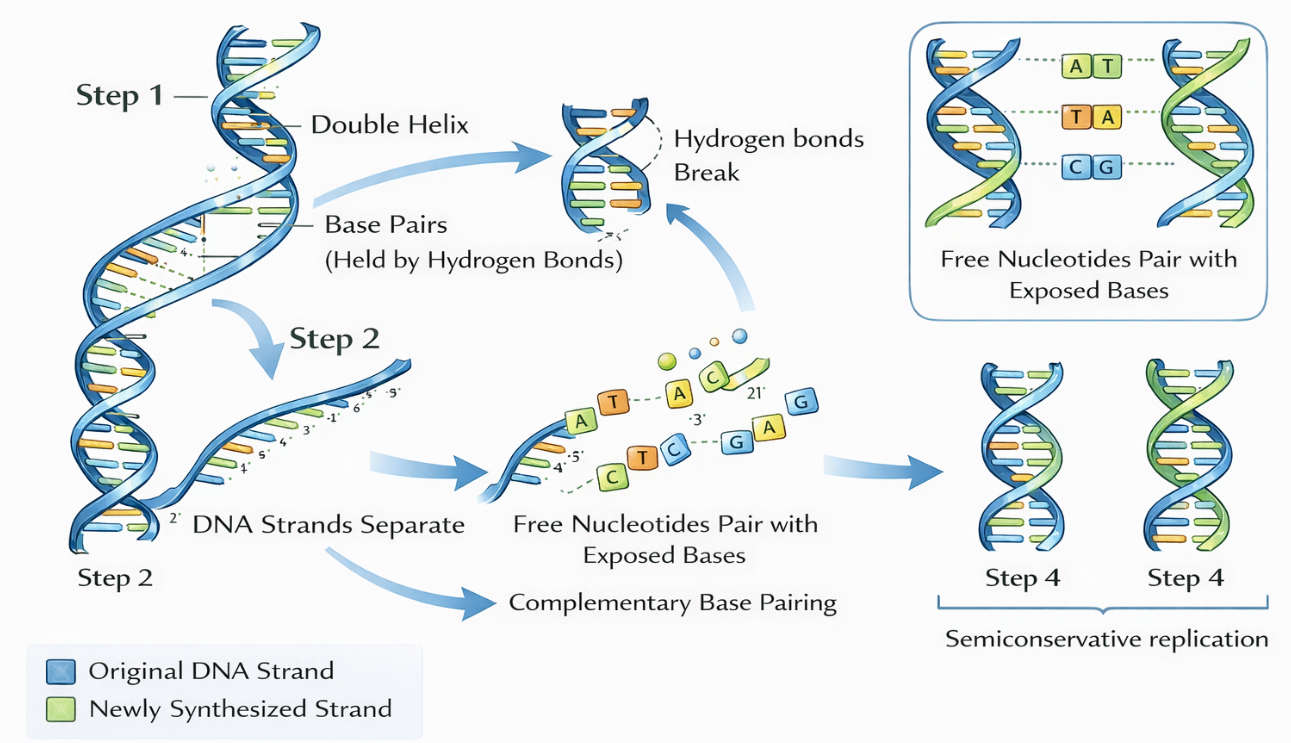
🧬 Step 1 – The Double Helix Unwinds
In the model:
- DNA begins as a double helix
- Hydrogen bonds between base pairs break
- The two strands separate
Important:
- The sugar-phosphate backbone does not break
- Only hydrogen bonds between bases break
The DNA now looks like a “Y” shape at the opening region.
Each original strand is now exposed.
🧬 Step 2 – Each Strand Acts as a Template
This is the most important idea.
Each original strand:
- Contains a specific sequence of bases
- Guides the formation of a new complementary strand
If one strand has:
A → new strand adds T
T → new strand adds A
G → new strand adds C
C → new strand adds G
This is called:
Complementary base pairing
The base sequence determines the new strand sequence.
🧬 Step 3 – New Nucleotides Are Added
Free DNA nucleotides in the nucleus:
- Pair with exposed bases
- Form hydrogen bonds
- Become linked into a growing strand
Phosphate and sugar join to form the backbone of the new strand.
Now each original strand has:
- One newly synthesized complementary strand attached
🧬 Step 4 – Two Identical DNA Molecules Form
At the end of replication:
There are two DNA molecules.
Each one contains:
- One original strand
- One newly synthesized strand
This is called:
Semiconservative replication
“Semi” means half
“Conservative” means original strand is conserved
Each daughter DNA molecule keeps one old strand.
🧠 Why the Model Is Important
The replication model explains:
- How DNA copies itself accurately
- Why base pairing ensures correct sequence
- How genetic information is preserved
- Why daughter cells receive identical DNA
Without this model, replication would be difficult to visualize.
📊 Simple Replication Model Summary
| Stage | What Happens |
|---|---|
| 1 | Double helix unwinds |
| 2 | Strands separate |
| 3 | Each strand acts as template |
| 4 | Complementary nucleotides pair |
| 5 | Two identical DNA molecules form |
📦 Quick Recap
DNA replication copies genetic information
Double helix unwinds
Strands separate
Each strand acts as template
Complementary base pairing occurs
Result → Two identical DNA molecules
Replication is semiconservative
Function of Enzymes in DNA Synthesis
🌿 Introduction
DNA synthesis does not happen on its own.
DNA is a stable, tightly coiled molecule. Its strands are held together by hydrogen bonds. New nucleotides cannot attach randomly.
So. the cell needs enzymes.
Enzymes are biological catalysts that speed up and control chemical reactions.
In DNA replication, two primary enzymes are required:
1. DNA helicase
2. DNA polymerase
🧠 Why Enzymes Are Necessary in DNA Synthesis
Without enzymes:
- DNA strands would not separate
- Nucleotides would not attach properly
- Replication would be too slow to support life
- Errors would increase
Enzymes ensure replication is fast, controlled, and accurate.
🧬 DNA Helicase – The “Unzipping” Enzyme
What It Does
DNA helicase:
- Breaks hydrogen bonds between base pairs
- Separates the two strands of DNA
- Unwinds the double helix
Important:
- It does NOT break the sugar-phosphate backbone
- It only separates the base pairs
As helicase works:
- The double helix opens
- A replication region forms
- Each strand becomes exposed
Without helicase, replication cannot begin.
🧬 DNA Polymerase – The Building Enzyme
After helicase separates the strands, DNA polymerase acts.
🔎 Main Functions of DNA Polymerase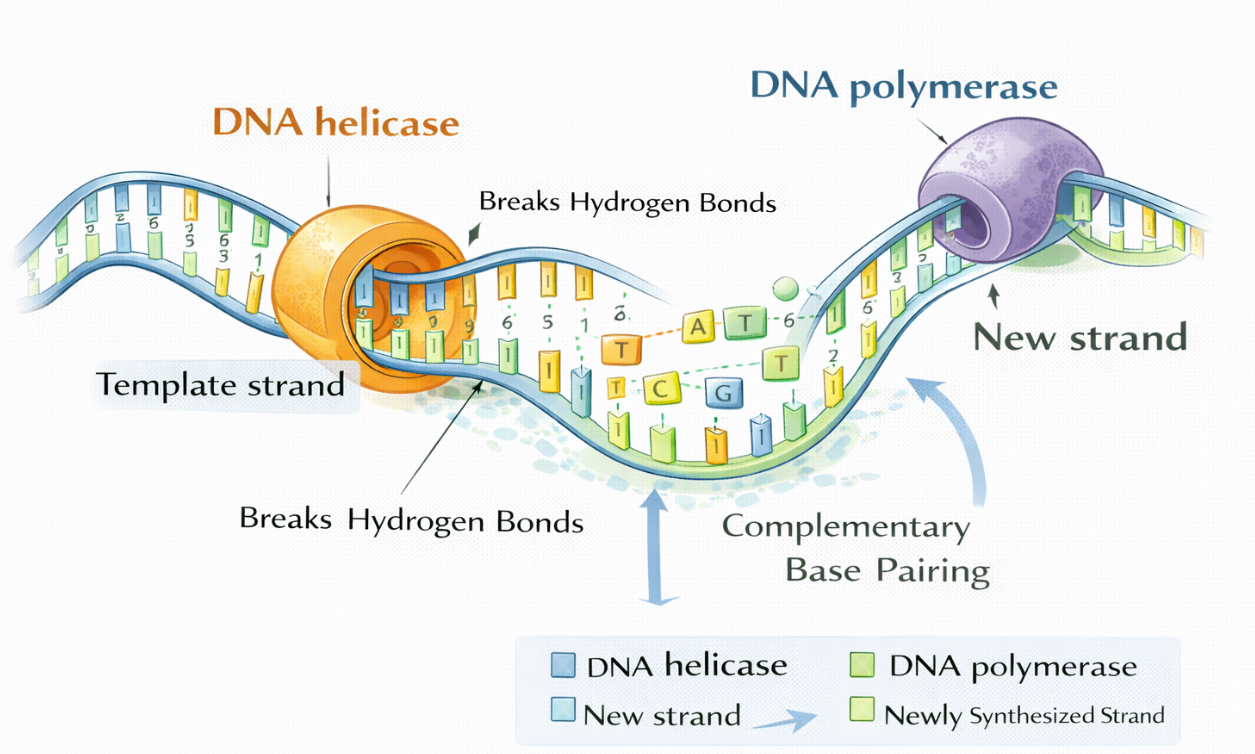
1. Adds complementary nucleotides
2. Forms bonds between nucleotides
3. Builds the new DNA strand
It works by:
- Reading the template strand
- Matching correct base
- Joining nucleotide into growing chain
Base pairing rules:
A pairs with T
G pairs with C
DNA polymerase ensures correct pairing.
🧠 Accuracy Role of DNA Polymerase
DNA polymerase also helps maintain accuracy.
It:
- Ensures complementary base pairing
- Reduces replication errors
- Helps maintain genetic stability
Accurate replication is essential for preserving genetic information.
🧪 Step-Wise Enzyme Action in DNA Synthesis
Let’s connect both enzymes clearly:
Step 1
DNA helicase breaks hydrogen bonds → strands separate
Step 2
DNA polymerase attaches new nucleotides to each template strand
Step 3
New strands form through complementary base pairing
Result:
Two identical DNA molecules form.
🧬 Why These Enzymes Are Biologically Important
Their functions allow:
- DNA to be copied before cell division
- Genetic information to be passed accurately
- Growth and repair of organisms
- Reproduction and inheritance
If these enzymes fail:
- Replication stops
- Cells cannot divide
- Mutations may occur
📊 Summary Table
| Enzyme | Function | Why Important |
|---|---|---|
| DNA Helicase | Breaks hydrogen bonds, separates strands | Initiates replication |
| DNA Polymerase | Adds complementary nucleotides, builds new strand | Ensures accurate DNA copying |
📦 Quick Recap
Enzymes speed up replication
DNA helicase → unzips DNA
Breaks hydrogen bonds
DNA polymerase → builds new strand
Adds complementary nucleotides
Ensures accuracy
Essential for genetic continuity