
Structural Differences Between RNA and DNA
🌿 Introduction
DNA and RNA are both nucleic acids. They are essential biological macromolecules that contain and help use genetic information. Although they are similar in basic composition, they differ in important structural ways.
These structural differences are not random. They directly relate to their biological roles.
DNA is designed for long-term storage of genetic information.
RNA is designed to help carry out protein synthesis.
🧬 Overall Structural Organization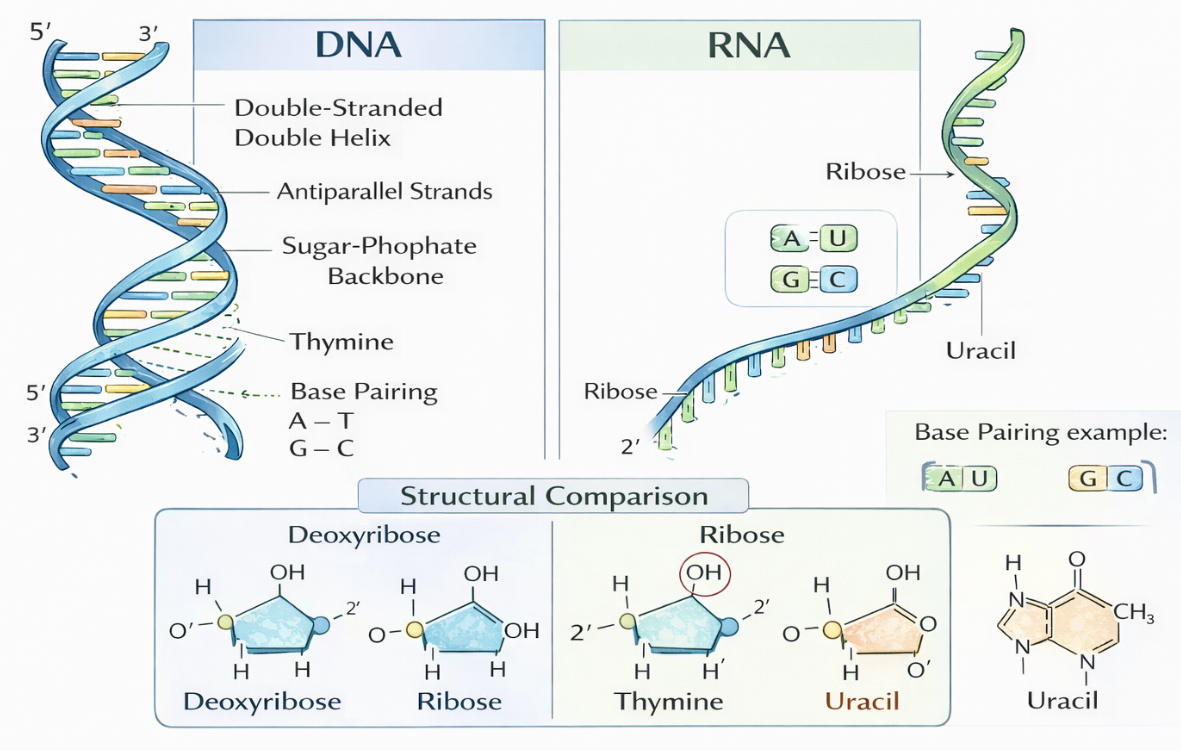
Both DNA and RNA are polymers made of repeating units called nucleotides.
Each nucleotide contains:
- A phosphate group
- A 5-carbon sugar
- A nitrogenous base
However, the type of sugar, the nitrogen base composition, and the strand arrangement differ between DNA and RNA.
These differences affect stability, shape, movement, and function.
🧪 Difference in Sugar Component
The first major structural difference is the sugar molecule.
DNA Sugar: Deoxyribose
DNA contains the sugar deoxyribose.
Characteristics of deoxyribose:
- It is a 5-carbon sugar
- It lacks one oxygen atom on the 2′ carbon
- It is slightly less reactive
Because it lacks that oxygen, DNA is more chemically stable.
This stability is important because DNA must:
- Store genetic information long-term
- Remain intact for the life of the cell
- Be passed accurately to new cells
RNA Sugar: Ribose
RNA contains the sugar ribose.
Characteristics of ribose:
- It is also a 5-carbon sugar
- It has an extra oxygen atom on the 2′ carbon
- It is slightly more reactive
That extra oxygen makes RNA less stable than DNA.
However, this is not a disadvantage.
RNA is meant to:
- Function temporarily
- Be made and broken down quickly
- Participate in protein synthesis
📌 Structural difference in sugar explains difference in stability and lifespan.
🧬 Difference in Nitrogenous Bases
Bases in DNA
DNA contains four nitrogenous bases:
- Adenine (A)
- Thymine (T)
- Guanine (G)
- Cytosine (C)
Base pairing in DNA:
A pairs with T
G pairs with C
Bases in RNA
RNA also contains four nitrogenous bases:
- Adenine (A)
- Uracil (U)
- Guanine (G)
- Cytosine (C)
The difference is:
RNA contains uracil instead of thymine.
So, in RNA:
A pairs with U
G pairs with C
Uracil is structurally similar to thymine but slightly simpler.
This difference contributes to:
- Reduced stability compared to DNA
- Suitability for temporary genetic messages
🧬 Difference in Strand Structure
This is one of the most important structural differences.
DNA Structure
- Double-stranded
- Twisted into a double helix
- Antiparallel in orientation
- Stabilized by hydrogen bonds between base pairs
Because it is double-stranded:
- It is more stable
- It is protected
- It can serve as a reliable genetic archive
RNA Structure
- Single-stranded
- Not arranged in a double helix
- More flexible
Being single-stranded allows RNA to:
- Leave the nucleus
- Travel through the cytoplasm
- Interact with ribosomes
- Participate in protein synthesis
Some types of RNA (like tRNA and rRNA) fold into specific shapes, but they remain single-stranded molecules.
📌 DNA stays protected in the nucleus.
📌 RNA moves and functions in protein synthesis.
🧬 Types of RNA and Structural Variation
Although all RNA shares basic structural differences from DNA, different types of RNA vary slightly in shape.
Messenger RNA (mRNA)
- Single-stranded
- Linear
- Carries genetic information from DNA to ribosome
Transfer RNA (tRNA)
- Single-stranded
- Folded into a specific 3D shape
- Carries amino acids during protein synthesis
Ribosomal RNA (rRNA)
- Single-stranded
- Highly folded
- Forms structural and functional part of ribosome
Despite these differences in folding, all RNA:
- Contains ribose
- Contains uracil
- Is single-stranded
🧠 Why RNA Structure Supports Protein Synthesis
- Single-stranded structure allows flexibility
- Ribose allows dynamic interactions
- Uracil enables proper base pairing during transcription
- Folding ability allows formation of ribosomes and amino acid carriers
DNA is designed for stability and storage.
RNA is designed for movement and function.
This structural specialization allows the flow of genetic information from DNA to proteins.
📊 Detailed Comparison Table
| Feature | DNA | RNA |
|---|---|---|
| Full Name | Deoxyribonucleic Acid | Ribonucleic Acid |
| Sugar | Deoxyribose | Ribose |
| Oxygen at 2′ Carbon | Missing | Present |
| Stability | More stable | Less stable |
| Nitrogen Base Difference | Thymine | Uracil |
| Strand Structure | Double-stranded | Single-stranded |
| Main Function | Long-term genetic storage | Protein synthesis involvement |
| Location | Mostly nucleus | Nucleus and cytoplasm |
📦 Quick Recap
DNA → Deoxyribose, Thymine, Double-stranded, Stable
RNA → Ribose, Uracil, Single-stranded, Functional
Structure determines function:
DNA stores.
RNA works.