
Transfer of Heritable Information from DNA to RNA (Transcription)
🌿 Introduction
DNA stores genetic information inside the cell. However, DNA does not directly build proteins. Instead, the information in DNA must first be copied into RNA.
This process is called: Transcription
Transcription is the first step in gene expression.
It transfers genetic instructions from DNA to RNA.
🧠 What Is Heritable Information?
Heritable information refers to:
- The sequence of nitrogenous bases in DNA
- The genetic instructions for building proteins
- Traits passed from one generation to the next
This information is stored in the order of bases:
A, T, G, C
The sequence determines:
- Which protein is produced
- The order of amino acids
📌 Transcription preserves this sequence information in RNA form.
🧬 Where Does Transcription Occur?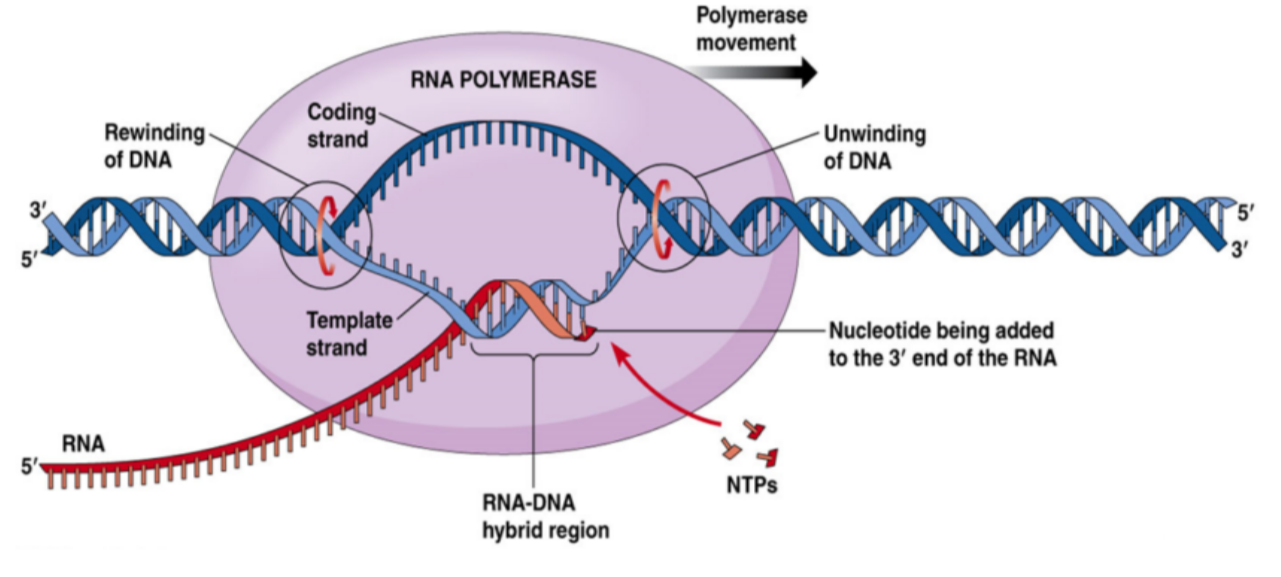
Location depends on cell type.
In Prokaryotes:
- Transcription occurs in the cytoplasm
- No nucleus is present
In Eukaryotes:
- Transcription occurs in the nucleus
- DNA remains inside the nucleus
- RNA is synthesized in the nucleus
After transcription in eukaryotes:
- RNA moves from nucleus to cytoplasm
📌 Location difference is important for understanding cell organization.
🧪 What Happens During Transcription?
Transcription uses one strand of DNA as a template.
Step 1 – DNA Unwinds
- A specific region of DNA unwinds
- Hydrogen bonds between base pairs break
- The two strands separate locally
Only a small portion of DNA is transcribed at a time.
Step 2 – One DNA Strand Serves as Template
Important:
- Only one strand of DNA is used
- This strand is called the template strand
- The template strand determines the RNA sequence
Step 3 – Complementary RNA Nucleotides Pair
Free RNA nucleotides in the nucleus (or cytoplasm in prokaryotes) pair with the exposed DNA bases.
Base pairing rules during transcription:
DNA A → RNA U
DNA T → RNA A
DNA G → RNA C
DNA C → RNA G
Note:
RNA uses uracil (U) instead of thymine.
This pairing ensures accurate copying of genetic information.
Step 4 – RNA Strand Is Synthesized
- RNA nucleotides join together
- A complementary RNA strand forms
- The RNA strand detaches from DNA
- The DNA double helix reforms after transcription
Now the RNA carries the genetic message.
🧬 Products of Transcription
RNA synthesis results in three main types of RNA polymers:
1. Messenger RNA (mRNA)
- Carries genetic instructions
- Contains codons (base triplets)
- Moves to ribosome for protein synthesis
mRNA directly reflects the DNA template sequence (with U instead of T).
2. Transfer RNA (tRNA)
- Transfers amino acids during protein synthesis
- Has specific structure
- Contains anticodon region
Though produced through transcription, its function occurs during translation.
3. Ribosomal RNA (rRNA)
- Forms part of ribosome structure
- Combines with proteins
- Essential for protein assembly
All three types are formed by transcription of DNA.
🧠 Why Transcription Is Important
- DNA cannot leave nucleus (in eukaryotes)
- RNA acts as a messenger
- Genetic code must be converted into a usable form
- It is the first step in protein synthesis
Without transcription:
- Genes could not be expressed
- Proteins could not be produced
- Cells could not function properly
📊 Summary Table
| Feature | Description |
|---|---|
| Process Name | Transcription |
| Purpose | Transfer genetic info from DNA to RNA |
| Template | One DNA strand |
| Base Pairing | A–U, T–A, G–C, C–G |
| Location (Prokaryotes) | Cytoplasm |
| Location (Eukaryotes) | Nucleus |
| Products | mRNA, tRNA, rRNA |
📦 Quick Recap
DNA stores genetic information
Transcription copies DNA → RNA
Occurs in nucleus (eukaryotes)
Occurs in cytoplasm (prokaryotes)
One DNA strand acts as template
RNA uses uracil instead of thymine
Produces mRNA, tRNA, rRNA