
Role of mRNA in Protein Synthesis
🌿 Introduction
Proteins are essential molecules in cells. They function as enzymes, structural components, transporters, and signaling molecules.
However, proteins are not built directly from DNA.
DNA remains protected inside the nucleus in eukaryotic cells. Ribosomes, where proteins are made, are located in the cytoplasm.
So, the cell needs a messenger molecule.
That messenger is messenger RNA (mRNA).
mRNA acts as the intermediate that transfers genetic information from DNA to the ribosome.
🧠 What Is mRNA?
Messenger RNA is:
- A single-stranded RNA molecule
- Transcribed from a specific gene on DNA
- Complementary to the DNA template strand
- Temporary in nature
Its primary role is to carry genetic instructions required to build a specific protein.
mRNA does not store information permanently like DNA. It carries instructions only long enough for protein synthesis to occur.
🧬 Formation of mRNA (Connection to Transcription)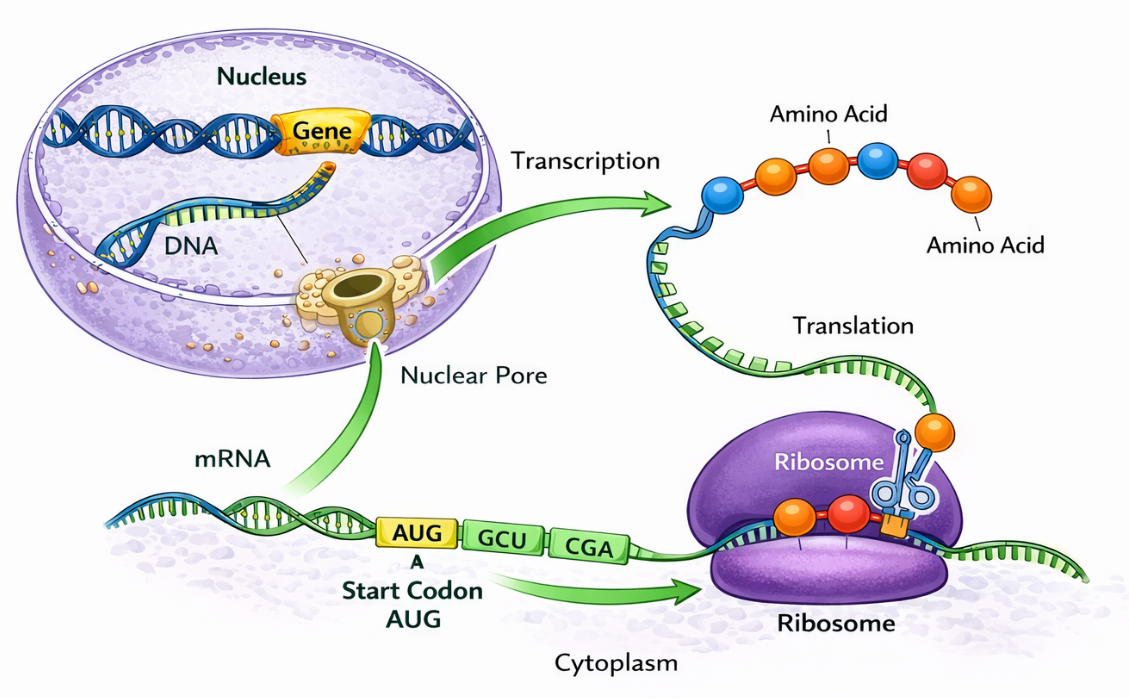
mRNA is produced during transcription.
During transcription:
- A specific section of DNA (a gene) unwinds.
- One DNA strand acts as the template.
- RNA nucleotides pair with complementary DNA bases.
- Uracil replaces thymine in RNA.
Base pairing rules during transcription:
DNA A → RNA U
DNA T → RNA A
DNA G → RNA C
DNA C → RNA G
The resulting mRNA molecule contains a sequence of bases that reflects the genetic code of the gene.
This sequence determines the amino acid order of the protein.
🧪 mRNA Leaves the Nucleus (In Eukaryotes)
In eukaryotic cells:
- DNA remains inside the nucleus.
- mRNA is synthesized in the nucleus.
- mRNA exits the nucleus through nuclear pores.
- It enters the cytoplasm.
In prokaryotes:
- There is no nucleus.
- Transcription and translation both occur in the cytoplasm.
mRNA acts as the link between DNA and ribosomes.
🧬 mRNA and the Ribosome
Ribosomes are the sites of protein synthesis.
When mRNA reaches a ribosome:
- The ribosome binds to the mRNA.
- The ribosome reads the mRNA sequence three bases at a time.
- Each group of three bases is called a codon.
🧠 Codons and the Genetic Code
A codon:
- Consists of three nucleotides.
- Specifies one amino acid.
For example:
AUG → codes for Methionine and serves as the start codon.
Other codons correspond to different amino acids.
mRNA determines:
- The order in which amino acids are added.
- The length of the protein.
If the mRNA sequence changes, the amino acid sequence may change.
🚦 Start and Stop Signals
mRNA contains signals that control translation.
Start codon:
- Usually AUG
- Signals the ribosome to begin translation
Stop codons:
- UAA
- UAG
- UGA
These codons signal the ribosome to stop adding amino acids.
This ensures proteins are built correctly and to the proper length.
🧬 Why mRNA Is Essential in Protein Synthesis
Without mRNA:
- DNA could not communicate instructions to ribosomes.
- Amino acids would not be assembled in the correct order.
- Proteins would not be produced.
mRNA ensures:
- Genetic information is accurately transferred.
- The correct protein is synthesized.
- Cells can express specific genes when needed.
mRNA determines which protein is made and when it is made.
🧠 Relationship Between mRNA and Protein Structure
The sequence of codons in mRNA determines → The sequence of amino acids in the polypeptide
The sequence of amino acids determines → The folding pattern of the protein
The folding pattern determines → The protein’s function
So:
DNA sequence → mRNA sequence → Amino acid sequence → Protein structure → Function
mRNA is the critical middle step in this process.
📊 Summary Table
| Feature | Role of mRNA |
|---|---|
| Origin | Transcribed from DNA |
| Structure | Single-stranded RNA |
| Function | Carries genetic code |
| Unit Read by Ribosome | Codon (3 bases) |
| Determines | Amino acid sequence |
| Importance | Enables protein synthesis |
📦 Quick Recap
mRNA is transcribed from DNA
Single-stranded
Leaves nucleus (in eukaryotes)
Read in codons (3 bases)
Each codon → one amino acid
Controls protein sequence
Essential for gene expression
Role of Amino Acids in Protein Synthesis
🌿 Introduction
Proteins are essential molecules in every living cell. They function as:
- Enzymes
- Structural components
- Hormones
- Transport molecules
- Antibodies
However, proteins are not built directly from DNA.
Proteins are built from amino acids.
So, in protein synthesis, amino acids are the actual building materials used to construct proteins.
🧠 What Are Amino Acids?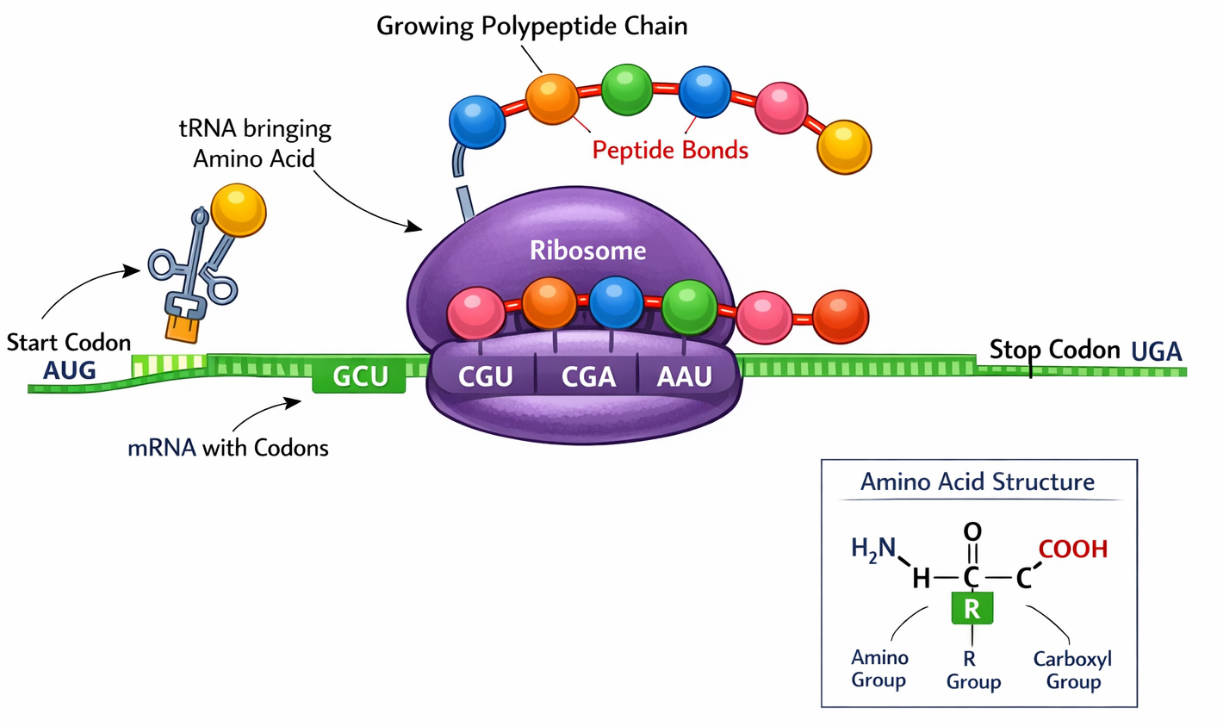
Amino acids are small organic molecules that serve as the monomers of proteins.
There are 20 common amino acids used by cells to build proteins.
Each amino acid has:
- An amino group (-NH₂)
- A carboxyl group (-COOH)
- A hydrogen atom
- A variable side chain called the R group
The R group is different in each amino acid and determines its chemical properties.
Because R groups differ, amino acids can be:
- Polar
- Nonpolar
- Acidic
- Basic
This variety is what allows proteins to have complex shapes and functions.
🧬 Amino Acids as Building Blocks of Proteins
Proteins are polymers.
The monomers of proteins are amino acids.
During protein synthesis:
- Amino acids are joined together
- They form a long chain
- This chain is called a polypeptide
Amino acids are linked by peptide bonds.
A peptide bond forms between:
- The carboxyl group of one amino acid
- The amino group of another amino acid
This creates a growing chain.
🧪 How Amino Acids Are Added During Translation
Protein synthesis occurs at the ribosome.
The ribosome reads mRNA in groups of three bases called codons.
Each codon specifies one amino acid.
For example:
AUG → codes for Methionine
When the ribosome reads a codon:
- The correct amino acid is brought to the ribosome
- It is added to the growing polypeptide chain
- A peptide bond forms
This process repeats until a stop codon is reached.
📌 The order of amino acids depends entirely on the mRNA sequence.
🧬 Importance of Amino Acid Sequence
The specific order of amino acids in a protein is extremely important.
The sequence determines:
- How the polypeptide folds
- The final 3D structure
- The protein’s function
If the sequence changes:
- The shape may change
- The function may change
Even a single amino acid substitution can alter protein function.
So amino acids do not just form proteins – their order determines how the protein works.
🧠 Amino Acids and Protein Structure Levels
The sequence of amino acids is called the primary structure of a protein.
Primary structure determines:
- Secondary structure (folding patterns)
- Tertiary structure (3D shape)
- Quaternary structure (multiple subunits, if present)
All of these structural levels depend on the amino acid sequence.
So amino acids control protein architecture.
🧬 Why Amino Acids Are Essential in Gene Expression
Gene expression ultimately leads to protein formation.
The process:
DNA → mRNA → Amino acid sequence → Protein
Without amino acids:
- Translation cannot occur
- Polypeptides cannot form
- Proteins cannot function
Amino acids are the physical components that turn genetic information into functional molecules.
📊 Summary Table
| Feature | Role of Amino Acids |
|---|---|
| Function | Building blocks of proteins |
| Number | 20 common types |
| Joined by | Peptide bonds |
| Sequence determined by | mRNA codons |
| Determines | Protein structure and function |
| Importance | Enables gene expression |
📦 Quick Recap
Amino acids = monomers of proteins
20 common types
Joined by peptide bonds
Each codon → one amino acid
Sequence determines protein shape
Shape determines function
Using Models to Demonstrate How Genes Are Expressed as Proteins
🌿 Introduction
A gene is a specific section of DNA that contains instructions for making a protein.
However, DNA itself does not directly build proteins.
The information stored in genes must first be copied into RNA and then translated into an amino acid sequence.
This overall process is called: Gene Expression
Gene expression explains how genetic information becomes a functional protein.
A model of gene expression helps visualize this flow clearly.
🧠 What a Gene Expression Model Must Show
A proper model must include:
- A gene (section of DNA)
- Transcription
- Formation of mRNA
- Movement of mRNA to ribosome
- Translation
- Amino acid chain formation
- Folding into functional protein
The model demonstrates:
DNA → RNA → Protein
🧬 Step 1 – Gene on DNA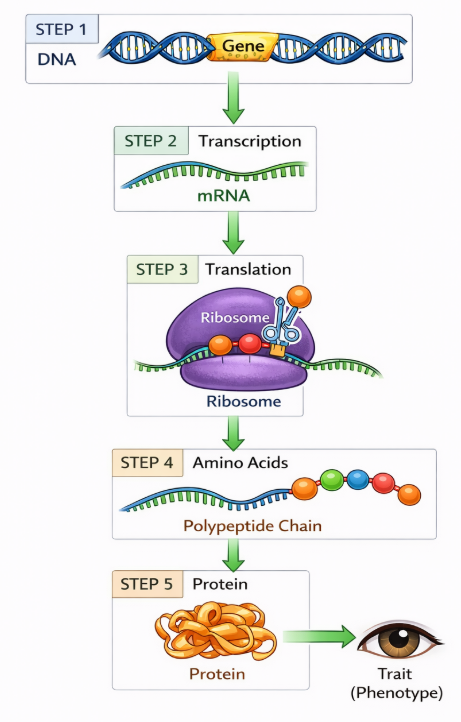
A gene is:
- A specific sequence of bases
- Located on a chromosome
- Contains instructions for a specific protein
The sequence of nitrogen bases in the gene stores heritable information.
This information determines the order of amino acids in the final protein.
🧪 Step 2 – Transcription (DNA → mRNA)
During transcription:
- The DNA double helix unwinds
- One strand serves as the template
- RNA nucleotides pair with complementary DNA bases
- mRNA is synthesized
Base pairing rules:
DNA A → RNA U
DNA T → RNA A
DNA G → RNA C
DNA C → RNA G
The mRNA produced carries the genetic instructions.
In eukaryotes:
- Transcription occurs in the nucleus
- mRNA then leaves the nucleus
🧬 Step 3 – mRNA Moves to the Ribosome
The ribosome is the site of protein synthesis.
mRNA attaches to a ribosome in the cytoplasm.
The ribosome reads the mRNA sequence.
🧠 Step 4 – Translation (mRNA → Amino Acids)
The ribosome reads mRNA in groups of three bases.
Each group of three bases is called a codon.
Each codon corresponds to one amino acid.
Example:
AUG → Methionine (start codon)
As the ribosome moves along the mRNA:
- Amino acids are added one by one
- Peptide bonds link them together
- A polypeptide chain forms
Translation begins at a start codon and ends at a stop codon.
🧬 Step 5 – Polypeptide Folding
Once the amino acid chain is complete:
- The polypeptide folds into a specific 3D shape
- The shape determines function
If the sequence of amino acids changes:
- Folding may change
- Protein function may change
🧠 Connecting the Model to Information Flow
The gene expression model demonstrates:
DNA base sequence → mRNA codon sequence → Amino acid sequence → Protein structure → Cell function → Organism trait
This shows how genetic information is expressed as a physical trait.
📊 Complete Gene Expression Flow Table
| Stage | Process | Molecule Involved | Result |
|---|---|---|---|
| 1 | Gene | DNA | Stores instructions |
| 2 | Transcription | mRNA | Message created |
| 3 | Translation | Amino acids | Polypeptide formed |
| 4 | Folding | Protein | Functional molecule |
| 5 | Expression | Trait | Phenotype observed |
📦 Quick Recap
Gene = DNA section
Transcription → mRNA
mRNA read in codons
Each codon → one amino acid
Amino acids form polypeptide
Protein folds → functional protein
DNA → RNA → Protein
How DNA Structure Relates to Genotype and Phenotype
🌿 Introduction
DNA is not just a molecule inside the nucleus.
Its structure directly determines:
- An organism’s genotype
- An organism’s phenotype
DNA structure → gene sequence → protein → observable trait
That is the complete biological pathway.
🧠 Understanding DNA Structure
DNA has a very specific structure:
- Double-stranded helix
- Sugar-phosphate backbone
- Nitrogen bases paired inside
- Complementary base pairing (A–T, G–C)
The most important feature for genotype and phenotype is: The sequence of nitrogen bases
The order of A, T, G, and C along the DNA strand carries genetic information.
This sequence is what makes each organism unique.
🧬 What Is a Gene?
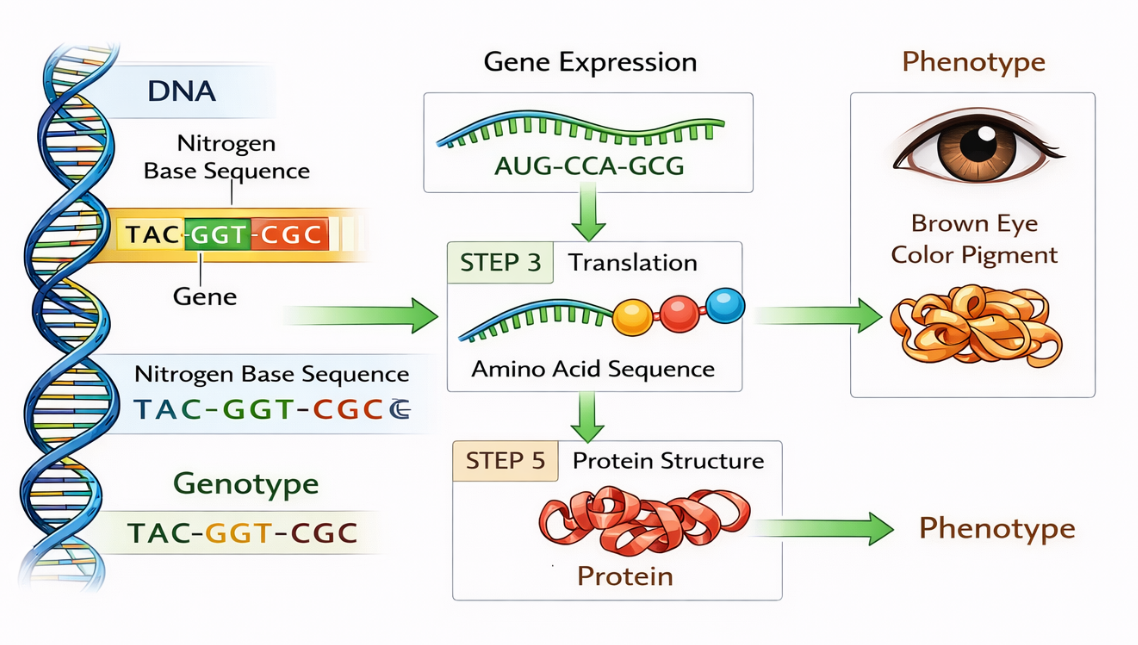
A gene is:
- A specific segment of DNA
- Located on a chromosome
- Contains instructions for making a specific protein
So, genes are parts of DNA whose base sequence codes for proteins.
Different genes have different base sequences.
🧠 Genotype – The Genetic Makeup
Genotype refers to:
- The genetic information stored in DNA
- The specific sequence of bases
- The alleles an organism possesses
Genotype exists at the molecular level.
It is the actual DNA code.
Example:
A gene may contain a base sequence that codes for a certain enzyme.
That sequence is part of the genotype.
🧬 From DNA Sequence to Protein
The structure of DNA determines the order of bases.
The base sequence determines:
- The mRNA sequence (during transcription)
- The codon sequence (during translation)
- The amino acid sequence
- The protein structure
Because:
- Each codon codes for one amino acid
- The order of amino acids determines protein shape
- Protein shape determines function
So, the DNA sequence directly controls protein structure.
🧪 Phenotype – Observable Traits
Phenotype refers to:
- Observable characteristics
- Physical traits
- Biochemical properties
Examples:
- Eye color
- Height
- Blood type
- Enzyme activity
Phenotype is determined by proteins.
Proteins:
- Form pigments
- Act as enzymes
- Build structures
- Control cell processes
If a protein functions normally → trait appears normal.
If a protein change → trait may change.
🧠 Connecting DNA Structure to Phenotype
Let’s connect everything logically.
DNA base sequence → Determines mRNA sequence → Determines amino acid sequence → Determines protein shape → Determines protein function → Determines trait
So, the structure of DNA, specifically the order of bases, determines phenotype.
🧬 How Changes in DNA Affect Phenotype
If the DNA base sequence changes:
- A codon may change
- An amino acid may change
- Protein shape may change
- Protein function may change
This can lead to:
- Altered traits
- New traits
- Loss of function
This shows how genotype influences phenotype.
📊 Comparison Table
| Term | Meaning | Level |
|---|---|---|
| DNA Structure | Sequence of A, T, G, C | Molecular |
| Gene | Section of DNA coding for protein | Molecular |
| Genotype | Genetic makeup (DNA sequence) | Genetic |
| Protein | Product of gene expression | Functional |
| Phenotype | Observable trait | Organism level |
🧠 Big Idea
Genotype = DNA sequence
Phenotype = Expression of that DNA through proteins
DNA structure stores the instructions.
Proteins carry out the instructions.
Traits are the result of protein activity.
📦 Quick Recap
DNA base sequence stores genetic information
Gene = section of DNA
Genotype = DNA sequence
DNA → mRNA → amino acids → protein
Protein structure determines function
Protein function determines phenotype