
Why Asexual Reproductive Strategies Do Not Lead to Genetic Diversity
🌿 Introduction
Asexual reproduction is a way of producing offspring using only one parent.
There are no mating and no fusion of gametes.
Because of this, asexual reproduction usually produces offspring that are genetically identical to the parent.
Genetic diversity means variation in genes within a population.
In asexual reproduction, this diversity does not increase in a strong way.
🧠 Step 1 – First Understand What Genetic Diversity Means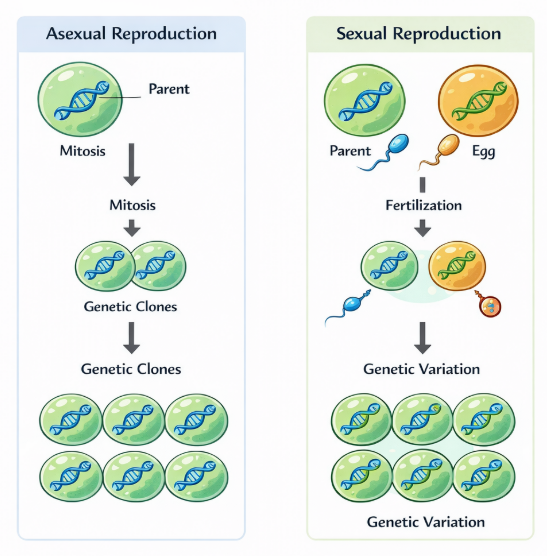
Genetic diversity refers to:
- Differences in DNA sequences among individuals
- Different versions of genes (alleles) in a population
- Variation that causes individuals to show different traits
Example idea:
If a population has genetic diversity, individuals might differ in:
- Size
- Color
- Resistance to disease
- Ability to survive heat or cold
A genetically diverse population has a better chance that some individuals survive when conditions change.
🧬 Step 2 – How Genetic Diversity Is Normally Created
This step is very important because it explains what asexual reproduction is missing.
Genetic diversity increases strongly when:
- Two parents contribute DNA
- Genes are mixed into new combinations
- Offspring get a unique combination of alleles
This mixing happens through processes linked with sexual reproduction.
In contrast, asexual reproduction does not include the main mixing steps.
🧬 Step 3 – Key Reason: Only One Parent Contributes DNA
In asexual reproduction:
- Offspring inherit genetic information from one parent only
- There is no second set of genes coming from a mate
This means no new combinations of alleles are formed by mixing two parents.
So, if the parent’s DNA is:
A B C D (genes)
then offspring DNA will be:
A B C D
again and again.
That is why asexual reproduction does not increase diversity.
🧪 Step 4 – Asexual Offspring Are Clones
Because DNA comes from a single parent and is copied, asexual reproduction produces genetic clones
A clone means:
- An offspring with the same DNA sequence as the parent
- Genetic copy, not a mixture
So, in a population reproducing asexually:
- Many individuals are almost identical genetically
- Variation between individuals is very small
This is the direct reason genetic diversity does not rise.
🧬 Step 5 – Asexual Reproduction Uses DNA Copying, Not Gene Mixing
Asexual reproduction is mainly based on:
- DNA replication
- Cell division
The key point are:
DNA is copied and passed on but not mixed. So, the genetic information stays the same from generation to generation.
If the parent is well adapted, all offspring will have the same traits. But if environment changes, all offspring may struggle the same way.
🧫 Step 6 – Use the Syllabus Examples to Prove the Idea
Binary Fission (Example: bacteria, amoebas)
Binary fission is a form of asexual cell division where:
- The parent cell copies its DNA
- The cell splits into two equal halves
- Each daughter cell receives the same DNA
Result:
- Two new cells are produced
- They are symmetrical genetic clones of the parent
Why no diversity?
Because both daughter cells have the same genetic sequence as the parent.
Budding (Example: corals, yeast)
Budding is asexual reproduction where:
- A small outgrowth forms on the parent
- The bud grows by mitotic cell division
- The bud detaches and becomes a new organism
Result:
- Offspring is a diploid, asymmetrical genetic clone
Diploid means it has two sets of chromosomes like the parent.
Asymmetrical means it grows as a bud, not equal split.
Why no diversity?
Because the bud receives a copied set of DNA from the parent, not a mixture.
Parthenogenesis (Example: bees, lizards, sharks)
Parthenogenesis is when:
- Offspring are produced by females without genetic contribution of a male
Key point for diversity:
- There is no mixing of genes from two parents.
Result:
- Genetic diversity remains limited compared to sexual reproduction
- The offspring’s DNA is derived from the mother only
So parthenogenesis also does not significantly increase genetic diversity.
🧠 Step 7 – The Only Source of New Variation in Asexual Populations
Even though asexual reproduction does not mix genes, you may still see some variation over time because of Mutations.
Mutations are:
- Random changes in DNA sequence
- Can happen during DNA copying
- Can create new alleles
But mutation:
- Is not the main purpose of reproduction
- Happens randomly
- Often rare compared to how fast cloning occurs
So overall:
Asexual reproduction does not produce regular genetic diversity like sexual reproduction.
🧬 Step 8 – Why This Matters for Populations
Because genetic diversity stays low:
- A population may be less adaptable
- One disease could affect many individuals the same way
- Environmental change could wipe out most of the population if all are similar
So, lack of diversity is a major limitation of asexual reproduction.
📊 Summary Table
| Asexual Strategy | How Offspring Form | Genetic Result | Why Diversity Does Not Increase |
|---|---|---|---|
| Binary fission | Cell splits into two equal parts | Symmetrical clone | DNA copied, no mixing |
| Budding | New individual grows as bud | Diploid clone | DNA copied, no mixing |
| Parthenogenesis | Female produces offspring without male | Limited variation | No second parent genes |
📦 Quick Recap
Genetic diversity = variation in DNA in a population
Asexual reproduction = one parent only
No gene mixing → no new allele combinations
Offspring are clones
Binary fission → symmetrical clones
Budding → diploid asymmetrical clones
Parthenogenesis → female only, no male genes
Only variation source = mutation
Advantages of Asexual Reproduction Strategies
🌿 Introduction
Asexual reproduction involves:
- One parent
- No gamete fusion
- No recombination
- Offspring genetically identical to parent
Although it does not increase genetic diversity, it provides important advantages that help many organisms survive and reproduce successfully.
Many unicellular organisms and some multicellular organisms rely on this strategy.
🧠 Rapid Reproduction and Population Growth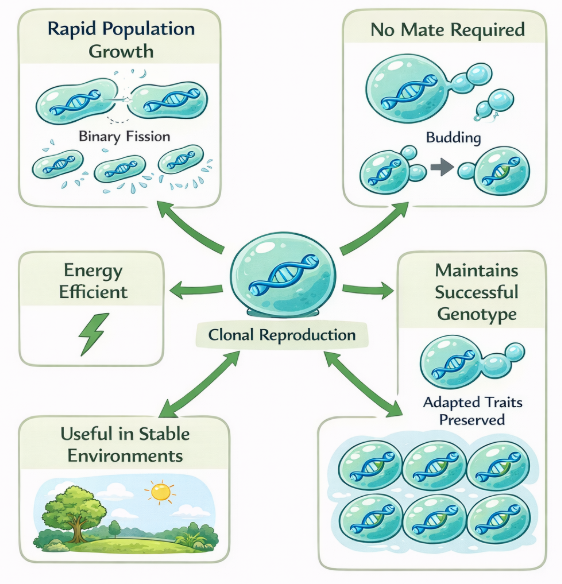
One of the biggest advantages of asexual reproduction is speed.
Because:
- Only one parent is required
- No need to locate a mate
- No courtship or fertilization
Reproduction can occur quickly and frequently.
For example:
- Bacteria reproduce by binary fission
- Under ideal conditions, populations can double rapidly
This allows:
- Fast colonization of environments
- Quick recovery after population decline
- Rapid increase in population size
In stable environments, rapid reproduction is highly beneficial.
🔋 Energy Efficiency
Sexual reproduction requires:
- Energy for producing gametes
- Energy for courtship behavior
- Energy for finding and attracting mates
Asexual reproduction avoids these costs.
It requires:
- Only mitotic cell division
- Minimal energy investment
This makes it efficient, especially for simple organisms.
Energy saved can be used for:
- Growth
- Survival
- Resource acquisition
🌍 Advantage in Stable Environments
If an organism is already well adapted to its environment:
- Its genotype is successful
- Its traits support survival
Asexual reproduction produces clones that preserve this successful genotype.
In stable, unchanging environments:
- There is no immediate need for variation
- Maintaining a proven genetic combination is beneficial
This ensures:
- Consistency
- Reliability of traits
🧭 Reproductive Assurance
Asexual reproduction ensures reproduction even when:
- Population density is low
- Individuals are isolated
- No mates are available
This is especially important for:
- Organisms in harsh environments
- Newly colonized areas
- Early stages of population establishment
Because only one individual is needed to start a population, asexual reproduction provides reproductive security.
🧬 Equal Genetic Contribution
In sexual reproduction:
- Only half of each parent’s genes are passed to offspring
In asexual reproduction:
- The parent passes 100% of its genetic information
This ensures:
- Complete transmission of successful traits
- No dilution of advantageous allele combinations
🧠 Examples of Asexual Advantages
Binary Fission (Bacteria)
- Extremely fast reproduction
- Rapid adaptation through large population sizes
Budding (Yeast, Corals)
- Efficient population expansion
- Colony formation
Parthenogenesis (Some reptiles, insects)
- Reproduction possible even without males
- Useful when mates are scarce
📊 Summary Table
| Advantage | Why It Helps |
|---|---|
| Rapid reproduction | Quick population growth |
| Energy efficient | Low reproductive cost |
| No mate required | Reproductive assurance |
| Stable genotype maintained | Preserves successful traits |
| 100% gene transmission | Ensures survival of adapted traits |
📦 Quick Recap
One parent required
Fast population growth
Low energy cost
No mate needed
Preserves successful genotype
Useful in stable environments
Allows rapid colonization