
Why Reduction Division Must Occur to Produce Gametes
🌿 Introduction
In sexual reproduction, organisms produce special reproductive cells called gametes.
Gametes include:
- Sperm
- Egg
These cells are different from body (somatic) cells because they contain half the number of chromosomes.
The process that reduces chromosome number by half is called: Reduction division, which occurs during meiosis.
🧠 Step 1 – Understanding Chromosome Number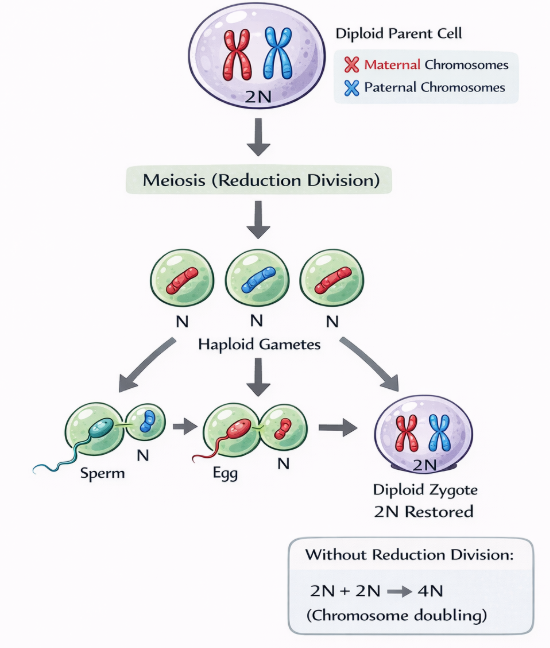
Most body cells are:
- Diploid (2N)
- Contain two sets of chromosomes
- One set inherited from the mother
- One set inherited from the father
Example:
If a species has 6 chromosomes in body cells: 2N = 6
Each parent contributes 3 chromosomes.
This diploid number must remain constant for the species.
🧬 Step 2 – What Happens During Fertilization?
Fertilization occurs when:
Sperm + Egg → Zygote
Each gamete contributes chromosomes to the offspring.
If each gamete were diploid (2N), then:
2N + 2N = 4N
The chromosome number would double in every generation.
Over generations, it would become:
2N → 4N → 8N → 16N
This would cause:
- Chromosome imbalance
- Genetic instability
- Nonviable offspring
So, gametes must contain only half the chromosome number.
🧪 Step 3 – Purpose of Reduction Division
Reduction division ensures that:
- Diploid (2N) parent cells produce haploid (N) gametes
- Each gamete contains only one set of chromosomes
Then during fertilization:
N + N = 2N
This restores the correct diploid number in the zygote.
Therefore:
Reduction division prevents chromosome number from increasing every generation.
🧬 Step 4 – How Reduction Occurs in Meiosis
Meiosis includes two divisions:
- Meiosis I
- Meiosis II
The actual reduction happens in Meiosis I.
During Meiosis I:
- Homologous chromosome pairs separate
- Each new cell receives only one chromosome from each pair
This reduces chromosome number from:
2N → N
After Meiosis II:
- Sister chromatids separate
- Four haploid cells are formed
Each gamete contains one set of chromosomes.
🧠 Step 5 – Why This Is Essential for Sexual Reproduction
Sexual reproduction requires:
- Production of haploid gametes
- Fusion of two gametes
- Restoration of diploid chromosome number
Without reduction division:
- Chromosome number would double
- Species chromosome number would not remain stable
- Genetic balance would be disrupted
So, reduction division maintains:
- Chromosome stability across generations
- Correct gene dosage
- Proper organism development
📊 Simple Numerical Example
Let’s say a species has:
2N = 8
Without reduction:
Gametes would have 8 chromosomes.
Fertilization would produce: 16 chromosomes.
But with reduction division:
Meiosis produces gametes with:
N = 4
Then fertilization restores:
4 + 4 = 8
Chromosome number remains constant.
📦 Quick Recap
Body cells = Diploid (2N)
Gametes = Haploid (N)
Reduction division occurs in Meiosis I
Prevents chromosome doubling
N + N = 2N after fertilization
Maintains chromosome stability
How Meiosis Followed by Fertilization Leads to Genetic Diversity
🌿 Introduction
Sexual reproduction produces genetically diverse offspring.
This diversity does not happen randomly – it is generated through:
- Meiosis
- Fertilization
Meiosis creates genetically different gametes.
Fertilization randomly combines those gametes.
Together, these processes increase genetic variation within a population.
🧠 Step 1 – What Is Genetic Diversity?
Genetic diversity refers to: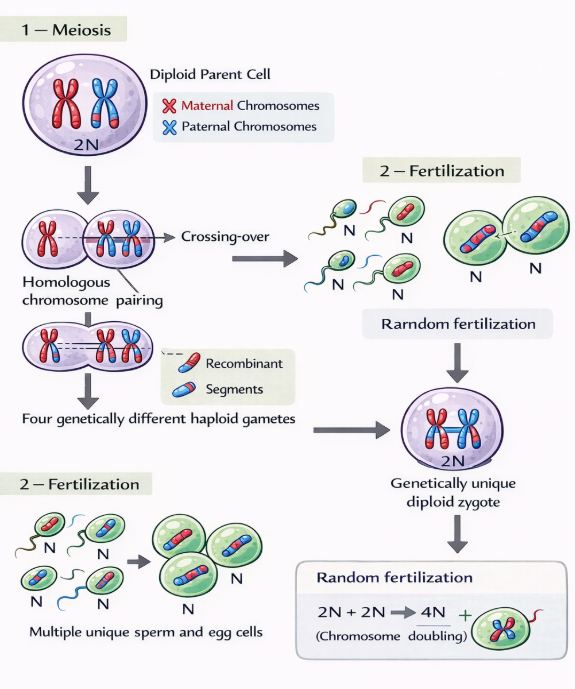
- Variation in DNA sequences among individuals
- Different combinations of alleles in a population
- Differences in traits among individuals
Higher genetic diversity means:
- Greater variation
- Greater ability for a population to survive environmental change
Now let’s see how meiosis creates that variation.
🧬 Step 2 – Genetic Variation During Meiosis
Meiosis consists of two divisions:
- Meiosis I
- Meiosis II
The major sources of variation occur during Meiosis I.
A) Homologous Chromosome Pairing
During Prophase I:
- Homologous chromosomes pair together
- Each pair forms a structure called a tetrad
- Each tetrad contains four chromatids
This pairing sets the stage for variation.
B) Crossing Over
While homologous chromosomes are paired:
- They exchange segments of DNA
- This exchange is called crossing-over
Crossing-over:
- Swaps genetic material between homologous chromosomes
- Produces new combinations of alleles
- Creates recombinant chromosomes
This increases genetic diversity because:
The chromatids after crossing-over are not identical to the original parental chromosomes.
C) Separation of Homologous Chromosomes
During Meiosis I:
- Homologous chromosomes separate
- Each daughter cell receives one chromosome from each pair
Because of random orientation during separation:
Each gamete receives a different combination of maternal and paternal chromosomes.
So even without crossing-over, chromosome combinations vary.
D) Meiosis II
During Meiosis II:
- Sister chromatids separate
- Four haploid cells are formed
Each of the four gametes is genetically unique due to earlier recombination and separation.
🧠 Step 3 – How Fertilization Adds More Diversity
After meiosis:
- Each parent produces many genetically different gametes
Fertilization occurs when:
One sperm fuse with one egg
A diploid zygote form
Fertilization is random:
- Any sperm can fertilize any egg
- Each sperm and egg are genetically unique
So the resulting zygote receives:
- A random set of chromosomes from mother
- A random set from father
This creates even more genetic variation.
🧬 Step 4 – Combined Effect on Population
Meiosis increases diversity by:
- Crossing-over
- Random separation of homologous chromosomes
Fertilization increases diversity by:
- Random combination of two unique gametes
Together, they create enormous genetic variation within a population.
No two offspring (except identical twins) are genetically identical.
🧠 Step 5 – Why This Diversity Matters
Genetic diversity is important because:
- It allows adaptation to environmental changes
- It increases survival chances
- It reduces the risk that one disease wipes out entire population
Populations with higher genetic diversity are more likely to survive changing conditions.
📊 Summary Table
| Process | How It Increases Diversity |
|---|---|
| Crossing-over | Creates new allele combinations |
| Separation of homologous chromosomes | Random distribution of chromosomes |
| Formation of gametes | Four unique haploid cells |
| Fertilization | Random fusion of gametes |
📦 Quick Recap
Meiosis creates variation
Crossing-over → new allele combinations
Random chromosome separation
Four genetically unique gametes
Fertilization randomly combines gametes
Result → high genetic diversity in population
How Chromosome Number Is Halved During Meiosis
🌿 Introduction
Body cells are diploid (2N), meaning they contain:
- Two sets of chromosomes
- One set from each parent
Gametes must be haploid (N), meaning they contain:
- Only one set of chromosomes
To reduce chromosome number from 2N to N, a special type of cell division called meiosis occurs.
A model of meiosis must clearly show how this reduction happens.
🧠 Step 1 – Start with a Diploid Cell (2N)
Imagine a cell with:
- Two homologous chromosome pairs
Example model:
Chromosome Pair 1:
Red chromosome (from mother)
Blue chromosome (from father)
Chromosome Pair 2:
Red chromosome
Blue chromosome
This cell is diploid (2N) because it has two of each chromosome type.
🧬 Step 2 – DNA Replication (Still 2N)
Before meiosis begins:
- Each chromosome replicates
- Each chromosome now consists of two sister chromatids
Important:
Even though DNA is duplicated, chromosome number is still 2N.
Why?
Because sister chromatids are still attached and count as one chromosome.
So, at this stage:
Chromosome number has NOT changed.
🧬 Step 3 – Meiosis I (Reduction Division)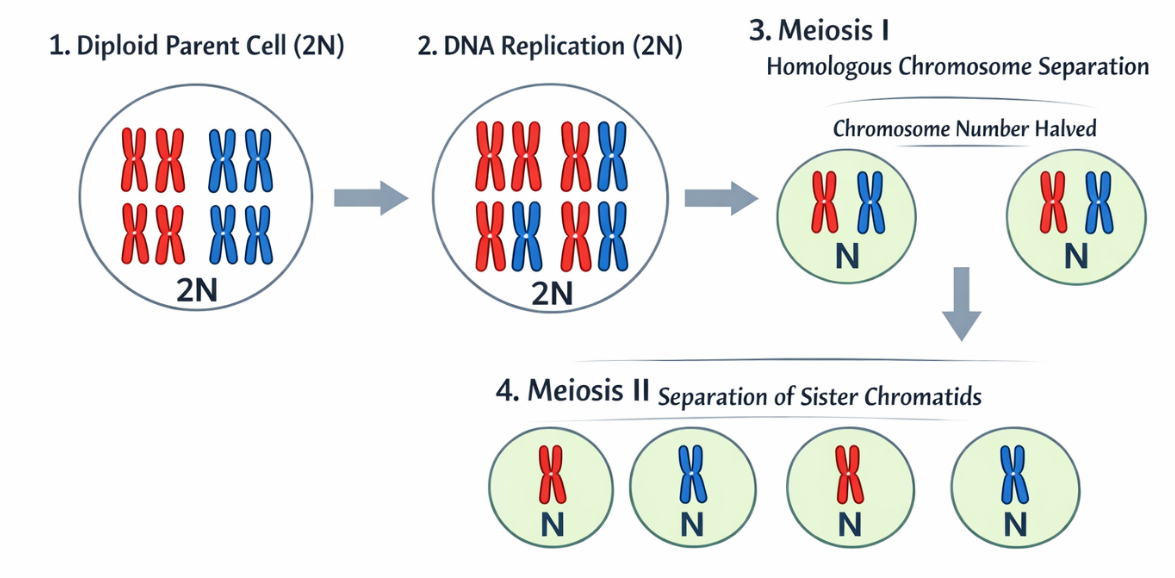
This is the most important step for halving chromosome number.
During Meiosis I:
- Homologous chromosomes pair together
- Crossing-over may occur
- Homologous chromosomes separate
Key point: Homologous chromosomes separate — not sister chromatids.
Each new cell receives:
- Only one chromosome from each homologous pair
So, if the original cell had 2 copies of each chromosome:
After Meiosis I:
Each daughter cell has only 1 copy of each chromosome.
Chromosome number changes from:
2N → N
This is called reduction division.
🧬 Step 4 – Meiosis II (No Further Reduction)
During Meiosis II:
- Sister chromatids separate
- Similar to mitosis
Important:
Chromosome number does NOT change in Meiosis II.
It remains:
N → N
At the end:
- Four haploid cells are produced
Each has:
- One set of chromosomes
- Half the original number
🧠 Step 5 – Why Chromosome Number Is Halved
Chromosome number is halved because:
- Homologous chromosomes separate in Meiosis I
- Each cell receives only one chromosome from each pair
Since diploid cells have two of each chromosome:
Removing one of each pair results in haploid cells.
This ensures:
Gametes have half the chromosome number.
🧬 Step 6 – Model Summary
Let’s use numbers.
Suppose:
Diploid cell (2N) = 6 chromosomes
After DNA replication:
Still 6 chromosomes (each duplicated)
After Meiosis I:
Each daughter cell has 3 chromosomes (N)
After Meiosis II:
Four cells each have 3 chromosomes (N)
Chromosome number successfully reduced.
📊 Model Table of Chromosome Number
| Stage | Chromosome Number |
|---|---|
| Parent cell | 2N |
| After replication | 2N |
| After Meiosis I | N |
| After Meiosis II | N |
📦 Quick Recap
Start with diploid (2N) cell
DNA replicates (still 2N)
Meiosis I separates homologous chromosomes
Chromosome number reduced to N
Meiosis II separates sister chromatids
Four haploid cells produced