
Relationship Between Genotype and Phenotype
🌿 Introduction
Every organism has observable traits such as:
- Eye color
- Flower color
- Height
- Blood type
These observable characteristics are called phenotypes.
But where do these traits come from?
They come from an organism’s genotype, which is the genetic information stored in DNA.
🧠 What Is Genotype?
Genotype refers to: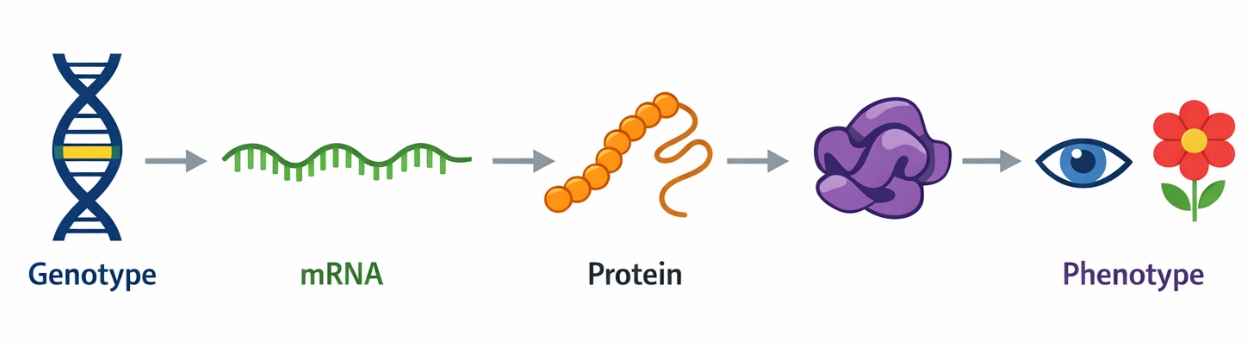
- The genetic makeup of an organism
- The specific alleles it carries
In sexually reproducing organisms:
- Somatic (body) cells are diploid (2N)
- They contain two copies of each gene
- One copy is inherited from the mother
- One copy is inherited from the father
Each version of a gene is called an: Allele
So, genotype describes the combination of alleles an organism has for a trait.
Example:
AA
Aa
aa
These are different genotypes for the same gene.
🧬 What Is Phenotype?
Phenotype refers to:
- The observable expression of a trait
- Physical appearance
- Physiological characteristics
- Biochemical traits
Phenotype is the visible or measurable outcome of gene expression.
🔬 How Genotype Produces Phenotype
Genes contain instructions for making proteins.
Proteins control:
- Structure (hair, skin, cell shape)
- Enzymes (chemical reactions)
- Pigment production
- Hormone regulation
So, the pathway is: Gene (DNA) → Protein → Trait → Phenotype
If the genotype changes, the protein produced may change.
If the protein changes, the trait may change.
🧬 Role of Alleles
Each gene has variants called alleles.
Because organisms are diploid:
- Two alleles are present for each gene
- These alleles may be identical or different
There are three possible allele combinations:
Homozygous dominant → AA
Heterozygous → Aa
Homozygous recessive → aa
The interaction between alleles determines phenotype.
🧠 Dominant and Recessive Alleles
If a dominant allele is present:
- It is expressed
- It masks the recessive allele
A recessive allele is expressed only when:
- Two copies are present (aa)
Example:
If A = dominant trait
and a = recessive trait
Genotype AA → dominant phenotype
Genotype Aa → dominant phenotype
Genotype aa → recessive phenotype
So, phenotype depends on allele interaction.
🧬 Why Genotype Does Not Always Equal Phenotype Directly
Although genotype determines phenotype, expression may also be influenced by:
- Other genes
- Environmental factors
But at the core:
Phenotype results from the genetic instructions carried in genotype.
📊 Genotype vs Phenotype Table
| Term | Meaning | Example |
|---|---|---|
| Genotype | Genetic makeup (alleles) | AA, Aa, aa |
| Phenotype | Observable trait | Purple flower or white flower |
| Allele | Variant form of gene | A or a |
| Dominant allele | Expressed if present | A |
| Recessive allele | Expressed only if no dominant allele | a |
📦 Quick Recap
Genotype = genetic makeup
Phenotype = observable trait
Diploid cells have two alleles
Alleles may be dominant or recessive
Genes → Proteins → Traits
Genotype determines phenotype
Describe the Type of Inheritance Pattern Based on Data or Models
🌿 Introduction
When studying inheritance, scientists analyze:
- Offspring ratios
- Punnett squares
- Family pedigrees
- Phenotypic data
From this data, we identify the inheritance pattern.
Some traits follow simple Mendelian patterns.
Most traits follow more complex patterns.
🧠 Mendelian (Single-Gene) Inheritance
Key Features of Mendelian Inheritance
- Controlled by one gene
- Two alleles
- One dominant, one recessive
- Predictable ratios
Recognizing Mendelian Pattern From Data
If a cross between two heterozygous parents (Aa × Aa) gives:
Genotype ratio: 1 AA : 2 Aa : 1 aa
Phenotype ratio: 3 dominant : 1 recessive
That 3:1 ratio strongly suggests:
Simple dominant-recessive Mendelian inheritance
Example pattern:
If 75% of offspring show trait A and 25% show trait a
This matches 3:1 ratio → Mendelian.
🧬 Codominance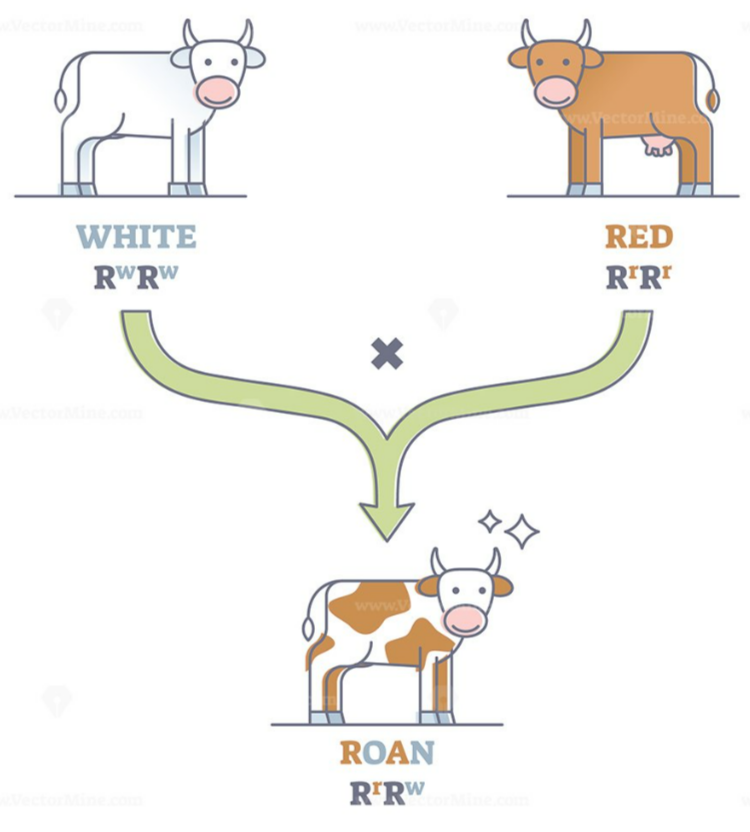
What Is Codominance?
- Both alleles are fully expressed in the heterozygote
- No allele masks the other
How to Recognize from Data
If heterozygous individuals show BOTH traits clearly and separately:
Example pattern:
Red flower × White flower → Offspring show red AND white patches
There is no blending.
Phenotypic ratio may show:
1:2:1 (distinct phenotypes)
That suggests: Codominance
🧬Incomplete Dominance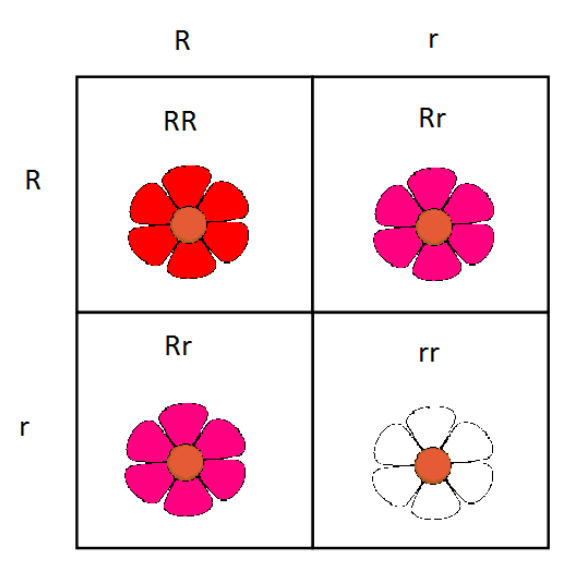
What Is Incomplete Dominance?
- Neither allele is completely dominant
- Heterozygote shows intermediate phenotype
Recognizing From Data
If red × white → pink
And offspring ratios follow:
1 red : 2 pink : 1 white
That 1:2:1 phenotype ratio indicates: Incomplete dominance
Key difference:
Incomplete dominance → blending
Codominance → both traits fully visible
🧬 Sex-Linked Inheritance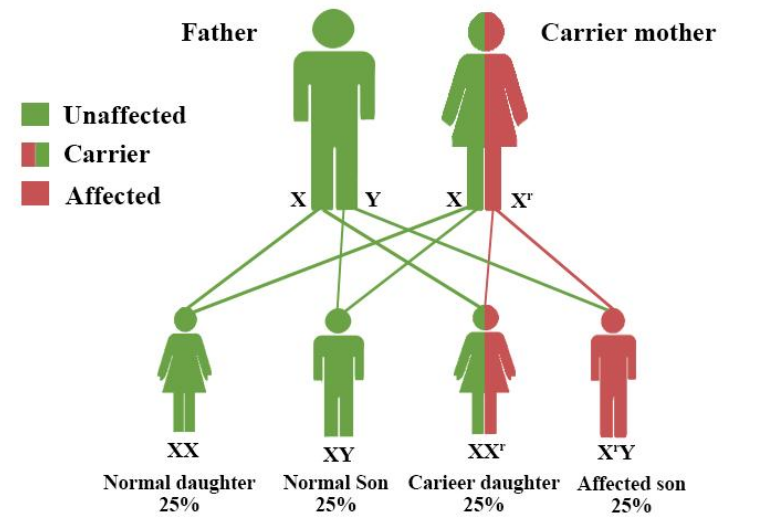
What Makes It Different?
- Gene located on sex chromosome
- Inheritance differs between sexes
Recognizing From Data
Clues:
- Trait appears more often in one sex
- Often more common in males
- Does not follow simple 3:1 ratio
Example:
Mostly males affected → likely X-linked recessive
🧬 Polygenic Inheritance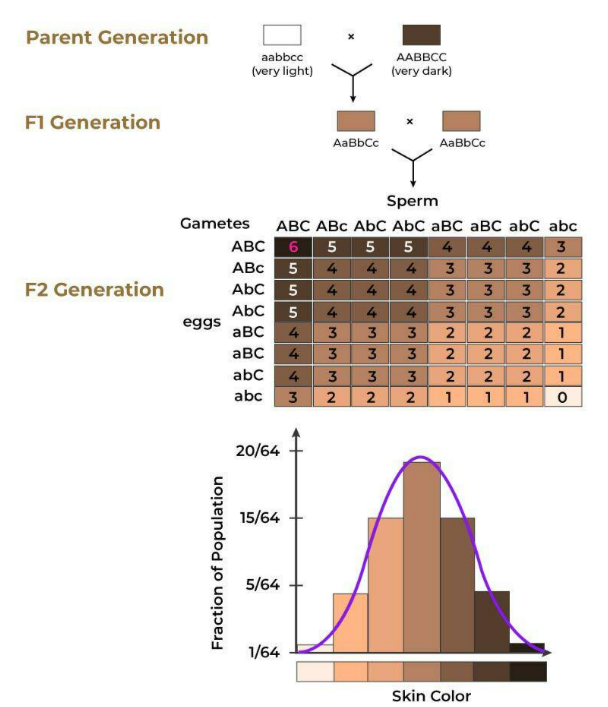
What Is Polygenic Inheritance?
- Trait controlled by multiple genes
- Each gene contributes small effect
Recognizing From Data
- Continuous variation
- No clear dominant/recessive categories
- Bell-shaped distribution
Example:
Height varies gradually across population.
No simple ratios → Polygenic inheritance.
🧬 Environmental Influence
Some traits depend on both:
- Genotype
- Environmental conditions
Clues in data:
- Same genotype, different phenotype
- Trait changes under different conditions
This suggests environmental influence.
📊 Pattern Recognition Summary Table
| Data Pattern | Likely Inheritance Type |
|---|---|
| 3:1 phenotype ratio | Mendelian dominant/recessive |
| 1:2:1 with blended phenotype | Incomplete dominance |
| 1:2:1 with both traits visible | Codominance |
| Trait more common in one sex | Sex-linked |
| Continuous range of variation | Polygenic |
📦 Quick Recap
3:1 → Mendelian
1:2:1 blended → Incomplete dominance
1:2:1 both traits → Codominance
Sex bias → Sex-linked
Continuous variation → Polygenic
Always analyze ratios first