
Using Data to Examine Inheritance and Chromosomal Disorders
🌿 Introduction
Genetic inheritance and chromosomal disorders can be identified by analyzing biological data.
Scientists do not guess.
They examine:
- Chromosome number
- Chromosome structure
- Family inheritance patterns
- Visual chromosome models
One of the most important tools for this is the: Karyotype
🧠 What Is a Karyotype?
A karyotype is:
- A visual display of chromosomes
- Organized into homologous pairs
- Arranged by size, shape, and centromere position
Human somatic cells normally contain:
- 46 chromosomes
- 23 homologous pairs
The final pair determines sex:
- XX → female
- XY → male
Karyotypes allow scientists to examine chromosomal inheritance and detect abnormalities.
🔬 Using Data from a Karyotype
Step 1 – Count the Chromosomes
Normal human diploid number = 46
If total count is:
- 47 → possible trisomy
- 45 → possible monosomy
This indicates altered chromosome number.
Step 2 – Check Homologous Pairs
Each chromosome should appear in pairs.
If one pair has:
- Three copies → trisomy
- One copy → monosomy
That reveals a chromosomal disorder.
Step 3 – Examine Sex Chromosomes
Normally:
- Female → XX
- Male → XY
If abnormal combinations appear:
- XXY
- XO
- XXX
This indicates sex chromosome variation.
Step 4 – Look for Structural Abnormalities
Besides number changes, structural differences may include:
- Missing segments
- Extra segments
- Rearranged segments
These structural alterations can affect gene expression.
🧬 Types of Chromosomal Disorders Identified from Data
A) Trisomy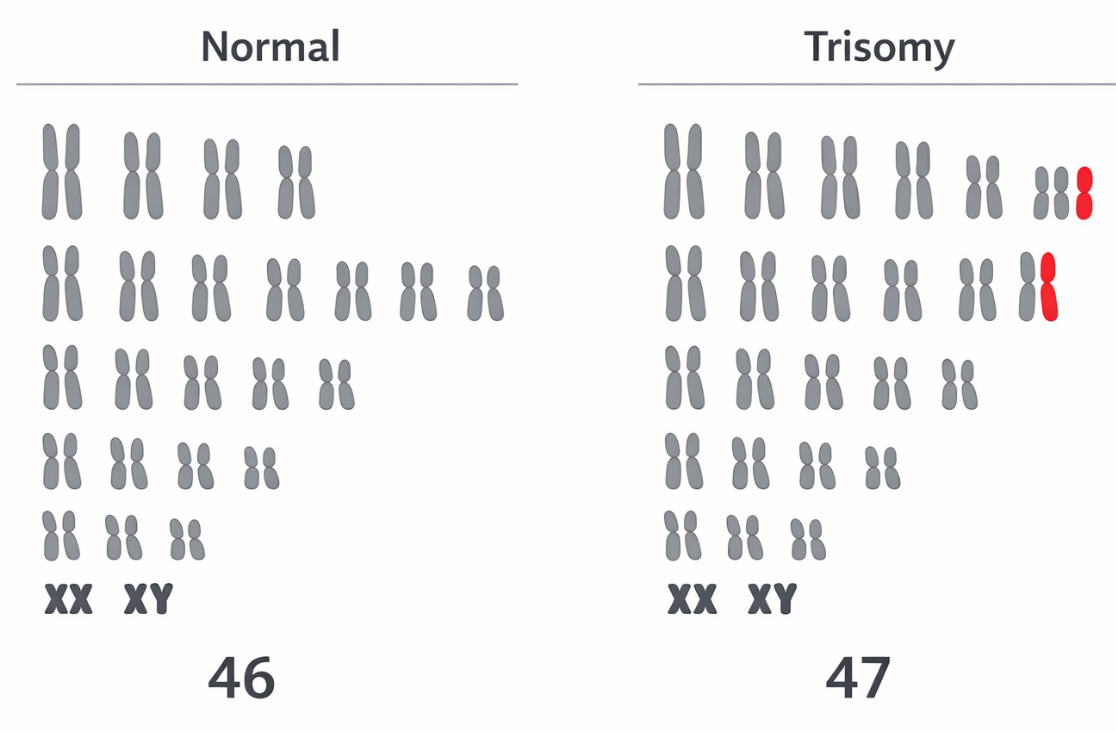
Three copies of a chromosome instead of two.
Result:
- Extra gene dosage
- Increased gene expression
- Developmental disruption
Detected when karyotype shows 47 chromosomes.
B) Monosomy
Only one copy of a chromosome instead of two.
Result:
- Missing gene dosage
- Reduced protein production
- Often more severe effects
Detected when karyotype shows 45 chromosomes.
🧠 Why Chromosome Number Matters
Each chromosome carries hundreds to thousands of genes.
Cells are designed to function with:
- Two copies of each gene
When chromosome number changes: Gene dosage becomes unbalanced.
This imbalance may:
- Disrupt normal development
- Affect organ systems
- Reduce viability
Analyzing chromosome number helps predict severity of disorder.
🧬 Using Data to Examine Inheritance Patterns
Karyotype data can also help determine:
- Whether disorder arose from nondisjunction
- Whether it may recur in future offspring
If abnormal chromosome number appears:
It suggests an error during meiosis.
Understanding this helps assess inheritance risk.
🧠 Data Interpretation Strategy
When given chromosome data:
- Identify total chromosome count
- Compare to normal diploid number
- Determine if extra or missing chromosome exists
- Identify which chromosome is affected
- Predict potential gene dosage imbalance
This step-by-step reasoning is essential for exam questions.
📊 Summary Table
| Observation from Data | Interpretation |
|---|---|
| 46 chromosomes | Normal diploid |
| 47 chromosomes | Trisomy |
| 45 chromosomes | Monosomy |
| Extra chromosome in a pair | Gene overexpression |
| Missing chromosome | Gene underexpression |
| Abnormal sex chromosome combination | Sex chromosome variation |
📦 Quick Recap
Karyotype = chromosome model
Normal human cells = 46 chromosomes
47 → trisomy
45 → monosomy
Extra chromosome → too much gene product
Missing chromosome → too little gene product
Data analysis = count → compare → predict
Techniques Used to Manipulate DNA
🌿 Introduction
DNA manipulation means: Studying, copying, modifying, or engineering DNA to analyze or change genetic information.
Biotechnology provides tools that allow scientists to:
- Amplify small DNA samples
- Separate DNA fragments
- Compare DNA patterns
- Modify genes
These techniques are used in:
- Medicine
- Agriculture
- Forensics
- Research
🧠 Polymerase Chain Reaction (PCR)
What Is PCR?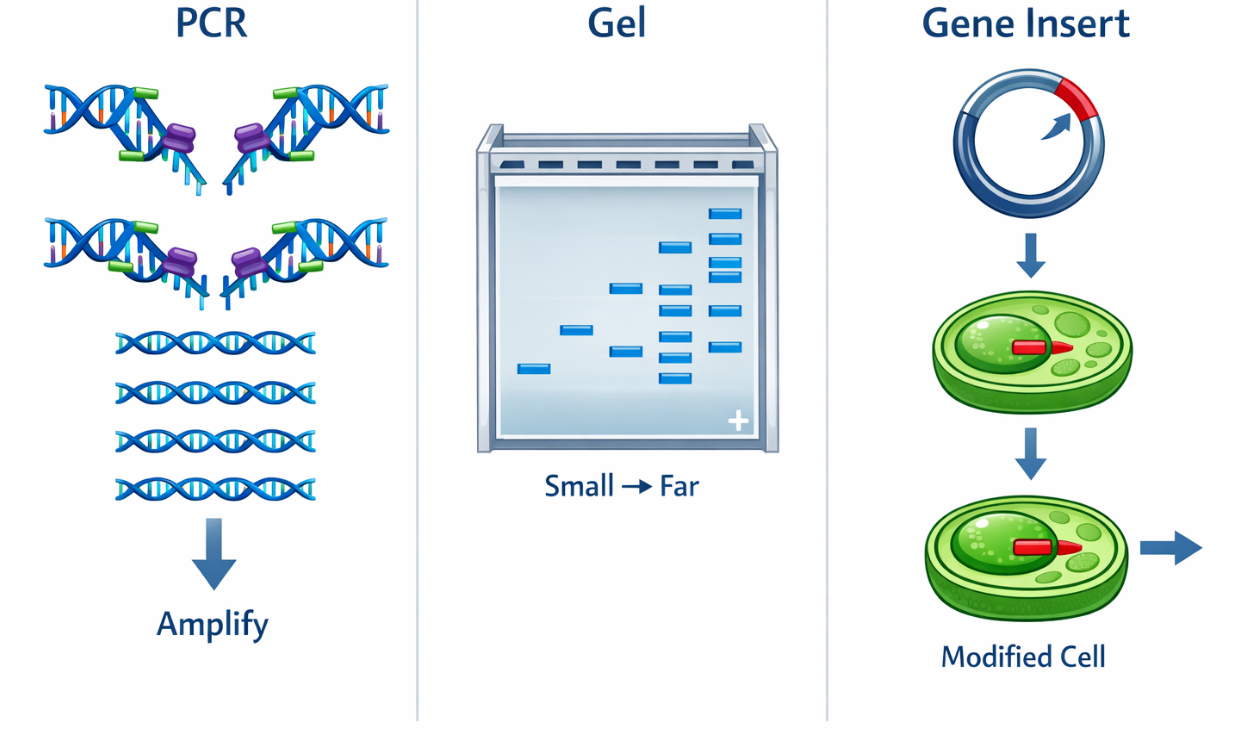
PCR is a laboratory technique used to: Make many copies of a specific DNA segment.
It is often called: DNA amplification
Why PCR Is Important
Sometimes only a tiny amount of DNA is available.
PCR allows scientists to:
- Copy a specific gene
- Analyze mutations
- Detect pathogens
- Perform forensic analysis
It produces millions of copies from a single DNA sample.
Basic Idea of PCR
PCR works by:
- Separating DNA strands
- Adding short primers
- Using DNA polymerase to build new strands
The process repeats in cycles.
Each cycle doubles the DNA amount.
This is exponential amplification.
🧬 Gel Electrophoresis
What Is Gel Electrophoresis?
Gel electrophoresis is a technique used to: Separate DNA fragments by size.
How It Works
- DNA fragments are placed in a gel
- An electric current is applied
- DNA moves toward the positive electrode
- Smaller fragments move faster
- Larger fragments move slower
The result is a pattern of bands.
Each band represents DNA fragments of a certain size.
Why It Is Useful
- Compare DNA samples
- Identify mutations
- Confirm PCR results
- Perform DNA profiling
🧬 DNA Profiling
What Is DNA Profiling?
DNA profiling is a method used to: Compare specific DNA regions between individuals.
These regions vary from person to person.
How It Is Used
- Forensics
- Paternity testing
- Identifying missing persons
DNA profiles appear as band patterns after gel electrophoresis.
If band patterns match, DNA likely came from the same individual.
🧬 Genetic Engineering
What Is Genetic Engineering?
Genetic engineering is the: Direct modification of an organism’s DNA.
This involves inserting, removing, or altering genes.
Examples of Genetic Engineering
Cloning
- Creating a genetically identical copy of an organism
- The cloned organism has the same DNA as the original
Genetically Modified Organisms (GMOs)
- Organisms whose DNA has been altered by inserting genes from another organism
Used to:
- Improve crops
- Increase disease resistance
- Enhance nutritional value
🧠 Why These Techniques Matter
These tools allow scientists to:
- Study genetic diseases
- Improve agriculture
- Develop medicines
- Understand gene function
However, they require careful regulation and ethical consideration.
📊 Summary Table
| Technique | Purpose | What It Does |
|---|---|---|
| PCR | Amplify DNA | Makes many copies of a gene |
| Gel Electrophoresis | Separate DNA | Sorts fragments by size |
| DNA Profiling | Compare DNA | Identifies individuals |
| Genetic Engineering | Modify DNA | Alters genetic information |
| Cloning | Copy DNA | Produces identical organism |
| GMOs | Insert genes | Changes traits |
📦 Quick Recap
PCR = DNA amplification
Gel electrophoresis = DNA separation by size
DNA profiling = DNA comparison
Genetic engineering = DNA modification
Cloning = identical copy
GMOs = inserted gene