
Question
The diagram below shows the molecular structure of glucose.
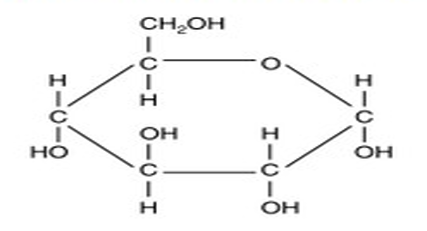
Glucose is a simple carbohydrate that is important to living organisms.
Most-appropriate topic codes (Pre-AP Biology):
• TOPIC: CELLS 7.1 — Cellular Respiration: Interdependence of energy processes and utilization of glucose — part (b)
• TOPIC: CELLS 1.1 — Biomolecules: Differentiating major macromolecules based on structure and monomers — parts (c), (d)
• TOPIC: CELLS 1.4 — Cellular Energy Requirements: Role of molecules in supporting biological processes — part (a)
▶️ Answer/Explanation
(a)
Glucose is a source of energy for the cell. The glucose is then broken down into pyruvate during glycolysis. During glycolysis, (\text{ATP}) is also created. The pyruvate is later broken down into carbon dioxide during the Krebs Cycle.
(b)
Cellular respiration would be affected from a shortage of glucose because it would be missing a reactant for it to occur. Water, carbon, and energy wouldn’t be produced. Glucose is eventually broken down into (\text{ATP}) so there would be no energy.
(c)
Proteins and lipids are other macromolecules. Lipids are macromolecules that store high amounts of energy. Proteins are complex molecules that are required for function (e.g., as enzymes, structural components, or for transport).
(d)
Nucleotides are another monomer and they form nucleic acids (such as (\text{DNA}) and (\text{RNA})).