Home / AP® Exam / Pre AP Biology / Exam Style Questions

Pre AP Biology -CELLS 1.3 Enzymes- MCQ Exam Style Questions -New Syllabus

Pre AP Biology -CELLS 1.3 Enzymes- MCQ Exam Style Questions – New Syllabus 2025-2026

Pre AP Biology -CELLS 1.3 Enzymes- MCQ Exam Style Questions – Pre AP Biology – per latest Pre AP Biology Syllabus.

Pre AP Biology – MCQ Exam Style Questions- All Topics

Question

Which of these statements applies only to noncompetitive inhibition of an enzyme-catalyzed reaction?
a. The process of noncompetitive inhibition changes the conformation of the enzyme.
b. The inhibitory molecule in noncompetitive inhibition is similar to the normal substrate.
c. Noncompetitive inhibition decreases the rate at which the product is made.
d. The process of noncompetitive inhibition results in the enzyme becoming permanently inactive.
▶️ Answer/Explanation
Detailed solution

The correct answer is a.
In noncompetitive inhibition, the inhibitor binds to an allosteric site rather than the active site.
This binding induces a change in the 3D conformation (shape) of the enzyme.
As a result, the active site can no longer effectively catalyze the conversion of substrate to product.
Unlike competitive inhibition, the inhibitor does not need to resemble the substrate.
Both types of inhibition decrease the reaction rate, so statement c is not unique to noncompetitive.
Inhibition is typically reversible, meaning statement d is generally incorrect for standard noncompetitive models.

Question

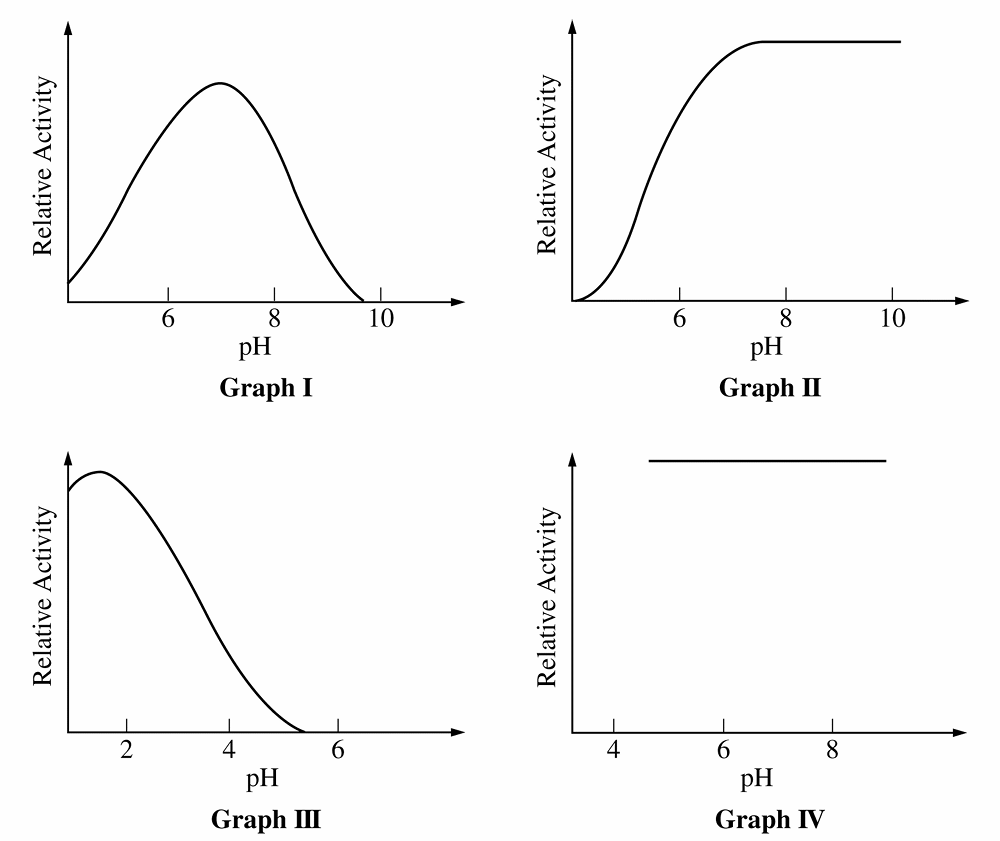
Graphs \(I\)-\(IV\) depict the effect of \(pH\) on the activity of four different hydrolytic enzymes.
Q. Enzymes with their highest activity at an alkaline (basic) \(pH\) are represented by which of the following graphs?
A. \(I\) only
B. \(II\) only
C. \(III\) only
D. \(I\) and \(III\) only
Q. Graphs representing enzymes sensitive to changes in \(pH\) include which of the following?
A. \(I\) only
B. \(IV\) only
C. \(II\) and \(III\) only
D. \(I\), \(II\), and \(III\) only
Q. The most likely explanation for the results shown in Graph \(I\) is that
A. \(pH\) affects the shape of the active site of the enzyme
B. \(pH\) affects the temperature of the reaction
C. the enzyme has a quaternary structure
D. the enzyme has disulfide bonds
▶️ Answer/Explanation
A. Answer: B (II only)
A. Answer: D (I, II, and III only)
A. Answer: A
Detailed solution

For Q, Graph \(III\) peaks at acidic \(pH\) (\(\approx 2\)) and Graph \(I\) peaks at neutral \(pH\) (\(\approx 7\)).
Graph \(II\) shows activity increasing and remaining high in the alkaline range (\(pH\) \(8\)-\(10\)), identifying it as the alkaline enzyme.
For Q, “sensitive” means enzyme activity varies as \(pH\) changes.
Graph \(IV\) is a horizontal line, indicating activity is constant and independent of \(pH\) (insensitive).
Graphs \(I\), \(II\), and \(III\) all show curves where activity changes with \(pH\), making them the correct choice.
For Q, enzyme activity depends on the precise shape of the active site.
Changes in \(pH\) alter the charge of amino acid side chains, disrupting the bonds holding the active site’s shape.
This loss of specific shape prevents substrate binding, explaining the decline in activity seen in Graph \(I\).

Question

If a highly complex and folded protein becomes completely denatured, what level of protein structure will it still contain?
A. Only primary structure
B. Only secondary structure
C. Only quaternary structure
D. It will not have any level of protein structure
▶️ Answer/Explanation
Correct Option: A
Detailed solution

Denaturation involves the disruption of weak bonds such as hydrogen bonds and ionic interactions.
This process causes the protein to lose its quaternary, tertiary, and secondary structures.
The primary structure consists of amino acids linked by strong covalent peptide bonds.
These covalent bonds are not broken by standard denaturing agents like heat or pH changes.
Therefore, the linear sequence of amino acids remains intact after denaturation.
The protein returns to an unfolded polypeptide chain, retaining only its primary level of organization.

Scroll to Top